Matter triage automation works when it pairs intake speed with governance controls, not when it replaces judgment with guesswork. Legal teams that automate classification and routing without audit trails, human approval gates, and SLA tracking create new liability instead of removing old friction. Done right, it cuts time-to-assignment and frees legal ops from manual sorting. Done without governance, it becomes a compliance problem wearing an efficiency costume.
TL;DR:
- Automation works best when paired with governance controls such as audit trails, human approval gates, and SLA tracking, rather than replacing judgment entirely.
- It is most effective for high-volume, low-complexity matters like NDAs, vendor contracts, and routine compliance requests, but not for matters requiring partner-level judgment or legal risk assessment.
- Core architecture must include capture and normalization, classification with risk scoring, orchestration between systems, and signed, immutable logs to ensure auditability and defend decisions.
- Successful deployment involves phased implementation: planning, pilot testing on low-risk matter types, and scaling within three to six months, with metrics like time-to-assignment and SLA compliance guiding progress.
- A governance-first approach with policy-as-code, signed logs, and regular model reviews ensures automation remains defensible during audits and regulatory scrutiny.
Table of Contents
- What Matter Triage Automation Covers and When to Use It
- Core Components and Architecture You Must Plan For
- Practical Implementation Roadmap: Pilot to Scale
- Governance, Auditability, and Risk Controls
- KPIs and Expected Benefits: What to Measure
- Common Pitfalls and a Pre-Launch Checklist
- Industry Applications: Where Triage Automation Earns Its Keep
- Governance-First Lessons From the Field
- A Governed Path to Automated Matter Triage
- Sources
- FAQ
What Matter Triage Automation Covers and When to Use It
Matter triage automation handles the lifecycle between “a request arrives” and “the right person is working on it.” That lifecycle has three stages: intake, classification, and routing. Intake captures the request. Classification tags it by risk, matter type, and urgency. Routing assigns it to the correct reviewer or queue, often with a conflict check running in parallel.
Most legal teams see the fastest returns automating high-volume, low-complexity request types. Others need to stay largely manual.
- Good fits: NDAs, standard vendor contracts, routine employment questions, repeat compliance requests, low-dollar procurement reviews.
- Poor fits: bet-the-company litigation, novel regulatory exposure, matters requiring partner-level judgment before intake even completes.
- Common channels: web forms, shared inboxes, Slack or Microsoft Teams requests, and self-service portals, all of which need to feed one normalized pipeline.
If a matter type still needs a partner’s gut check before anyone can even classify it, automation should route it to a human immediately, not attempt to score it.
Core Components and Architecture You Must Plan For
Matter triage automation is not one tool. It is four layers working together, and skipping any one of them breaks the chain of custody legal teams need for audit defense.
- Capture and normalization. Every channel, whether a form, email, or Teams message, must map to a single structured intake schema. Inconsistent fields here corrupt every downstream classification decision.
- Classification and risk scoring. The system tags matter type, urgency, and risk tier, and triggers conflict-check automation in parallel. Conflict checks should generate a routed report for human review, never an automatic clearance. Treating conflict automation as a report generator that always escalates positives to a reviewer with a short SLA is the safer design pattern.
- Orchestration layer. This is the connective tissue between intake, your document management system, your CRM, and your case management platform. It enforces routing rules and hands off to human reviewers at defined gates, a pattern demonstrated in supervised legal-ops agent design, where deterministic rules run before any model-generated synthesis.
- Audit evidence. Every classification, routing decision, and reviewer action needs a signed, immutable log entry (write-once-read-many, or WORM) and version-controlled policy artifacts.
Architecture that skips step four is not defensible. It is fast, until someone asks how a decision was made.
Practical Implementation Roadmap: Pilot to Scale
Matter triage automation succeeds in phases. Teams that try to automate everything at once usually stall at the first audit question they can’t answer.
- Plan (weeks 1 to 3). Map existing intake flows end to end. Build a RACI matrix defining who owns classification rules, who approves exceptions, and who signs off on audit reports. Tier matter types by risk and define which tiers require mandatory human review before routing.
- Pilot (weeks 4 to 8). Select one or two high-volume, low-risk matter types. Automate intake forms and conflict-check routing for that narrow scope. Assign a small reviewer group with a defined SLA, such as a four-hour turnaround on flagged conflicts. Measure time-to-assignment against your manual baseline.
- Scale (months 3 to 6). Add connectors to your document management system, CRM, and communication tools. Move from ad hoc rules to policy-as-code, so routing logic is version-controlled and testable. Stand up monitoring dashboards for SLA compliance and schedule recurring audits of classification accuracy.
A practical automation recipe, running digital intake through conflict check, engagement, e-signature, and a welcome sequence, has cut per-matter staff time from several hours to under one hour in documented deployments. That is the kind of gain worth planning around, but it only holds when each step still routes exceptions to a human.
Pro Tip: Run your pilot on a matter type with a low legal-risk profile and a clear historical baseline. If you can’t measure “how long did this used to take,” you can’t prove the automation worked.
Most legal ops teams should expect three to six months from a scoped pilot to a defensible, scaled rollout. Teams that rush past pilot metrics tend to discover gaps in their audit trail only after regulators or opposing counsel ask for one.
Governance, Auditability, and Risk Controls
Governance is not a compliance afterthought bolted onto matter triage automation. It is the architecture. A system that classifies and routes matters without policy-as-code, immutable logs, and human approval gates cannot survive an audit, a malpractice inquiry, or a regulator’s question about how a decision was reached.
Four controls make automation defensible:
- Policy-as-code for routing. Rules live in version-controlled code, not tribal knowledge, so every routing decision is reproducible and testable before deployment.
- Signed, immutable logs. WORM-based logging and versioned policy artifacts create a forensic record auditors can reconstruct after the fact.
- Calibrated abstention. The system should escalate ambiguous or high-risk matters to a human rather than force a classification it isn’t confident in. Automated triage that guesses under uncertainty is a liability, not a feature.
- Periodic red-teaming and AI inventory. Regular reviews of model drift, accuracy, and an up-to-date inventory of every AI component in use keep governance current instead of theoretical.
A governance architecture combining policy-as-code with signed WORM logs produces high temporal validity and anchored citation precision, meaning the system’s outputs can be traced back to the exact rule and source that generated them. That traceability is what separates an audit-ready platform from a black box. Trusted AI frameworks reinforce this with a consistent recommendation: maintain an AI inventory, RACI accountability, and periodic reviews as non-negotiable controls, not optional add-ons. Our governance framework for legal AI breaks down how these controls fit together in practice.
KPIs and Expected Benefits: What to Measure
Matter triage automation only proves its value when you track the right numbers from day one. Four KPIs matter most:
- Time-to-assignment: how long between intake and a reviewer taking ownership.
- Percent of matters automated: how much volume never needs manual triage.
- SLA compliance: whether flagged matters get reviewed inside your defined window.
- Reviewer throughput: matters closed per reviewer per week, before and after automation.
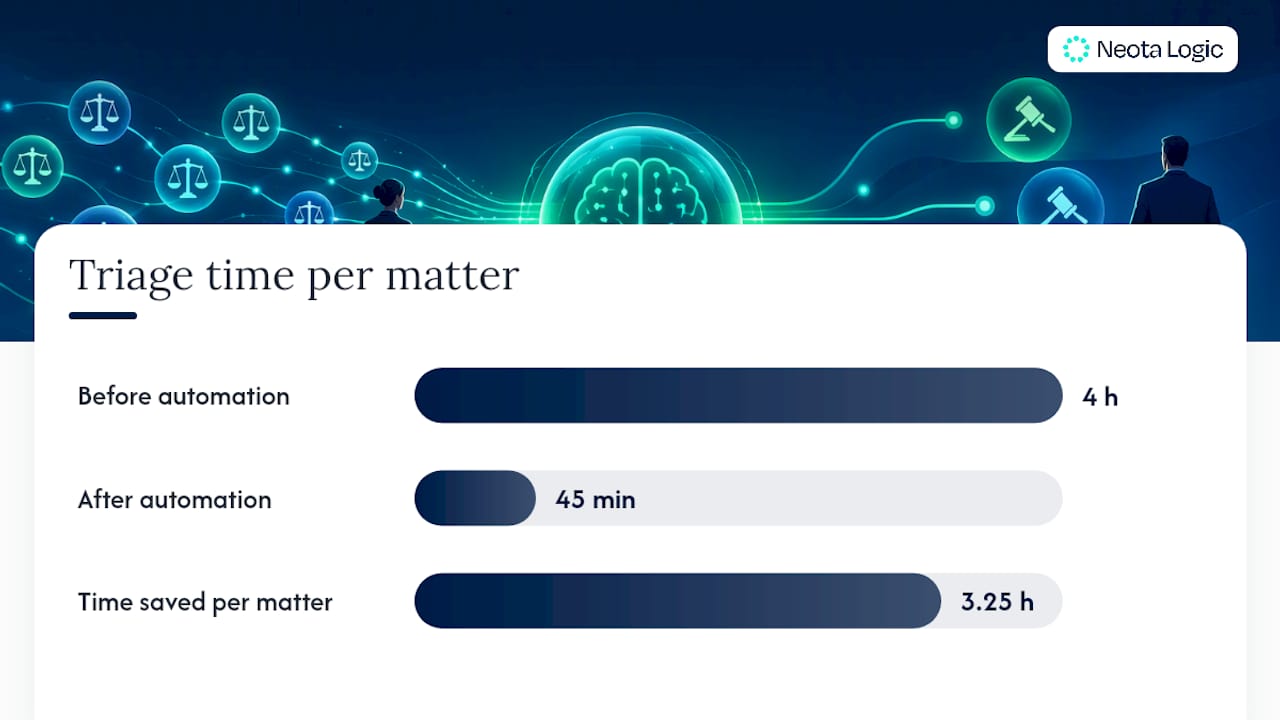
Converting time savings into FTE equivalents is straightforward once you have a baseline. If automation cuts average triage time from four hours to 45 minutes per matter, multiply that saved time across monthly volume and compare it against a reviewer’s loaded hourly cost. That’s your cost avoidance figure, not a vague efficiency claim.
The adoption data backs the urgency here. A 2025 survey of 300 legal operations executives found 52% had already invested in dedicated matter intake platforms, while 40% were still running generic ticketing systems built for IT tickets, not legal risk. That gap is your competitive window.
Common Pitfalls and a Pre-Launch Checklist
Most matter triage automation failures trace back to the same three mistakes: skipping human review on conflict checks, treating rollout as an IT project instead of a change-management project, and logging decisions loosely enough that an audit can’t reconstruct them.
Run this checklist before go-live:
- Input mapping confirmed across every intake channel, with no field left inconsistently defined.
- Test scenarios covering edge cases, not just the happy path.
- Reviewer SLA documented and agreed to by the reviewers themselves, not just imposed by legal ops.
- Rollback plan defined for when the automation misclassifies a high-risk matter.
- Retention policy set for logs and intake data, aligned to your document retention schedule.
Pro Tip: Test your rollback plan before launch, not after the first bad classification. If reverting to manual triage takes longer than the incident it’s fixing, the plan isn’t ready.
Our governance-first intake playbook walks through how to structure review gates so conflict escalation never gets skipped under volume pressure.
Industry Applications: Where Triage Automation Earns Its Keep
Matter triage automation looks different depending on the legal function running it, and the risk tolerance shifts accordingly.
In-house teams at regulated industries, banking, insurance, healthcare, tend to automate the volume end first: NDA intake, vendor contract requests, and routine compliance questions. These teams often layer risk scoring on top of classification so anything touching a regulated product line automatically routes to a senior reviewer, regardless of how routine the request looks on the surface.
Law firms running high-volume practice areas, employment defense, insurance defense, consumer litigation intake, use triage automation primarily to solve throughput. A firm fielding hundreds of new-matter inquiries a month cannot have a partner manually screening each one for conflicts and fit. Automated conflict-check routing combined with a human-in-the-loop approval gate lets intake staff clear the routine volume while flagging anything ambiguous for attorney review.
Compliance-heavy sectors, including teams operating under EU data protection rules, face an added wrinkle: automated decisions affecting individuals can trigger additional scrutiny under frameworks like GDPR Article 22, which is worth understanding before automating any matter classification that touches personnel or consumer decisions, as this partner resource on automated decision-making explains. The pattern across every sector is the same: automate the volume, escalate the exception, and log both.
Governance-First Lessons From the Field
Governance decides whether automation survives contact with a real audit. Explainability is not a nice-to-have layered on afterward. It has to be designed in from the first routing rule.
Multi-model orchestration matters more than most teams realize. Locking into a single AI vendor for classification creates the same fragility as locking into a single reviewer for every matter type. Evaluate your governance architecture before you evaluate any model. The model is replaceable. A weak audit trail is not.
— Patrick
A Governed Path to Automated Matter Triage
Neota Logic is the governance-first alternative to point solutions and chatbots bolted onto legal workflows. Where generic ticketing platforms give you routing without a defensible audit trail, Neota Logic builds the audit trail into every classification and routing decision from the start, with versioning, explainability, and signed logs as the foundation, not an add-on.
The platform orchestrates multiple AI models rather than locking your legal team into one vendor’s roadmap, which matters when a single model’s limitations shouldn’t become your compliance risk. Our solutions for AI-enabled workflows and document automation cover matter intake, conflict-check routing, and compliance reporting inside one governed environment. Every routing rule, every approval gate, and every log entry is built to survive a regulator’s question, not just impress a demo audience.
If your team is ready to see how a governed architecture handles your actual intake volume, a Discovery Sprint is the direct next step. Current pricing and deployment options are available on the Neota Logic pricing page.
Sources
- Tonkean Releases Survey of 300 Legal-Ops Executives — The State of the Legal Operations Tech Stack
- Legal Matter Intake Automation: 2026 Playbook
FAQ
What Is Matter Triage Automation?
Matter triage automation is the use of software and AI to capture, classify, and route incoming legal requests to the right reviewer without manual sorting. It covers intake, risk scoring, conflict-check automation, and assignment, with human approval gates at defined decision points.
How Long Does It Take to Deploy?
Most legal teams can run a scoped pilot in four to eight weeks, then scale to a full deployment within three to six months. Timelines depend on how many intake channels and connectors need integration.
Does Automated Triage Replace Conflict Checks?
No. Automated conflict checks generate a routed report for human review, and positives should always escalate to a reviewer rather than clear automatically. Removing that human gate is one of the most common and costly pitfalls in deployment.
What Makes Matter Triage Automation Defensible in an Audit?
Signed, immutable logs (WORM), version-controlled policy-as-code, and documented human approval gates make automated routing decisions reconstructible after the fact. Without that evidence trail, an automated decision cannot be defended to a regulator or an opposing party.
Does Neota Logic Offer Matter Triage Automation?
Yes. Neota Logic’s AI Enabled Solutions and Workflows include governed intake, classification, and routing built around audit trails and multi-model orchestration. Pricing and deployment details are available through a Discovery Sprint.
Recommended
Ready to make your AI workflows defensible?
Book a demo and we'll walk one of your real processes through Neota.
Book demo