You manage compliance requests well when every request enters one channel, gets classified by rule, reaches a named owner, and leaves a complete record. Anything less is a liability. Requests that arrive by email, chat and hallway conversation have no deadline, no owner and no trail. When a regulator, auditor or opposing counsel asks what happened, you cannot answer.
This guide covers the full path: intake, triage, routing, ownership, escalation, audit trails and the role of AI. We take a position throughout. Governance is the design problem. Features are secondary.
TL;DR
- Centralize intake. One front door for every compliance request, whatever the source.
- Classify and route with deterministic rules. Decisions that cannot be wrong should never depend on a probabilistic model.
- Use AI for drafting, classification and summarizing. Keep a human checkpoint wherever risk is material.
- Log every step with versions: who asked, what rule fired, which model ran, who approved.
- Judge any tool by its audit trail and explainability, not its feature list.
Table of Contents
- What counts as a compliance request
- Why email-based handling fails
- Step 1: Centralize intake
- Step 2: Triage by rule, not by instinct
- Step 3: Route to a named owner
- Step 4: Set deadlines, escalation paths and status updates
- Step 5: Build the audit trail first
- Where AI belongs in the workflow
- Governing the AI tools you already use
- Perspective
- What to demand from any compliance request platform
- Metrics worth tracking
- How Neota Logic supports compliance request management
- FAQ
- Sources
What counts as a compliance request
A compliance request is any ask that carries regulatory, contractual or policy exposure if it is mishandled. The category is wider than most teams admit.
Typical examples:
- Business questions about whether an action is permitted under a policy or regulation.
- Audit and inspection follow-ups from internal audit, external auditors or regulators.
- Vendor and supplier onboarding that needs a legal or compliance sign-off.
- Employee disclosures, conflicts checks and attestation exceptions.
- Third-party subpoenas and records demands, where a missed deadline can escalate quickly.
- Contract review requests that trigger a regulatory or policy check.
These requests share one trait. Someone will later ask who handled it and why. That question defines how you should build the process.
Why email-based handling fails
Most legal departments still receive compliance requests in shared inboxes. The failure modes are predictable.
- No single record. The request lives in a thread. The decision lives in someone’s head.
- No clock. Nobody sets a response deadline, so urgency is set by whoever shouts loudest.
- No consistent classification. Two lawyers triage the same request differently.
- No defensibility. When the file is requested, you reconstruct events from memory.
The fix is not a better inbox rule. The fix is a workflow with a defined structure and a durable record.
Step 1: Centralize intake
Start with one channel. Requesters should not need to know who in legal handles what. They submit once, and the system does the sorting.
A sound intake design has these parts:
- A structured form that captures the request type, the business unit, the jurisdiction, the deadline and the supporting documents.
- Email capture that converts messages sent to a shared address into structured records, so the inbox habit does not break the process.
- Immediate acknowledgment that tells the requester the request is logged and when to expect a response.
Acknowledgment within a defined timeframe is a core step in legal request management guidance. It also sets the first timestamp in your audit trail.
Keep the form short. Ask only for facts that change the routing decision. Every extra field lowers submission rates and pushes requesters back to email.
Step 2: Triage by rule, not by instinct
Triage answers three questions. What kind of work is this? How urgent and risky is it? Who should handle it?
The same guidance emphasizes prioritizing by deadline, response requirements and complexity. Many teams add business impact. Whatever criteria you choose, write them down as rules.
A simple tiering model works:
| Tier | What lands here | Default owner | Response expectation |
|---|---|---|---|
| 1 | Verified external deadline or material regulatory exposure | Senior counsel or compliance lead | Same-day assessment |
| 2 | Routine requests with a workable deadline | Assigned lawyer or analyst by request type | Next-business-day acknowledgment, agreed review date |
| 3 | Repeatable requests within approved policy limits | Designated process owner or self-service | Immediate answer from approved guidance |
The tier boundaries are yours to set. The point is that they are explicit, versioned and applied the same way every time.
This is where we draw a hard line. Tier assignment, jurisdiction checks and approval thresholds are decisions that cannot be wrong. They belong in a deterministic rules engine. The same inputs must produce the same output, and you must be able to show why.
Step 3: Route to a named owner
Routing converts a classified request into accountable work. Every request needs one owner. Not a team. Not a shared mailbox. A person or a defined role.
Routing rules typically key off:
- Request type and subject matter.
- Jurisdiction or regulatory regime.
- Business unit and requester seniority.
- Risk tier and deadline.
- Conflicts or workload constraints.
The research on legal request handling points the same way: automate classification and routing to the right team, so requests do not wait on a human to read and forward them.
Write the routing table as a rule set, not a document. A rule set can be tested, versioned and logged. A document gets ignored.
Step 4: Set deadlines, escalation paths and status updates
Ownership without a clock is a suggestion. Build four mechanisms into every request.
Deadlines that come from the request
Set the deadline from the source: a regulator’s response window, a contractual notice period, an internal policy standard. Store the source next to the date. When someone asks why a request was marked urgent, the answer sits in the record.
Escalation on a schedule
Define what happens when a request sits idle. A common pattern is an automated reminder to the owner at a set interval, then a notice to the owner’s manager, then a flag to the head of legal or compliance. Make each step a rule with a threshold.
Delegation and override with proof
Owners go on leave. Priorities shift. Allow reassignment, but require a reason and log it. Overrides need the same treatment. Compliance Week’s framework for human-accountable automation stresses clear decision authority and managing overrides with proof and tight timelines. We agree. An override without a recorded reason is a gap in your defensibility.
Status updates that run themselves
Requesters send follow-up emails because they cannot see progress. Give them a status view and automatic notifications at each stage change. Legal ops time spent answering “where is my request” is time not spent on actual work.
Step 5: Build the audit trail first
The audit trail is not a reporting feature. It is the product. If your process cannot prove what it did, it did not do it.
The guidance on managing legal requests says to maintain a centralized system that records who sent each request, when it was sent and received, and who is responsible. It adds that automated tracking should log activities and produce a reliable record that can be presented in court or to third parties. That is the minimum.
For AI-assisted workflows, extend the record. Capture:
- A unique request ID that follows the matter end to end.
- The original request as received, unaltered.
- The normalized facts the system extracted.
- The rule version that fired and the outcome it produced.
- The model and prompt version used for any AI step.
- The route selected and the task assignments that followed.
- Every approval, rejection, comment, delegation and override, with user and timestamp.
- The final write to the system of record.
Two properties matter most.
Versioning. Rules change. Policies change. Models change. You must be able to say which version governed a given decision on a given date. Without version history, an audit trail shows that something happened but not why.
Explainability. A reviewer should be able to open a record and read the reasoning path in plain terms. A rule fired because these facts met this condition. A model suggested this classification, and a named attorney confirmed it. If the explanation requires an engineer, it fails.
Protect the logs from routine editing. Apply role-based access. Retain them according to your records policy, not by accident.
Where AI belongs in the workflow
Your team knows what AI does. The question is where it is allowed to act.
Our position is a clean split.
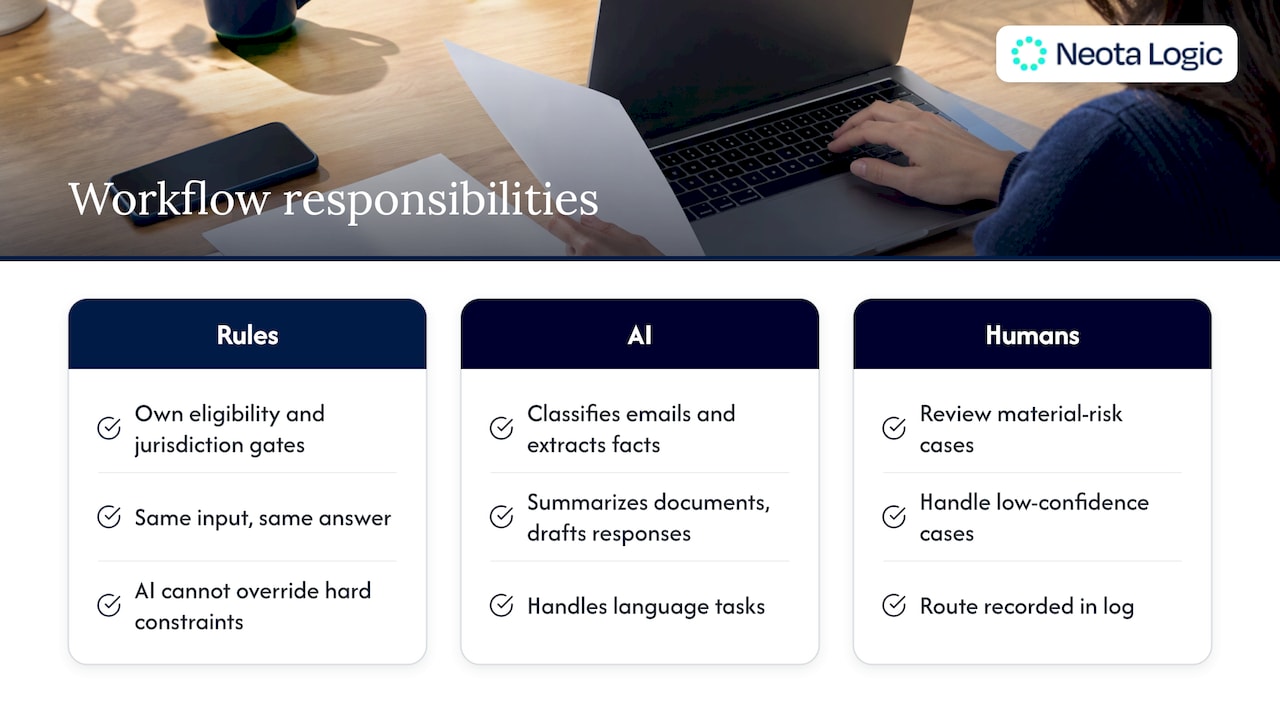
Deterministic rules own the decision path. Eligibility gates, jurisdiction logic, approval authority, escalation thresholds and anything a regulator might ask you to justify. Rules produce the same answer every time and can be inspected line by line.
AI handles the language work. Classifying an unstructured email, extracting key facts from an attachment, summarizing a long document, drafting a first response. These tasks benefit from a model and tolerate review.
Humans own judgment. Wherever risk is material or model confidence is low, the workflow routes to a person. It does not guess. The route itself goes in the log.
This architecture follows a principle that practitioners keep reaching: keep hard constraints in explicit rules the model cannot override, and let the model handle nuance that rules cannot encode. Authority stays with named roles.
The alternative is an ungoverned assistant that reads a request and decides. That approach creates privilege exposure, inconsistent outcomes and no defensible record. It is the fastest way to turn a compliance function into a compliance risk.
Governing the AI tools you already use
Most legal departments already run one or more AI tools. Replacing them is rarely the answer. Governing them is.
A control layer sits on top of those tools and enforces policy at the point of use. It does four things:
- Routes each task to an approved model under defined conditions.
- Applies rules before and after the model acts.
- Inserts human checkpoints where policy requires them.
- Logs the full exchange, including versions.
Integration discipline matters here. AI should follow existing roles, permissions and access models. Data should stay isolated by matter, client or department where confidentiality requires it. Retrieved content should be treated as data, not as instructions. Each of these is a design requirement, not an option.
Perspective
Governance is the differentiator. Features are not.
Every legal AI vendor can show you a demo that drafts, summarizes and classifies. Few can show you what happens when a regulator asks for the record of a decision made fourteen months ago. That is the test that matters to a General Counsel.
We built Neota Logic as governed AI infrastructure for legal and compliance teams. It is not a point solution. It is not a chatbot. A deterministic rules engine handles the decisions that cannot be wrong. AI handles the work that benefits from it. A human checkpoint sits wherever you want one. Every step is logged and versioned.
Our rules engine structurally cannot hallucinate on the decision path. That is a design property, not a promise about model quality. It is why compliance requests are a natural fit. The stakes are high, the rules are knowable, and the record must hold up.
We also do the build. Our legal engineers scope and construct each solution, so your team stays on client and business work. We sit on top of the AI tools you already run. We do not ask you to replace them.
If your organization uses AI on compliance work without a control layer, you are accumulating risk with every request. Governance is cheaper before the first incident than after it.
Patrick
What to demand from any compliance request platform
Evaluate on governance. Use this checklist.
- Audit trail depth. Does the record capture rule versions, model versions, approvals and overrides, not just status changes?
- Versioning. Can you reproduce the logic that governed a decision on a past date?
- Explainability. Can a non-technical reviewer read why a request was routed or approved?
- Deterministic control. Are decision-path rules separate from AI output, and can the model override them?
- Human checkpoints. Can you place a review step at any point, and is it enforced?
- Integration with existing tools. Does it work with your current document, CRM and communication systems and your current AI tools?
- Access control. Does it respect role-based permissions and data isolation?
- Build model. Who configures workflows, and how long until something runs?
A platform that scores well on features and poorly on the first four is a demo, not infrastructure.
Metrics worth tracking
Once the workflow runs, measure it. Track a short list:
- Time from receipt to acknowledgment.
- Time from receipt to resolution, by tier.
- Percentage of requests routed without manual intervention.
- Number of escalations and overrides, and their reasons.
- Recurring request types that signal a policy gap or a candidate for self-service.
- Human review rate on AI-assisted steps, and the rate at which reviewers change the AI output.
Recurring requests deserve special attention. If the same question arrives thirty times a quarter, turn the answer into a guided workflow. The requester gets an immediate, consistent response. Your lawyers get their time back.
How Neota Logic supports compliance request management
We build governed workflows for legal and compliance teams. Intake, triage, routing, review and reporting run in one environment, with the audit trail built in rather than bolted on.
Relevant capabilities include legal intake automation, email intake and routing, a deterministic rules engine, AI governance and compliance advisory workflows. Our legal engineers scope and build each solution with you. You can review the AI-enabled solutions and the compliance and risk workflows to see how the pieces fit.
If you are ready to put a control layer under your compliance requests, talk to us about platform access and deployment. Bring your hardest request type. We will show you the rule set, the checkpoint and the log.
FAQ
What is the first step to manage compliance requests?
Centralize intake. Give every requester one channel and capture the request type, jurisdiction, deadline and documents in structured form. Acknowledge each request immediately. That creates the first record and starts the clock.
Should AI classify and route compliance requests?
AI can classify unstructured requests and extract facts. Routing authority, approval thresholds and escalation should sit in deterministic rules. A human reviews anything high-risk or low-confidence. Log each step, including the model version.
What should an audit trail for compliance requests include?
Include the sender, timestamps, the owner, the original request, the rule version that fired, any model and prompt version, the route chosen, every approval and override, and the final outcome. Protect the log from routine editing and restrict access by role.
How do you stop requests from stalling?
Assign one named owner per request and set the deadline from its source. Add timed reminders, then escalation to a manager and then to legal leadership. Require a logged reason for any reassignment or override.
Do we need to replace our existing AI tools?
No. Put a control layer on top of them. It routes tasks, applies rules, inserts human checkpoints and logs every exchange. You keep the tools your lawyers already use and gain governance over them.
Sources
Ready to make your AI workflows defensible?
Book a demo and we'll walk one of your real processes through Neota.
Book demo