Legal LLM evaluation requires two things at once: task-specific benchmarks that score all-pass accuracy and citation grounding, and judge validation backed by documented governance under frameworks like the EU AI Act and NIST AI RMF. We recommend starting with a small all-pass pilot, five to ten real matters, graded by a validated judge model and reviewed by a human expert. That pilot tells you more about deployment readiness than any vendor demo.
TL;DR:
- Conduct small all-pass pilot tests of five to ten real legal matters graded by validated judges to assess deployment readiness and identify issues.
- Regulators require comprehensive documentation of testing methodologies, impact assessments, citation verification, audit trails, and version tracking for high-risk AI systems.
- Legal evaluation metrics must focus on correctness, including grounding, citation accuracy, doctrinal agreement, reasoning quality, and proper abstention when unsure.
- Use multiple benchmarks tailored to legal reasoning, retrieval robustness, and compliance behavior, pairing reasoning tests with operational evaluation for source verification.
- Embed evaluation, monitoring, and validation into governed workflows with audit trails, version control, and continuous telemetry logging to ensure regulator-ready transparency.
Table of Contents
- How regulation and governance change what evaluation must show
- Core evaluation constructs and metrics tailored to legal tasks
- Which benchmarks and datasets to use and what each actually measures
- How to build trustworthy LLM judges and validate them against human experts
- Designing an evaluation harness for retrieval-augmented, tool-using legal agents
- Telemetry, sampling, and governance for continuous evaluation
- Step-by-step checklist legal teams can act on this quarter
- Neota Logic: governed workflows for defensible evaluation
- What legal leaders should prioritize, and what to avoid
- How Neota Logic supports governed evaluation and how to get started
- FAQ
- Sources
How regulation and governance change what evaluation must show
Evaluation in legal settings is no longer a private engineering exercise. Regulators now expect documentation that shows how a system was tested, what it failed at, and who reviewed the results.
The EU AI Act requires provenance documentation and transparency for general-purpose AI systems, and it imposes risk-management obligations on systems classified as high-risk. Many legal and compliance use cases, including those that affect access to justice or employment decisions, fall into that category. The practical effect is that evaluation stops being optional diligence and becomes a compliance artifact. If a system flags contract risk or supports a hiring decision, you need a record of how it was tested, not just evidence that it works most of the time.
The NIST AI RMF generative AI profile adds operational texture to that requirement. It recommends both internal and external evaluations, documented testing policies, and proportional independent assessments scaled to the system’s risk level. Generative AI, in NIST’s framing, needs ongoing risk management, not a one-time test before launch.
One documented finding sets the baseline for why this matters: legal LLM hallucination rates ranged from roughly 58% to 88% depending on the model and task complexity in sampled legal case Q&A tasks. That range alone justifies treating evaluation as a governance function rather than a technical afterthought.
Translating these obligations into practice means producing artifacts regulators, auditors, and procurement teams can actually review. At minimum, legal teams should be able to produce:
- A documented evaluation methodology showing what was tested, on what data, and against what standard.
- Impact assessment records for any system used in a high-risk context under the EU AI Act.
- Explainability notes describing how outputs were generated and verified, including citation checks.
- Audit trails that log every decision point: retrieval, generation, grading, and human override.
- Version records tying evaluation results to the specific model and prompt configuration tested.
We built our own approach to governed legal AI around exactly this gap. Documentation that exists only in a data scientist’s notebook does not satisfy a regulator or a general counsel signing off on deployment. It needs to live in the workflow itself, timestamped and attributable.
Core evaluation constructs and metrics tailored to legal tasks
Generic LLM benchmarks miss what legal work actually demands. A chatbot that sounds confident and cites a case that does not exist has failed, even if its prose reads well. Legal evaluation needs constructs built around correctness, not fluency.
Grounding and factuality measure whether a claim in the output is supported by a real, retrievable source. Citation correctness goes further: it checks not just that a citation exists, but that it says what the model claims it says. Doctrinal agreement scores whether the legal conclusion matches the position a competent practitioner would reach given the same facts. Analysis quality evaluates reasoning structure, not just the final answer, since a correct conclusion reached through broken reasoning is still a liability. Abstention and deferral tracks whether the system correctly declines to answer when it lacks sufficient grounding, which matters enormously in compliance contexts where a wrong answer is worse than no answer.
These constructs map to specific metrics:
- All-pass grading: a binary score requiring every element of a response, including every citation, to be independently verified as correct.
- Weighted pass: partial credit for responses that get the core conclusion right but miss secondary elements, useful for triage tasks but risky for anything client-facing.
- Hallucination rate: the share of outputs containing at least one fabricated or unsupported claim, measured per task rather than per word.
- Citation precision: the proportion of cited sources that are both real and accurately characterized.
- Calibration: how well a system’s stated confidence matches its actual accuracy, which determines whether abstention signals can be trusted.
Legal Research Bench treats legal research correctness as all-pass with source verification, and its results are instructive. That gap between “mostly right” and “fully verified” is the entire reason all-pass grading matters for legal use. It is a liability with a plausible cover story.
| Metric | What it measures | When to require it |
|---|---|---|
| All-pass grading | Every claim and citation verified correct | Client-facing memos, court filings, compliance determinations |
| Weighted pass | Partial credit for core conclusion | Internal triage, first-pass drafting |
| Hallucination rate | Share of outputs with fabricated content | All legal generation tasks, tracked continuously |
| Citation precision | Accuracy of cited sources | Research, brief drafting, regulatory citation |
| Calibration | Confidence versus actual accuracy | Abstention and escalation logic |
Decide which standard applies before you run the evaluation, not after you see the scores. Reserve all-pass grading for anything a client or regulator will see. Weighted pass is acceptable for internal drafting aids where a human reviews every output before it leaves the building. Whatever you choose, report sample sizes and task counts alongside the pass rate.
Which benchmarks and datasets to use and what each actually measures
No single benchmark covers legal reasoning, retrieval, and compliance behavior at once. Building a defensible evaluation program means combining several, each chosen for what it actually tests rather than for its name recognition.
- LegalBench tests legal reasoning across a broad set of tasks, from issue spotting to rule application, using structured multiple-choice and short-answer formats.
- GREEKBARBENCH evaluates bar-exam-style legal reasoning with multi-dimensional scoring across facts, cited articles, and analysis, giving graders a structured rubric rather than a single pass/fail call.
- LeMAJ is not a task benchmark but a judging methodology: it uses span-based rubrics and discrete Legal Data Points to improve how well an LLM judge’s scores align with human expert evaluations.
- Legal Research Bench (LRB) measures end-to-end reliability in long-horizon legal research agents using all-pass grading with source verification, making it the closest proxy to real research workflows.
- ReguSim and ReguBench evaluate rule grounding and compliance behavior in agentic environments, testing whether an agent respects visible rules during multi-step tasks, which matters directly for compliance automation.
Each comes with real limits. Free-text scoring on benchmarks like LegalBench is expensive to grade reliably at scale, since human review of open-ended answers does not parallelize the way multiple-choice grading does. Jurisdictional coverage is another constraint: GREEKBARBENCH reflects one bar exam’s structure, and conclusions drawn from it do not transfer cleanly to common-law research tasks. Citation verification, the step that matters most for legal trust, is also the step most benchmarks underfund, because checking whether a cited case actually says what the model claims requires either a verified case database or costly manual review.
Our practical recommendation: pair a reference reasoning benchmark, LegalBench or GREEKBARBENCH, with an operational harness in the style of LRB for any task involving retrieval. The reference benchmark tells you whether the underlying model can reason like a lawyer. The operational harness tells you whether it can do that reliably when it has to find its own sources, parse them, and cite them correctly under realistic conditions. Testing only the first gives you a false sense of security, since reasoning ability on a clean multiple-choice question says little about what happens when the model has to retrieve a real statute from a messy database. For compliance-specific agent work, add a rule-grounding test like ReguSim, since neither LegalBench nor LRB was built to catch an agent that quietly ignores a posted compliance rule.
How to build trustworthy LLM judges and validate them against human experts
Grading legal outputs at scale requires an LLM judge, since human review of every output does not scale past a pilot. But a judge is only as trustworthy as its validation against real legal experts, and simple grading prompts are not sufficient for legal nuance.
Two judge architectures dominate current practice: grading judges, which score a single response against a rubric, and pairwise judges, which compare two responses and pick the better one. Grading judges give you absolute scores you can track over time. Pairwise judges are better suited to model selection, since relative comparisons are often more reliable than absolute scores for subtle quality differences.
The rubric itself matters more than the judge model choice. Span-based rubrics break an answer into discrete, checkable components, typically Facts, Cited Articles, and Analysis, and score each independently rather than asking the judge for one holistic number. This structure both improves alignment with human graders and makes disagreements easier to diagnose, since you can tell whether the judge and the human disagreed about the facts, the citations, or the reasoning.
Validating the judge itself follows a consistent recipe:
- Sample a representative set of outputs across practice areas and difficulty levels.
- Have qualified human reviewers grade the same sample independently, using the same rubric given to the judge.
- Measure correlation between judge scores and human scores, not just raw agreement percentage.
- Check inter-annotator agreement among the human reviewers first, since a judge cannot be expected to beat human consensus that does not exist.
- Recalibrate the rubric or the judge prompt where disagreement concentrates, rather than discarding the whole approach.
Pro Tip: Run judge validation on a rolling basis, not once at launch; model updates and prompt changes can silently shift judge behavior without warning.
Common failure modes include judges that reward confident prose over correct substance, judges that under-penalize fabricated citations because they do not actually verify sources, and judges whose agreement with humans looks strong in aggregate but collapses on the hardest 10% of cases. Mitigation is rarely about switching judge models. It usually means refining the rubric, adding explicit citation verification steps the judge must complete before scoring, and keeping a standing sample of human spot checks rather than treating validation as a one-time gate.
Designing an evaluation harness for retrieval-augmented, tool-using legal agents
Evaluating a static model answering a static question is the easy case. Evaluating an agent that searches case law, parses retrieved pages, stores intermediate findings, and assembles a final answer across multiple steps is a different problem entirely, and it is the one most legal deployments actually involve.
A workable harness for these agents needs distinct components: a search layer covering web and case-law databases, a page-parsing step that extracts usable text from retrieved documents, a storage mechanism that preserves intermediate findings with keys back to their source, a retrieval prompt that shapes how the agent queries its sources, and a final answer submission step that the grader evaluates against the original question.
Tool use changes the error profile in a specific way: it raises the chance of a partially correct answer while lowering the chance of a fully verified one, because each additional step is another place for a small error to enter and compound. Legal Research Bench captures this directly: agents often retrieve and cite relevant material, earning partial credit but fall short of all-pass because one citation out of several does not hold up to verification. Point-in-time benchmarking also understates failure risk in live settings, since errors that look minor in isolation compound across a multi-step agent run in ways a static benchmark never exercises.
Build your test suite around three elements:
- All-pass with source checks: score the complete chain, not just the final output, requiring every retrieved and cited source to verify independently.
- Per-step error logging: record where in the chain a failure occurred, since an answer that is wrong because of bad retrieval needs a different fix than one wrong because of flawed synthesis.
- Controlled adversarial retrieval tests: deliberately include misleading or superseded sources in the retrieval pool to see whether the agent catches the problem or cites the bad source anyway.
Time budgets matter too. An agent given unlimited retrieval attempts will often eventually find the right source, which flatters its real-world reliability under a fixed, realistic query budget. Test under the time and query constraints your actual workflow imposes, not the constraints that make the agent look best.
Telemetry, sampling, and governance for continuous evaluation
A benchmark score from last quarter tells you nothing about a model update deployed last week. Legal evaluation needs to run continuously, not as a pre-launch gate, because prompts drift, models get updated upstream, and usage patterns shift in ways a static test never anticipated.
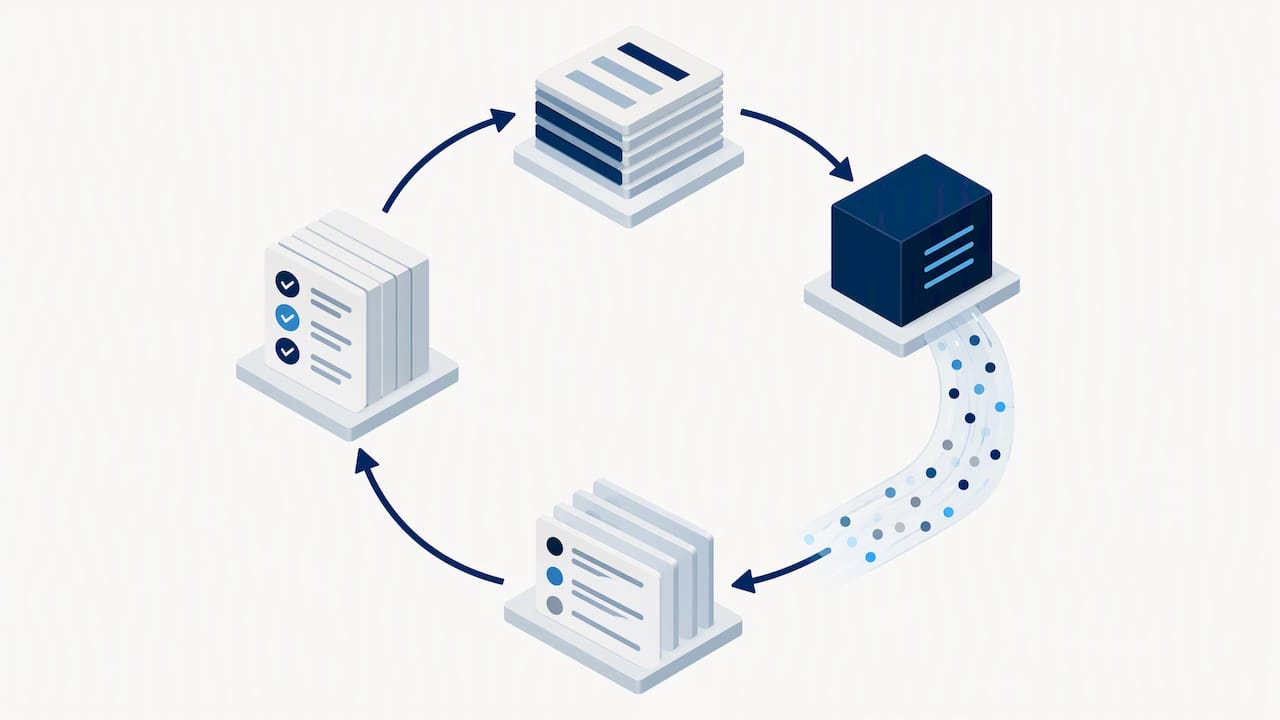
Operational monitoring starts with telemetry capture. At minimum, log the prompt text submitted, the full retrieval trace, the specific document IDs retrieved, the result of any citation verification step, any human override of the system’s output, a timestamp, and the role of the user who initiated the request. Capturing prompt traces, retrieval provenance, and human overrides is what turns a monitoring system into something a compliance team can actually audit later, rather than a log file nobody can reconstruct.
Sampling strategy determines whether that telemetry gets reviewed in time to matter. Stratify your sample by practice area, since a hallucination in employment law carries different risk than one in routine contract review. Weight sampling toward high-risk workflows, anything touching litigation strategy, regulatory filings, or client-facing advice. Add triggered sampling: any output flagged for abstention, any output a human overrode, and any output with a low confidence score should get automatic review regardless of your baseline sampling rate.
- Log prompt text, retrieval trace, document IDs, and citation verification results for every production query.
- Stratify sampling by practice area and risk level, not uniformly across all traffic.
- Trigger automatic review on abstention flags, human overrides, and low-confidence outputs.
- Retain logs long enough to satisfy both regulatory record-keeping rules and professional duty of competence standards in your jurisdiction.
Pro Tip: Treat triggered sampling as your early warning system; a spike in abstention flags after a model update usually means something upstream changed before anyone told you.
Retention periods should align with whichever is longer: your regulator’s record-keeping requirement or your profession’s own duty-of-competence documentation standard. When in doubt, keep more, since the cost of storage is far lower than the cost of being unable to reconstruct what a system did eighteen months ago when a malpractice question arises.
Step-by-step checklist legal teams can act on this quarter
Evaluation programs stall when they are treated as a single research project instead of a sequence of ownable tasks. Break it down this way:
- Scope the use case: identify the specific legal task, its risk tier under the EU AI Act, and the data available for testing. Owner: legal ops lead.
- Design the rubric: build a span-based rubric covering facts, citations, and analysis specific to the task. Owner: subject-matter attorney plus evaluation lead.
- Validate the judge: run the judge against a human-graded sample and measure correlation before trusting it at scale. Owner: evaluation lead.
- Run a pilot harness: execute all-pass grading with source verification on five to ten real matters. Owner: evaluation lead with IT support.
- Stand up operational monitoring: deploy telemetry capture and stratified sampling before full rollout. Owner: legal ops and IT.
- Assemble the documentation package: compile methodology, results, and governance artifacts for procurement and regulatory review. Owner: general counsel’s office.
| Step | Minimal artifact produced |
|---|---|
| Scope the use case | Risk classification memo |
| Design the rubric | Written rubric with scored dimensions |
| Validate the judge | Correlation report versus human graders |
| Run a pilot harness | All-pass results with source verification log |
| Stand up monitoring | Telemetry schema and sampling plan |
| Documentation package | Audit-ready evaluation file |
A realistic pilot plan runs over four to six weeks: two weeks to scope the task and build the rubric, one week to validate the judge against human review, two weeks to run the pilot harness and log results, and one week to compile the documentation package. That timeline fits inside a single sprint cycle and produces a defensible artifact at the end, not just a slide deck of promising numbers.
Neota Logic: governed workflows for defensible evaluation
Everything described above, audit trails, versioning, judge validation records, telemetry retention, requires a workflow layer that captures it by default rather than as an afterthought. That is the governance problem we built our platform to solve.
- Audit trails: every workflow step, model call, and human override is logged and timestamped, producing the record a regulator or auditor would need to review.
- Versioning: changes to workflows, rubrics, or model configurations are tracked, so an evaluation result can always be tied to the exact setup that produced it.
- Explainability: decision logic in our workflows is visible and traceable, not hidden inside a black-box prompt chain.
- Model-agnostic orchestration: we integrate multiple AI models within a single governed workflow, so an evaluation program is not locked to one vendor’s behavior or pricing.
Legal teams using governed intake workflows get these artifacts as a byproduct of normal operation rather than as a separate compliance project. A matter that moves through intake, triage, and resolution generates its own audit log automatically. That is the difference between evaluation as a one-time research exercise and evaluation as an operating discipline: the second one survives a regulator’s request for records.
What legal leaders should prioritize, and what to avoid
Prioritize auditability and judge validation over vendor demonstrations. A demo shows you a model’s best day. An audit trail shows you what actually happened across a thousand real queries, including the ones that went wrong.
The most common mistake we see is the one-off feature check: a legal ops team runs a model against a handful of hand-picked questions, likes the answers, and deploys. That approach catches nothing about reliability under real volume, and it leaves no documentation when a regulator or a malpractice claim asks what testing occurred.
Evaluation belongs inside procurement, inside deployment approval, and inside ongoing audit cycles, not as a separate research track that happens once and gets forgotten. Treat every model update as a new system requiring the same scrutiny as the first one. The teams that get this right build evaluation into their standing processes. The teams that get it wrong find out what they missed during a dispute.
— Patrick
How Neota Logic supports governed evaluation and how to get started
We built our platform around the governance gap this article describes. Evaluation artifacts, audit trails, version records, documented judge validation, only hold up under regulatory or malpractice scrutiny when they are generated inside a governed workflow, not bolted on afterward.
- Governed workflows route legal requests through documented, auditable decision logic with human oversight built in at every step.
- Model-agnostic orchestration lets your team evaluate and switch between AI models without rebuilding your governance layer each time.
- Audit trails and versioning capture the evidence procurement, compliance, and regulators ask for, as a default output rather than a special request.
- Discovery Sprint gives your team a structured starting point for scoping a governed evaluation pilot.
If your team is ready to move evaluation out of a spreadsheet and into a governed workflow, start with our Discovery Sprint and platform access details. It is the fastest way to see what a defensible, audit-ready evaluation process looks like inside your own matters.
This article is general information, not a substitute for advice from a qualified lawyer. Consult a qualified legal professional about your own circumstances before acting on anything here.
FAQ
What does LLM mean for a lawyer?
For a lawyer, an LLM is a large language model, an AI system that generates text, including legal analysis, drafting, and research summaries, based on patterns learned from training data. What matters practically is that it can produce fluent, confident-sounding answers that are factually wrong, which is why legal hallucination rates measured between 58% and 88% in sampled tasks make verification essential.
What is an LLM evaluation?
An LLM evaluation is a structured test measuring whether a model’s outputs meet defined correctness standards, such as citation accuracy, factual grounding, and reasoning quality, rather than just fluency. In legal contexts, this typically means all-pass grading with source verification, as used in Legal Research Bench, combined with judge validation against human expert reviewers.
Is LLM as a judge reliable?
LLM-as-a-judge can be reliable when validated against human experts using structured, span-based rubrics, but simple grading prompts without this validation are not sufficient for legal nuance. Reliability depends on measured correlation with human graders, not on the judge model’s reputation alone.
Which AI/LLM is best for legal?
There is no single best LLM for legal work, since performance varies by task, jurisdiction, and how the system is governed around the model. What matters more than model choice is whether outputs are verified through citation checks, judge validation, and audit trails, which is why model-agnostic, governed orchestration matters more than picking one vendor’s model.
How do you measure hallucinations in legal AI?
Hallucinations in legal AI are measured as the share of outputs containing at least one fabricated or unsupported claim, typically tracked through citation verification against real case law or statutes. Stanford research found hallucination rates between roughly 58% and 88% depending on the model and legal task tested, underscoring why citation-level verification is necessary rather than optional.
Sources
- Regulation (EU) 2024/1689 (Artificial Intelligence Act) — summary / official text
- NIST AI Risk Management Framework (Generative AI Profile)
- Study on hallucinations in LLMs applied to legal Q&A (Stanford)
- Legal Research Bench: Measuring end-to-end reliability in long-horizon legal research agents
- LeMAJ (Legal LLM-as-a-Judge): Bridging legal reasoning and LLM evaluation — ACL Anthology
Recommended
Ready to make your AI workflows defensible?
Book a demo and we'll walk one of your real processes through Neota.
Book demo