Legal tech procurement should be decided on governance, not on demo polish. Prioritize vendors that give you audit trails, versioning, and explainability over vendors with the smoothest sales pitch. Before you sign anything, take three actions: risk-classify the use case, require a contractual clause barring the vendor from training its models on your data, and run a real pilot of four to eight weeks with your own test cases.
These are not optional extras. The Association of Corporate Counsel recommends risk-classifying AI procurement so higher-risk use cases get deeper scrutiny before contracting. A generic contract review tool carries different exposure than a system touching privileged client data or regulatory filings.
Key Takeaways
Legal tech procurement succeeds when governance, not vendor demos, drives the buying decision, backed by risk classification, contractual no-training clauses, and a measurable pilot.
PointDetailsLead with governanceWeight audit trails, versioning, and explainability above feature lists when scoring vendors.Classify risk firstMatch due diligence depth to the AI use case’s actual risk level before scheduling demos.Demand contractual protectionsRequire no-training clauses, data ownership terms, and right-to-audit language before signing.Run a real pilotTest 5 to 10 real workflows over 4 to 8 weeks with pass or fail criteria set in advance.Choose governance-first infrastructureNeota Logic orchestrates multiple AI models under one auditable governance layer, avoiding single-vendor lock-in.
Table of Contents
What Is a Repeatable Legal Tech Procurement Framework?
Legal tech procurement fails most often when it skips straight from marketing pitch to signature. A staged framework fixes that. LegalBenchmarks’ evaluation framework breaks the process into pre-demo screening, live demo scoring, and pilot evaluation, and each stage exists to filter out vendors that can’t survive scrutiny.
Risk-based weighting matters here. A document summarization tool for internal templates deserves lighter scrutiny than a tool making triage or classification decisions on client matters. Scale your evaluation depth to the actual exposure.
Pro Tip: Build your scorecard before the first demo, not during it. Scoring criteria decided in real time bend toward whichever vendor just presented.
What Should a Vendor Due Diligence Checklist Include?
Vendor due diligence in legal tech procurement is where most teams under-invest, and it’s where the worst surprises surface later. A structured third-party due diligence checklist should scale to the relationship’s risk level and go well beyond a sales-provided security one-pager.
Request this evidence directly, in writing, before you negotiate terms:
Subcontractor risk deserves particular attention. A vendor’s AI layer often runs on a third-party model provider, and that provider’s practices become your practices whether you negotiated with them directly or not.
A vendor’s security posture is only as strong as its weakest subcontractor. If a vendor can’t name who processes your data downstream, that is the answer.
Validate everything with a right-to-audit clause, and confirm financial viability before signing. Legal AI has seen real consolidation, and a recent acquisition in the sector shows how quickly a vendor’s ownership, roadmap, and support commitments can shift.
What Contractual Protections Does AI Procurement Require?
Contracts, not demos, are where AI governance actually gets enforced. Guidance for legal departments buying AI tools consistently points to one non-negotiable: a clause forbidding the vendor from using your data to train its global models. Without it, every document your team processes becomes potential training data for every other customer’s outputs.
Require these terms before signature:
Academic guidance on AI vendor contracts frames governance and contractual protection as the central procurement priority for legal AI, ahead of feature comparisons. Explainability commitments deserve the same contractual weight as security terms. If a vendor can’t document why a model reached a given output, you can’t defend that output in an audit or a malpractice inquiry.
How Do You Design a Legal Tech Pilot That Produces Real Evidence?
A pilot only counts as evidence if it’s built to fail as easily as it succeeds. Vague pilots produce vague results, and vague results get overridden by whoever pushed hardest for the vendor internally.
Who Needs to Sign Off on Legal Tech Procurement?
Legal tech procurement stalls when ownership is unclear. Assign roles explicitly from day one.
Set decision rights at each gate: who can advance a vendor to pilot, and who can approve a contract. A standing governance committee, reviewing quarterly, keeps adoption and risk visible after the ink dries.
What KPIs Should Procurement Require in the Contract?
Procurement shouldn’t end at signature. Build reporting obligations into the contract itself, covering three categories.
Require quarterly reporting against these metrics, embedded as a dashboard obligation in the SLA, not a favor the vendor grants when asked. The Association of Corporate Counsel’s procurement guidance treats ongoing risk monitoring as inseparable from the original due diligence, and that logic extends to KPIs. A vendor that resists structured reporting is telling you something about renewal time.
Why Governance-First Platforms Reduce Procurement Risk
Governance is the differentiator in legal AI procurement, not feature count. A tool that automates a workflow but can’t show you an audit trail, a version history, or an explanation for its output creates exposure instead of removing it.
Neota Logic is built on that premise. The platform functions as governed AI infrastructure, not a point solution or a chatbot layered onto existing systems. It orchestrates multiple AI models under a single governance layer, which means legal teams get decision support without vendor lock-in to any single model provider. Every workflow, every routing decision, and every AI-assisted output is tracked for audit purposes.
Pro Tip: When you evaluate any AI vendor, ask them to show you an audit trail for a real output, not a mocked-up screenshot. If they can’t produce one on the spot, that’s your answer.
What Does a Typical Legal Tech Procurement Timeline Look Like?
Most legal tech procurement cycles run twelve to twenty weeks from initial screening to signed contract, and teams that compress it below that window usually skip a governance step they’ll regret later.
Weeks 1 to 3: pre-demo screening. Gather security documentation and reference checks from a shortlist of vendors before anyone sees a live demo.
Weeks 4 to 6: demo and scorecard evaluation. Run structured demos against your weighted criteria. Eliminate vendors that can’t answer governance questions directly.
Weeks 7 to 14: pilot. This is the longest phase by design. A 4 to 8 week pilot needs buffer time on either side for setup, data access provisioning, and results analysis.
Weeks 15 to 17: contract negotiation. Governance clauses, no-training language, and SLA metrics get finalized here. Expect this to take longer than a standard SaaS contract because AI-specific terms are still unfamiliar to many vendor legal teams.
Weeks 18 to 20: rollout and change management. Training, workflow integration, and phased user onboarding happen in parallel with final contract execution.
Compressing the pilot phase is the most common mistake. A two-week pilot produces a demo, not evidence. It tells you the tool works when the vendor is watching, which is a different fact than whether it works at 6 PM on a Friday when your team is racing a filing deadline.
What Does Legal Tech Actually Cost Beyond the License Fee?
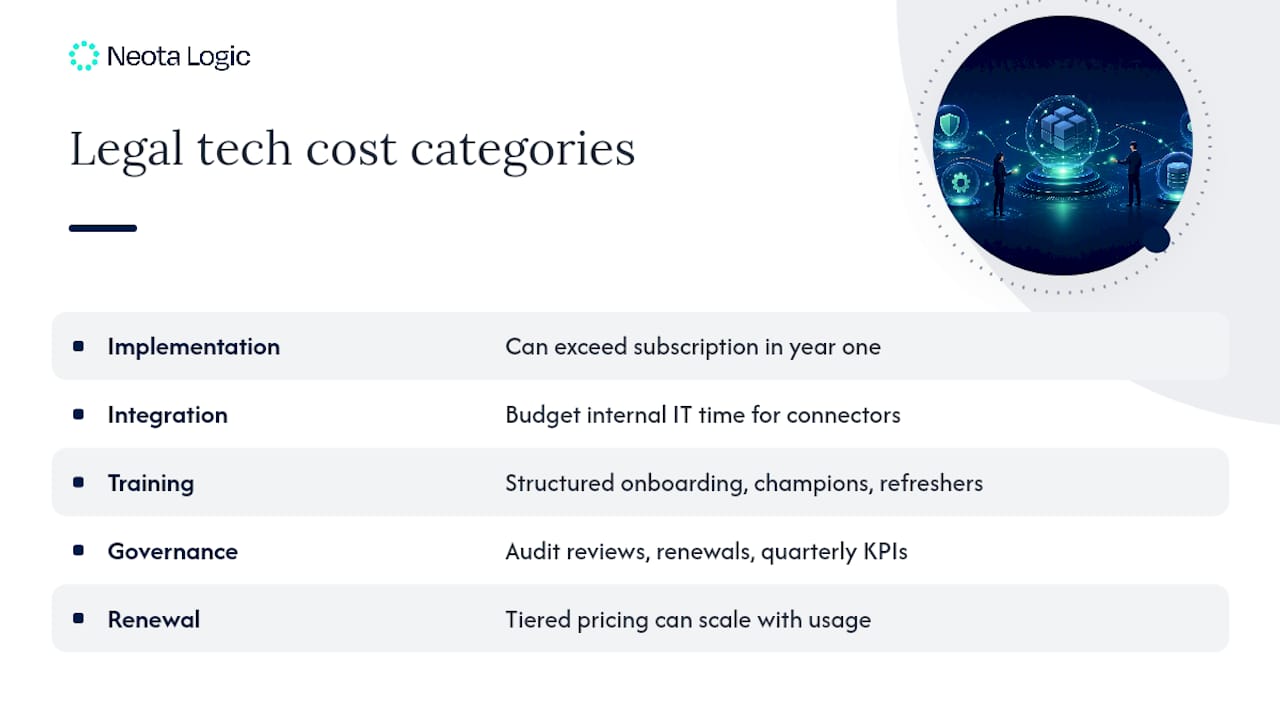
The license fee is the smallest line item most procurement teams underestimate. Total cost of ownership in legal tech includes implementation, integration, training, and ongoing governance overhead, and any of these can exceed the subscription cost in year one.
Implementation and configuration. No-code platforms reduce this cost substantially compared to custom-built workflow automation, but configuration time for complex matter types still adds weeks of internal effort, not just vendor hours.
Integration costs. Connecting a new tool to your document management system, CRM, and communication platforms rarely happens for free. Budget for internal IT time even when the vendor markets “seamless” connectors.
Training and change management. User adoption doesn’t happen automatically. Budget for structured onboarding sessions, champion programs, and refresher training after the initial rollout fades from memory.
Ongoing governance overhead. Audit reviews, contract renewal negotiations, and quarterly KPI reporting all consume legal ops time that doesn’t show up on the vendor’s price sheet.
Hidden renewal costs. Watch for tiered pricing that scales with usage volume or user count in ways that weren’t obvious during the pilot. A tool that looked affordable at pilot scale can become expensive once it’s embedded across the department.
Ask every vendor for a three-year total cost projection during procurement, not just the first-year quote. If they resist providing one, treat that resistance as data.
How Do You Manage Change When Rolling Out New Legal Tech?
Technology adoption fails more often from poor change management than from poor technology. Legal teams are risk-averse by training, and a new tool that disrupts a familiar workflow will get quietly abandoned unless adoption is actively managed.
Identify end-user champions during the pilot phase, not after rollout begins. These are the attorneys and paralegals who tested the tool early and can speak to its value in language their peers trust more than a memo from IT.
Communicate the “why” before the “how.” Teams that understand the governance rationale, faster turnaround, reduced manual error, better audit visibility, adopt faster than teams told simply to start using a new system.
Phase the rollout by practice group or matter type rather than forcing an all-at-once switch. Start with the workflows that scored highest in the pilot, where success is most likely and visible early wins build momentum for harder-to-convert groups.
Build a feedback loop that’s actually monitored. A suggestion box nobody checks signals that adoption isn’t a real priority, and users notice.
Tie a small part of the ongoing governance committee’s mandate specifically to adoption tracking, not just risk and compliance. A tool with strong governance but weak adoption still fails to deliver value.
What Integration Issues Should You Check Before Buying?
Legal tech doesn’t operate in isolation, and integration gaps are where procurement decisions quietly unravel months after signature.
Map your existing stack before evaluating vendors: document management system, CRM, e-signature tools, and internal communication platforms. Ask each vendor for a specific answer on how their tool connects to each one, not a general claim of “broad compatibility.”
API availability matters more than marketing language about integrations. A vendor with a documented, stable API gives your IT team a real path to custom connections if a pre-built integration doesn’t exist. A vendor without one leaves you dependent on manual workarounds or costly custom development.
Data flow direction matters too. Confirm whether the tool reads from your systems, writes back to them, or both, and what happens to that data if you terminate the contract. This ties directly back to the data export clause you should already have in the contract.

Security teams should review integration points as carefully as the core platform itself. Every connection to an existing system is a potential attack surface, and a governed AI platform should extend its audit trail across integrated workflows, not stop at its own boundary.
Ask specifically how the vendor handles version mismatches when your other systems update. A brittle integration that breaks every time your document management system patches is an ongoing operational cost, not a one-time setup problem.
Core Guides, Frameworks, and Checklists to Consult Next
The Procurement Mistake Nobody Names Out Loud
Most legal tech procurement guidance still treats the demo as the decision point. That’s backward. The demo tells you what a vendor wants you to see. A pilot, run against your own matters with pass or fail criteria set in advance, tells you what actually happens.
The conventional wisdom also underweights contracting. Legal ops teams that spend six weeks on a rigorous pilot often spend six days on the contract, and that’s where the real risk sits. A no-training clause, a right-to-audit provision, and a clear data export path matter more over a three-year term than any accuracy score from a two-month pilot.
What the research actually supports is uncomfortable for teams that like fast decisions: risk classification, contractual protections, and pilot design take real time upfront, and skipping them doesn’t save time, it defers the cost to an audit, an incident, or a renewal negotiation with no leverage. Prioritize the boring parts first. The exciting parts, the workflow automation, the turnaround improvements, only hold up if the governance underneath them does.
A Procurement Path Built Around Governance, Not Guesswork
Everything in this playbook, risk classification, contractual no-training clauses, audit rights, pilot design, points toward one requirement: the platform underneath your legal AI needs to be governed by design, not governed by add-on. Neota Logic is built as governed AI infrastructure specifically for legal and compliance teams, with audit trails, versioning, and explainability embedded in the workflow layer itself, not bolted on after a vendor incident forces the issue.
If your team is evaluating AI-enabled legal workflow automation, the Neota Logic platform is built for the exact procurement criteria this article walks through: multi-model orchestration that prevents vendor lock-in, governed decision logic for matter triage and intake, and full auditability for every action the system takes. It fits legal ops teams running exactly the kind of risk-classified, pilot-driven procurement process outlined here.
Request a demo structured around your own workflows, not a generic script, and score it against the same framework you’d apply to any other vendor.
This article is general information, not a substitute for advice from a qualified lawyer. Consult a qualified legal professional about your own circumstances before acting on anything here.
Sources
FAQ
What Is Legal Procurement?
Legal procurement is the process of sourcing, evaluating, and contracting for goods and services, including technology and outside counsel, on behalf of a legal department or law firm. For legal tech specifically, it includes vendor due diligence, security review, contract negotiation, and rollout management.
What Do Legal Tech Companies Do?
Legal tech companies build software that automates or supports legal work, ranging from document automation and e-discovery to contract analysis and workflow orchestration. Governance-first platforms like Neota Logic focus specifically on giving legal teams auditable, explainable AI decision support rather than a single-purpose point tool.
What Are Some Examples of Legal Tech Products?
Legal tech spans several categories: contract lifecycle management, e-discovery platforms, document automation tools, matter management systems, and AI-governed workflow orchestration platforms that route and track legal requests with full audit trails.
How Long Should a Legal Tech Pilot Run?
Practitioner guidance recommends a pilot length of 4 to 8 weeks, tested against 5 to 10 representative workflows with pass or fail criteria set before the pilot begins.
What Contract Clause Matters Most for AI Vendors?
A clause forbidding the vendor from using your data to train its global models is the single most important protection, according to legal department procurement guidance, alongside clear data ownership and right-to-audit terms.
Recommended
Ready to make your AI workflows defensible?
Book a demo and we'll walk one of your real processes through Neota.
Book demo