Legal prompt engineering, in the enterprise sense, means governed prompt orchestration inside no-code legal workflows: prompt templates, model routing, deterministic decision logic, and a permanent audit trail working together instead of a lawyer typing questions into a chat window. The value case is direct. Done right, it lets legal departments scale expert judgment across thousands of matters, keep every output consistent with policy, and capture institutional knowledge as reusable, auditable work product rather than one-off chat transcripts. Buyers evaluating this space should expect vendors to reference frameworks like the NIST AI RMF, cite oversight from a cross-functional AI governance committee, and, in Neota Logic’s case, point to a track record of deploying exactly this kind of orchestration for corporate legal teams.
Key Takeaways
Governed prompt orchestration turns individual AI prompting into a scalable, auditable enterprise capability that legal teams can defend to regulators, boards, and clients.
| Point | Details |
|---|---|
| Definition matters | Legal prompt engineering means governed orchestration, not individual prompt writing by lawyers. |
| Governance is structural | Effective oversight runs top-down from the board through a cross-functional AI governance committee to department procedures. |
| Procurement needs specifics | Demand policy bundles, multi-model routing, an append-only run ledger, and an AI addendum before signing. |
| Rollout is phased | Pilots typically run in weeks, with production-grade applications following shortly after, not after a lengthy build period. |
| Neota Logic fits the checklist | Neota Logic offers no-code policy bundles, instant policy propagation, and an auditable run ledger built for this exact procurement standard. |
Table of Contents
- What Does Governed Prompt Orchestration Look Like Inside a Legal Workflow?
- Why Should Legal Teams Move Beyond Ad-Hoc Prompting?
- Procurement-Ready Checklist for a Governed AI Platform
- Building the Governance Structure That Supports It
- What Does a Realistic Pilot-to-Production Timeline Look Like?
- What KPIs Justify the Procurement Spend?
- What Risks Should Procurement Negotiate Away in the Contract?
- How Neota Logic Maps to This Checklist
- Why Governed Orchestration Deserves Priority Now
- Getting Governed Orchestration Into Your Legal Department
- Sources
- FAQ
What Does Governed Prompt Orchestration Look Like Inside a Legal Workflow?
A governed workflow does not hand a model a blank text box. It routes a request through a defined sequence, and every step leaves a record.
- Intake: a request enters through a form, email parser, or integration, not a freeform chat.
- Classification: the system determines matter type, risk tier, and jurisdiction.
- Model routing: the platform selects the appropriate AI model or models for that task category.
- Deterministic decision rules: no-code logic applies firm or department policy to the output.
- Human-in-the-loop gates: a qualified reviewer signs off before anything reaches a client or counterparty.
- Approval and run ledger: the entire path, inputs, and outputs are written to an append-only record.
The core building blocks behind that flow are prompt templates, policy bundles, a model selector, integrations into existing systems, and an audit ledger that nothing in the workflow can quietly edit. Picture it as intake feeding an orchestration layer, which feeds a review stage, which feeds the audit record. This kind of governed AI orchestration platform is precisely what separates enterprise-grade deployment from a browser tab full of prompts.
Pro Tip: Deterministic boundaries matter because models change underneath you. When a vendor pushes a model update, a governed rule layer keeps your outputs consistent even if the underlying model’s behavior drifts.
Why Should Legal Teams Move Beyond Ad-Hoc Prompting?
Ad-hoc prompting scales one lawyer at a time. Governed orchestration scales the department. That distinction is the entire procurement argument.
Legal productisation turns expert legal judgment into a self-service application other people can run, correctly, without asking the original expert to repeat themselves. A single lawyer with a clever prompt might get a fast answer once. A governed application built from that same expertise can process the same request type many times, with the same policy applied every time, and a record of every run available on demand.
That consistency is the ROI story procurement should carry to leadership: individual assistant speed gains are nice, but platform-level throughput gains, applied across a whole intake queue, are what justify a subscription. Point solutions and personal prompting habits fragment governance, invite model drift nobody is tracking, and lose institutional knowledge the moment the person who wrote the prompt changes roles. Orchestration keeps that knowledge inside the organization, not inside someone’s browser history.
Procurement-Ready Checklist for a Governed AI Platform
Before you sign anything, run the platform against these requirements. Treat this as a starting point for your RFP or evaluation matrix.
Mandatory capabilities:
- Policy bundles that apply firm rules consistently across every application.
- Model routing with genuine multi-model support, so you are not locked to a single vendor.
- No-code rule editing, so legal ops can update logic without waiting on engineering.
- Human-in-the-loop gates configurable by matter type or risk tier.
- An append-only run ledger that cannot be altered after the fact.
- Tenant-level logging and role-based access control.
- Data residency controls that match your regulatory footprint.
- Integrations with your DMS, SSO provider, and ticketing system.
Acceptance criteria to test during evaluation:
- Ask the vendor to demonstrate a policy update propagating across every active application within minutes, not after a re-deployment cycle.
- Request a sample exportable audit packet and confirm it includes full evidence, not just a summary.
- Confirm role-based permissions actually block unauthorized users in a live test, not just on paper.
Contract terms to demand before signature: an AI addendum covering training-on-your-data restrictions, indemnity for third-party IP claims, full sub-processor disclosure, audit rights, and explicit data retention and legal-hold clauses. If a vendor resists any of these, that is diagnostic information in itself.
Building the Governance Structure That Supports It
A platform without governance behind it is just faster ad-hoc prompting. Effective enterprise AI governance runs top-down: board and general counsel value statements set direction, a cross-functional AI governance committee (legal, IT, security, procurement) translates that into policy, and department-level procedures put it into daily practice, a structure Deloitte’s guidance for chief legal officers lays out clearly for CLOs.

At the department level, your governance checklist should include an approved-tools list, a written prohibited-uses policy, mandatory training before platform access is granted, an incident runbook for when something goes wrong, and sub-processor due diligence tied to your AI addendum templates.

None of that works without monitoring. Build a routine cadence for sampling prompts and outputs, not just a one-time audit at launch, and prepare reporting the general counsel and board can actually use. Building a defensible AI governance framework means moving past principle statements into processes that address vendor liability, insurance coverage, and what gets reported upward, and when.
What Does a Realistic Pilot-to-Production Timeline Look Like?
Legal Ops buyers should expect a phased rollout, not a single flip of a switch.
- Discovery and intake mapping. Legal Ops and IT document current request volumes, bottlenecks, and existing point solutions.
- Pilot on a single use case. Pick one well-bounded matter type. This phase typically runs in weeks, not quarters.
- Policy and controls build. Governance committee input gets encoded as policy bundles and decision rules.
- Integration and training. Connect to your DMS and SSO, and train the legal staff who will actually run the workflow.
- Scale and measurement. Expand to additional matter types once adoption and compliance sampling clear your thresholds.
Production-grade applications built this way have shown up in weeks rather than the many months a full custom build usually requires. Success criteria at each phase should include a minimum adoption rate among target users, a compliance sampling pass rate, measurable time-to-result improvement, and audit-ready evidence artifacts you can hand a regulator or a skeptical board member without scrambling.
What KPIs Justify the Procurement Spend?
Finance and procurement will ask for numbers before they ask for opinions. Track these from day one:
- Throughput: matters automated per month.
- Average turnaround time (TAT): how long a request takes from intake to resolution.
- Human review rate: the percentage of outputs requiring manual correction.
- Error or downstream exception rate: how often something slips through incorrectly.
- Audit coverage: the percentage of runs with a complete, exportable evidence packet.
- User satisfaction: whether legal staff actually adopt the tool instead of routing around it.
A realistic procurement target: reduce manual review load meaningfully within a defined pilot window, then re-baseline once the workflow scales. Evidence collection should come from run-ledger exports, sample audit packs pulled at random, integration logs, and periodic compliance sampling the general counsel signs off on. The ACC Artificial Intelligence Toolkit for in-house lawyers is a useful reference for mapping these metrics to specific legal functions like contract analysis and eDiscovery.
What Risks Should Procurement Negotiate Away in the Contract?
Every governed AI deployment carries risk categories that belong in the contract, not in a footnote.
- IP ownership uncertainty over AI-generated outputs.
- Vendors training their models on your confidential inputs.
- Data residency and retention mismatches with your regulatory obligations.
- Model hallucinations reaching a client or counterparty unreviewed.
- Spoliation risk if prompts and outputs are not preserved for litigation holds.
- Regulatory exposure from automated decisions that lack human sign-off.
To mitigate these contractually, negotiate for the following before you sign:
- An AI addendum explicitly barring training on your customer or matter data.
- Indemnity coverage for third-party IP claims arising from generated content.
- A full sub-processor list with ongoing disclosure obligations.
- Audit rights that let your compliance team verify claims independently.
- SLAs governing data deletion and retention timelines.
On the negotiation side, require exportable evidence packets as a contractual deliverable, restrict production use until pilot validation clears your acceptance criteria, and insist on advance notification of any underlying model changes. Ad-hoc prompting without governance carries real legal exposure that a well-drafted contract, paired with the technical controls above, is designed to close off.
How Neota Logic Maps to This Checklist
Neota Logic was built around the checklist above, not retrofitted to match it after the fact. Its no-code policy bundles let legal ops teams update decision logic themselves, and that update propagates across live applications without requiring a retraining cycle. Multi-model routing keeps clients out of a single-vendor dependency, while a deterministic boundary wraps every model interaction so outputs stay auditable rather than freeform. An append-only run ledger, tenant-level logging, and role-based access controls round out the technical side, alongside integrations built for existing DMS, CRM, and communication stacks.
Client deployments have shown measurable turnaround-time improvements after moving matter types from manual handling to governed automation. When you evaluate Neota Logic in a demo, ask specifically to see a policy update propagate live, request a sample exportable evidence packet, walk through role-based access scenarios, review the AI addendum and data processing terms directly, and get a written commitment on the pilot-to-scale timeline. If a vendor cannot show you all five in one sitting, that gap is worth noting.

Why Governed Orchestration Deserves Priority Now
The legal teams that treat AI as a productisation problem, not a prompting skill, are the ones who will still have defensible answers when a regulator or a board member asks how a given output was produced, as discussed in The Future of the AI Lawyer: How AI is Transforming Law. Ad-hoc prompting builds skill in one person’s head. Governed orchestration builds an asset the whole department owns, with the audit trail to prove it. That is the real gap between what most AI pilots deliver today and what enterprise legal work actually requires.
Getting Governed Orchestration Into Your Legal Department
Most legal teams evaluating AI right now are choosing between two paths: keep prompting ad-hoc through individual chat tools, or build a governed layer that turns that prompting into a defensible, department-wide asset. Neotalogic is built specifically for the second path. It gives corporate legal departments a no-code platform for the governance, model routing, and audit trail that a serious procurement evaluation demands, without locking you into a single AI vendor.
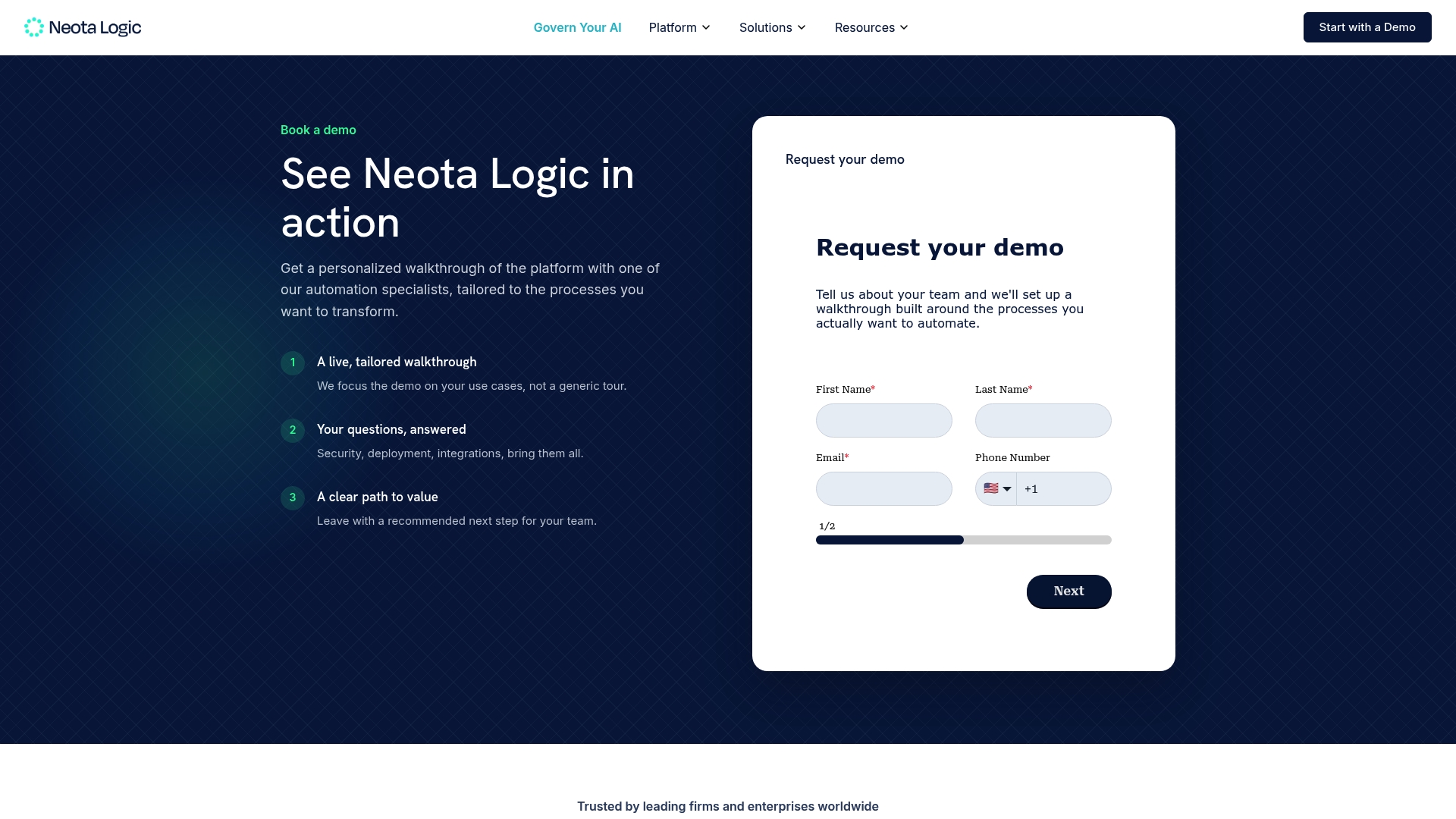
If your team is ready to see how policy updates propagate instantly across live applications, or wants to review a sample audit packet before committing budget, the Neotalogic platform page walks through exactly what a demo covers. For legal ops and IT buyers building an RFP, start by requesting a walkthrough of AI-enabled solutions built for corporate legal teams, and bring your governance committee to the call.
This article is general information, not a substitute for advice from a qualified lawyer. Consult a qualified legal professional about your own circumstances before acting on anything here.
Sources
- Generative AI governance considerations for CLOs - Deloitte
- ACC Artificial Intelligence Toolkit for In-house Lawyers
FAQ
What Is Legal Prompt Engineering?
In the enterprise context, it means governed prompt orchestration inside no-code legal workflows, combining prompt templates, model routing, decision logic, and a permanent audit trail rather than individual chat-based prompting.
How Is Governed Orchestration Different From Using ChatGPT or a Similar Tool Directly?
A governed platform routes every request through classification, deterministic policy rules, and human-in-the-loop review before logging the full run to an append-only ledger, while direct prompting leaves no consistent record or policy enforcement.
How Long Does It Take to Deploy a Governed AI Workflow?
Pilots on a single use case typically run in weeks, with production-grade applications following soon after, well short of the many-month timelines associated with custom AI builds.
What Contract Terms Should Legal Teams Require From an AI Vendor?
Require an AI addendum barring training on your data, indemnity for third-party IP claims, sub-processor disclosure, audit rights, and clear data retention and deletion SLAs.
Does Neota Logic Support Multiple AI Models?
Yes. Neota Logic routes tasks across multiple AI models rather than locking clients into a single vendor, which keeps deployments flexible as model options and pricing change.
Recommended
- Navigating the Bottlenecks in Legal Operations Without Slowing the Business — A Fireside Chat | Neota Logic
- Beyond Efficiency: Blueprint for a High-Performing Legal Function | Neota Logic
- Legal Teams | Neota Logic
- Prompting vs Governed Workflows: Why Clever Prompts Still Get Lawyers Sanctioned | Neota Logic
Ready to make your AI workflows defensible?
Book a demo and we'll walk one of your real processes through Neota.
Book demo