Legal process mapping is the discipline of documenting how a legal workflow actually runs, step by step, actor by actor, decision by decision, so a team can find waste and build governed automation on top of it. It removes hidden handoffs, gives leadership real visibility into cycle time and cost, and creates the foundation for auditable AI workflows. General counsel, legal operations leaders, and process owners should sponsor it, not delegate it entirely to outside consultants.
Table of Contents
What Does a Legal Process Map Need to Show?
A legal process map is not a flowchart for its own sake. It has to answer one question: where does work actually move, and where does it stall?
Every credible map includes four components. Miss one and the map becomes decoration instead of a diagnostic tool.
Legal teams map processes at intake, during contract lifecycle stages, in billing and matter closure, in AML and KYC screening, and anywhere volume is high enough that small inefficiencies compound. A mid-size legal department mapping its contract review batch, for example, typically finds that intake and routing consume more elapsed time than the actual substantive review. Process mapping documents the flow of work and reveals inefficiencies most clearly when fee earners are in the room drawing it, not reviewing it after the fact. Mapping also does more than trim cycle time. Done with real stakeholder input, it supports risk consistency and profitable fixed-fee pricing, because a documented process is a repeatable one.
How Do You Map a Legal Process Step by Step?
Treat this as a project with a start and an end, not an open-ended exercise. Here is the sequence that works.
Pro Tip: Sample real matters instead of relying purely on interviews. People describe how a process should work; timestamps in your case management system show how it actually works. Adding even indicative data to the diagram turns a mapping exercise into an evidence-based one.
Mapping without fee earner involvement is the single most common reason a map fails to change behavior. A process imposed from above rarely survives contact with how the work is actually done, because the people running it were never asked whether it matched reality.
Which KPIs Turn a Map Into Evidence?
A map without numbers is an opinion. A map with numbers is a business case.
Five metrics do most of the work: volume (how many matters move through this process), cycle time (elapsed time from start to finish), actual cost or time cost (hours or fees consumed at each step), error and rework rate (how often work gets sent back), and percentage of value-add steps (work the client or business would actually pay for if itemized).
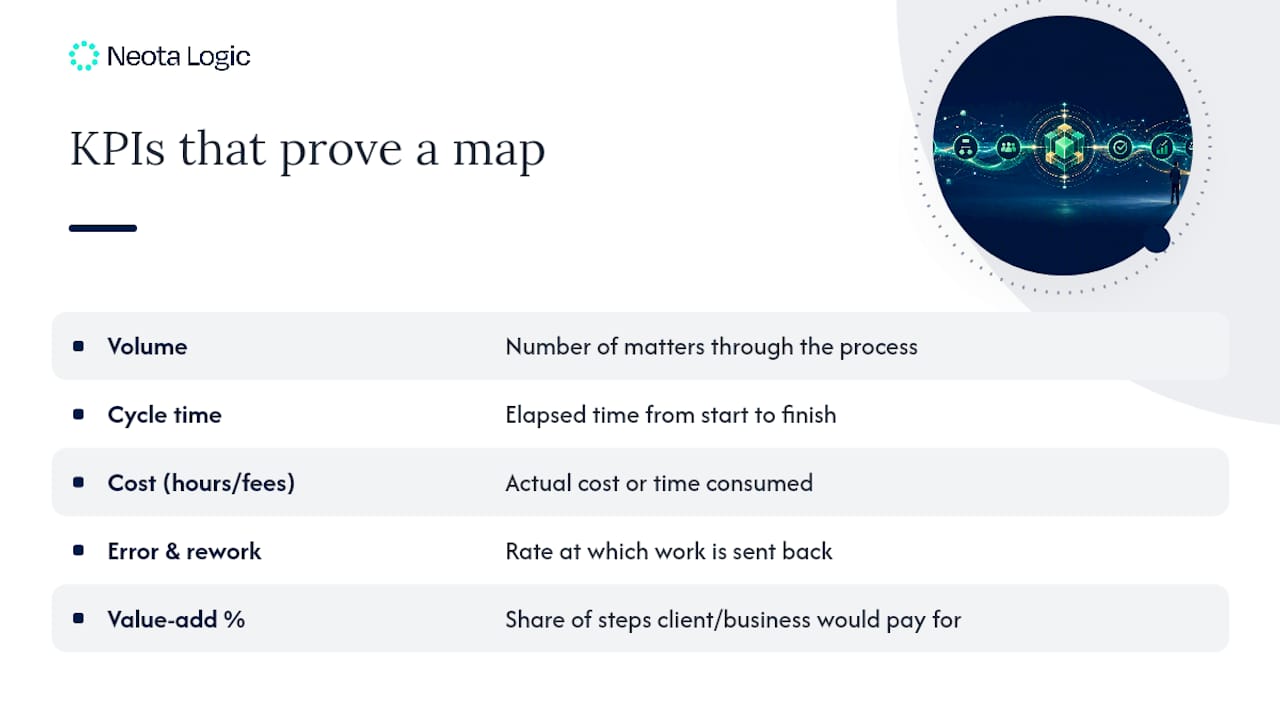
Attaching KPIs like volume, cost, cycle time, error rates, and process effectiveness to a map is what separates a diagnostic document from a wall poster. Without it, every improvement conversation is a debate about impressions rather than a decision grounded in data.
Gather the data three ways, in ascending order of effort: manual sampling of a handful of recent matters, exported logs from your case management or contract system, and, where digital event logs already exist, process mining. Process mining works only when the underlying system captures reliable timestamps and status changes, and it adds real value once those logs exist, but it is not a starting point. Start with sampling.
A map plus three or four honest KPIs is usually enough to rank which bottleneck to fix first. That ranking, not intuition about “where things feel slow,” should drive your pilot selection.
What Tools and Deliverables Should You Produce?
Notation choice should match the stakes, not your team’s appetite for complexity. Simple flowcharts work for linear approval chains. Swimlane diagrams earn their place the moment a process crosses more than two roles, because swimlanes make cross-role handoffs visible in a way a single-lane flowchart cannot. Full BPMN notation is worth the overhead only when a process is complex enough, or regulated enough, that a compliance or audit function needs formal notation as a reference standard.
On tooling, resist the instinct to buy a BPM suite before you have proven the map is worth automating. Start with low-friction diagramming tools and a fast pilot before escalating to process-mining or enterprise BPM platforms.
Whatever notation you choose, plan to hand stakeholders four deliverables:
What Mistakes Derail Legal Process Mapping Projects?
Most mapping projects don’t fail from lack of effort. They fail from a handful of predictable mistakes, repeated across departments.
Mapping in excessive detail is the most common one. Teams try to capture every micro-decision and end up with a diagram nobody can read or maintain. Excluding fee earners from the drafting sessions is the second: a map built entirely by process consultants or ops staff, without the people doing the work, gets the sequence wrong and the resistance high. Mapping without any data turns the exercise into guesswork dressed up as analysis. And skipping governance, no version control, no sign-off record, no audit trail, means the map decays the moment someone changes the process without telling anyone.
The fixes are just as concrete:
Pro Tip: If a mapping session runs past ninety minutes without a decision point being resolved, stop and split it. Fatigue produces bad maps just as reliably as inexperience does.
How Does Governed Automation Operationalize a Mapped Process?
A finished map is a diagnosis. It is not a workflow. The gap between the two is where most legal automation projects quietly stall, because a map tells you what should happen, but nothing enforces that it does happen, or that anyone can prove it happened six months later.
Governed automation closes that gap. Before you connect any AI model or automation layer to a mapped process, require three things from the platform: audit trails for every action, versioning so you can see exactly what changed and when, and explainability so a triage or routing decision can be reconstructed for a regulator, a client, or an internal review. Governance is what separates infrastructure from a point tool.
Neota Logic’s workflow platform is built around this principle. Governed orchestration removes the handoffs a map exposes as pure waste, applies your decision logic consistently instead of leaving it to individual judgment, and logs every step for audit. Because Neota Logic supports multiple AI models under one governance layer, teams using it for intake and triage avoid vendor lock-in while still enforcing the same acceptance criteria your mapping project defined.
Why Does Process Mapping Matter for Compliance and Risk?
Compliance teams cannot manage a risk they cannot see. Legal process mapping makes the invisible parts of a workflow, the ones auditors and regulators ask about, visible and provable.
Consider AML screening, contract approval authority, or privileged document handling. Each has a control point that exists on paper in a policy document, but a process map shows whether that control point is actually enforced in practice, by whom, and under what conditions it gets bypassed under deadline pressure. That gap between documented policy and actual practice is exactly where malpractice exposure and regulatory findings originate.
A map also creates a defensible record. When a regulator or auditor asks how a decision was made, “we followed our documented process, and here is the map, the decision points, and the sign-off history” is a fundamentally stronger position than reconstructing an explanation after the fact. This is where mapping and governance intersect directly: a process map without an enforced, logged execution layer behind it is a policy document, not a control.

Risk management teams should treat process mapping as a prerequisite for any AI adoption decision, not an afterthought. Before any automated decision logic touches a compliance-sensitive workflow, the map needs to identify every decision point that requires human sign-off, every artifact that needs retention, and every handoff that needs a timestamp. Skipping this step and automating first is how legal departments end up with efficient processes they cannot explain to a regulator.
How Should Legal Process Maps Connect to Existing Legal Technology?
A process map that lives in isolation from your contract management system, e-discovery platform, or case management tool has a short useful life. The value compounds when the map becomes the blueprint for how those systems actually connect.
Contract lifecycle management is the clearest example. A map of your contract review process should show exactly where the contract management system hands work to outside counsel, where redlines return, and where final execution triggers downstream obligations tracking. Without that map, integration decisions get made by whichever vendor is easiest to configure, not by what the workflow actually requires.
E-discovery workflows benefit the same way. Mapping the intake-to-production sequence exposes where legal hold notices, custodian interviews, and review platform handoffs create duplicate work or gaps in chain of custody. Legal teams that map before they integrate tend to catch these gaps before a court does.
The practical sequence is: map first, then integrate. Mapping tells you which system should own which step and where data needs to flow automatically instead of through manual re-entry. A pilot-first approach to workflow automation applies directly here: prove the mapped workflow works with a small, governed pilot before wiring it into your full technology stack. Trying to integrate systems around a process nobody has mapped is how legal departments end up with expensive software that automates the wrong steps.
How Do You Get Stakeholder Buy-In During Mapping?
Mapping sessions fail socially before they fail technically. If the people who do the work feel mapped rather than consulted, the resulting document gets quiet resistance instead of adoption.
Start by naming who needs a seat at the table before you schedule a single workshop: the fee earners actually doing the work, a business stakeholder who receives the output, and someone from compliance or risk if the process touches a regulated area. Skipping any of these creates blind spots that surface only after the map is declared final.
Frame the first session around discovery, not correction. Asking “walk me through what actually happens” produces more honest answers than asking people to validate a process someone else already drew. Engaging fee earners directly in the mapping exercise is what makes maps translate into real practice change instead of getting filed away.
Keep validation workshops short and specific. A thirty-minute session focused on one sub-process gets more honest engagement than a ninety-minute session trying to cover an entire matter lifecycle. Circulate the draft map beforehand so participants arrive ready to correct specifics rather than absorb the whole diagram cold.
Close every mapping phase with a visible decision. When stakeholders see their input change something concrete, whether that’s a step removed or a handoff eliminated, they treat the next round of mapping as worth their time. When their input visibly disappears into a document nobody acts on, engagement collapses on the next project.
How Often Should You Update a Legal Process Map?
A process map is a snapshot, and snapshots age. The question is not whether to update one, but how to build updating into the workflow instead of treating it as a separate project every few years.
Set a review trigger tied to events, not just a calendar date. A regulatory change, a new matter type crossing a volume threshold, a system migration, or a repeated spike in rework rate should each trigger a targeted review of the relevant map section, not a full remapping exercise. Calendar-only reviews, once a year regardless of what changed, tend to miss the maps that actually need attention sooner.
Version control matters as much here as it does in the initial mapping project. Every update needs a record of what changed, who approved it, and why, the same acceptance criteria and audit trail discipline from the original mapping phase. A map that changes without a logged reason becomes unreliable exactly when you need to explain a decision to a regulator or an internal audit.
Assign explicit ownership. A map with no named owner drifts out of date quietly, because nobody notices until the documented process and the actual process have diverged enough to cause a visible problem. Legal operations or a process owner should hold that responsibility permanently, not as a side task during the initial rollout.
The KPIs you attached during the original mapping exercise double as your early warning system. A creeping cycle time or rising error rate on a process you mapped eighteen months ago is the signal that it’s time to revisit the map, before the gap between documented and actual practice becomes a liability.
What This Means for How You Should Actually Run This
The conventional advice on legal process mapping treats it as a one-time documentation exercise: draw the map, present it, move on. That advice undersells what mapping is actually for. A map with no KPIs attached is a picture. A map with no governance path is a dead end, because it describes a process nobody can prove is being followed six months later.
The judgment this topic actually supports is narrower and more useful: map fast, attach real numbers immediately, and treat the map as the design document for a governed workflow, not the finished product. Teams that skip the KPI step end up debating impressions instead of evidence. Teams that skip governance end up automating a process they cannot explain to a regulator when it matters.
Prioritize two things first. Get fee earners into the drafting sessions, because a map built without them gets the sequence wrong. Then attach three or four honest metrics before you touch any automation decision. Everything else, notation choice, tooling, BPM versus flowcharts, matters far less than those two disciplines.
See How Mapped Processes Become Governed Workflows
Neota Logic is the operational path from a finished process map to a governed, auditable workflow, without the manual handoffs your mapping project just exposed as waste. Where a spreadsheet or diagram tool stops at documentation, Neota Logic takes the decision points and handoffs you mapped and turns them into enforced logic, with audit trails and version history built in from the first workflow you build.
A demo walks through the full sequence: how a mapped intake or triage process gets built as a governed workflow, how decision logic gets applied consistently across every matter instead of varying by who’s handling it, and how every action gets logged for audit. You bring the map. See exactly how it becomes infrastructure your compliance team can stand behind. Request a walkthrough of the Neota Logic platform to see your own mapped process running under governance.
Sources
FAQ
What is an example of legal process mapping?
A contract review batch is a common example: mapping shows every step from intake through redline, approval, and execution, often revealing that routing and approval waits consume more time than the substantive legal review itself.
What are L1, L2, and L3 process mapping levels?
L1 maps the high-level end-to-end process (intake to close), L2 breaks that into major sub-processes (review, negotiation, execution), and L3 documents the detailed step-by-step actions and decision points within each sub-process.
What should be included in a legal process map?
A complete process map shows the actors involved, the sequential steps, the decision points where the workflow branches, and the artifacts or documents produced at each handoff.
What tools do legal teams use for process mapping?
Most teams start with low-friction flowchart or swimlane diagramming tools, then escalate to process mining or governed automation platforms like Neota Logic once a pilot proves the process is worth systematizing.
How is legal process mapping different from legal workflow automation?
Process mapping documents and analyzes how work currently flows and where it should change; workflow automation, particularly governed automation, executes that improved process consistently and logs every step for audit.
Recommended
Ready to make your AI workflows defensible?
Book a demo and we'll walk one of your real processes through Neota.
Book demo