A defensible legal AI policy names an owner, publishes an approved-tools list with tiers, requires mandatory human sign-off before any AI-assisted work leaves the building, and documents vendor diligence, client disclosure, and audit logs. Anchor it to ABA Formal Opinion 512 and the EU AI Act if your firm touches EU-regulated matters. Everything else is implementation detail.
Table of Contents
Why Your Firm Needs A Written AI Policy Now
Bar regulators stopped treating AI as optional guidance. ABA Formal Opinion 512 tells lawyers they must supervise and verify AI-assisted work and remain personally responsible for the final output, full stop. Courts have already sanctioned lawyers who filed briefs with fabricated citations, and the New York City Bar Association’s policy paper points to cases like Mata v. Avianca and Wadsworth v. Walmart as proof that existing Model Rules on competence, confidentiality, and candor already apply to AI use. No new rulebook required. Just enforcement.
Malpractice carriers noticed too. Renewal applications increasingly ask whether the firm has a written AI use policy, and a blank answer reads as a red flag.
A blanket ban does not solve this. Prohibition pushes associates toward unmonitored consumer chatbots on personal devices, which is worse than sanctioned, logged use. State bar guidance increasingly favors governance over prohibition because shadow AI creates the exact confidentiality and verification risks a policy is supposed to prevent.
A short, enforceable policy beats a long aspirational one. What it needs:
The Ten-Section Legal AI Policy Framework
A ten-section structure gives carriers, bar reviewers, and your own partners something they can actually audit. Build it lean. Skip the philosophy.
Pro Tip: Write each section as a rule a non-lawyer administrator could enforce. If a paralegal can’t tell from the text whether a tool is approved, the section has failed its job.
How To Operationalize The Policy Beyond The Document
A policy that lives in a PDF changes nothing. Standing it up requires structure.
Form a cross-functional AI governance committee spanning legal, IT, risk, and at least one practicing attorney with veto power on new tools. Give it a charter that states decision rights explicitly: who can approve a pilot, who can kill one, and how fast an emergency ban can take effect.
Build an AI inventory before you write another policy clause. Most firms discover embedded AI already running inside document management, e-discovery, and billing platforms they never formally vetted. Governance guidance from board-and-risk advisory sources treats this inventory as the starting point for any credible program, not an afterthought.
Classify every entry by risk tier, borrowing the EU AI Act’s structure even for firms outside the EU: unacceptable, high-risk, limited-risk, minimal-risk.
Skip the delegated path and every request bottlenecks at committee, which guarantees shadow AI within a quarter.
Daily Controls That Turn Policy Into Audit Evidence
A policy statement means nothing to a carrier or a bar investigator without records behind it. Build the record-keeping into daily workflow, not into an annual compliance exercise.
Your approved-tools record needs specific fields: deployment model (firm-hosted, private tenant, multi-tenant), data retention period, and whatever SOC 2 or ISO 27001 evidence the vendor can produce. Multi-tenant tools with vague retention terms belong in a higher review tier automatically.
Prompt and output logging matters more than most firms assume. Version every AI-assisted draft, attach reviewer notes to each revision, and timestamp when a human, not the model, approved the final language.
Human-in-loop checkpoints need a clear rule: a licensed attorney with subject-matter familiarity in that practice area must sign off before AI-assisted work reaches a client or a filing. A paralegal skim does not satisfy this. ABA guidance frames verification as a repeatable checklist, not a one-time judgment call, and firms that treat it that way generate the audit trail carriers now expect at renewal.
Client Disclosure And Billing For AI-Assisted Work
Most clients don’t need a paragraph explaining AI to them. They need a clear default and an easy way to ask more.
A workable engagement-letter clause states plainly that the firm may use approved AI tools under attorney supervision for drafting and research support, with all substantive output reviewed by counsel before use. Affirmative, itemized consent becomes necessary when AI materially shapes strategy, touches sensitive personal data, or when a client contract specifically requires disclosure of automated tools.
Disclosure obligations tie directly to competence and candor duties. If a client asks whether AI touched their matter, the honest answer needs to already be documented, not improvised.
Vendor Due Diligence Before Any Tool Reaches Your Approved List
Procurement is where privilege risk actually gets created or avoided. An eight-question checklist catches most of it before signature.
Seek contractual language on non-training data use, audit rights, capped retention, and indemnification for data breaches. A vendor that won’t commit any of these to writing has told you the answer.
Pro Tip: Treat “we don’t train on customer data” as a claim to verify in the contract, not a marketing line to accept on faith.
Training, Competence, And Verification Standards
Every attorney and paralegal using an approved tool needs baseline training before access, not after a mistake surfaces. Recertify whenever the firm adds a materially different tool or workflow, not just annually on autopilot.
Give supervising attorneys a fixed verification checklist: confirm every citation independently, verify factual claims against primary sources, and check that no client-confidential detail leaked into a prompt sent to an external tool. Courts have sanctioned attorneys for skipping exactly this step.
Keep training completion and verification logs in the same system as your approved-tools record. If a malpractice claim ever surfaces, this record is what demonstrates the firm didn’t just have a policy. It enforced one.
What To Do When AI Output Causes An Error Or Breach
Contain first. Pull the affected work product, identify every matter it touched, and notify the supervising partner and the policy owner within hours, not days.
Set a clear notification threshold: any incident touching client confidential data or filed work product triggers a client notice, drafted with input from risk counsel rather than improvised by the attorney involved.
Audit this record quarterly. Carriers and regulators will ask for it eventually.
Keeping The Policy Current As Rules And Tools Change
Review the full policy twice a year at minimum, but don’t wait for the calendar when a trigger event hits: a new bar opinion, a sanctions ruling, a vendor changing its data-training terms, or an incident inside your own firm.
Maintain a change log documenting every amendment, its date, and the reason. Name one policy owner with standing authority to adopt emergency changes, like pulling a tool from the approved list overnight, without waiting for a full committee vote.
How Governed Workflows Turn Policy Into Enforced Process
A written policy is only as strong as the system enforcing it. Governed workflow platforms convert policy language into structural controls: every request routes through classification, every AI-assisted step requires a documented human checkpoint, and every action leaves a timestamped record.
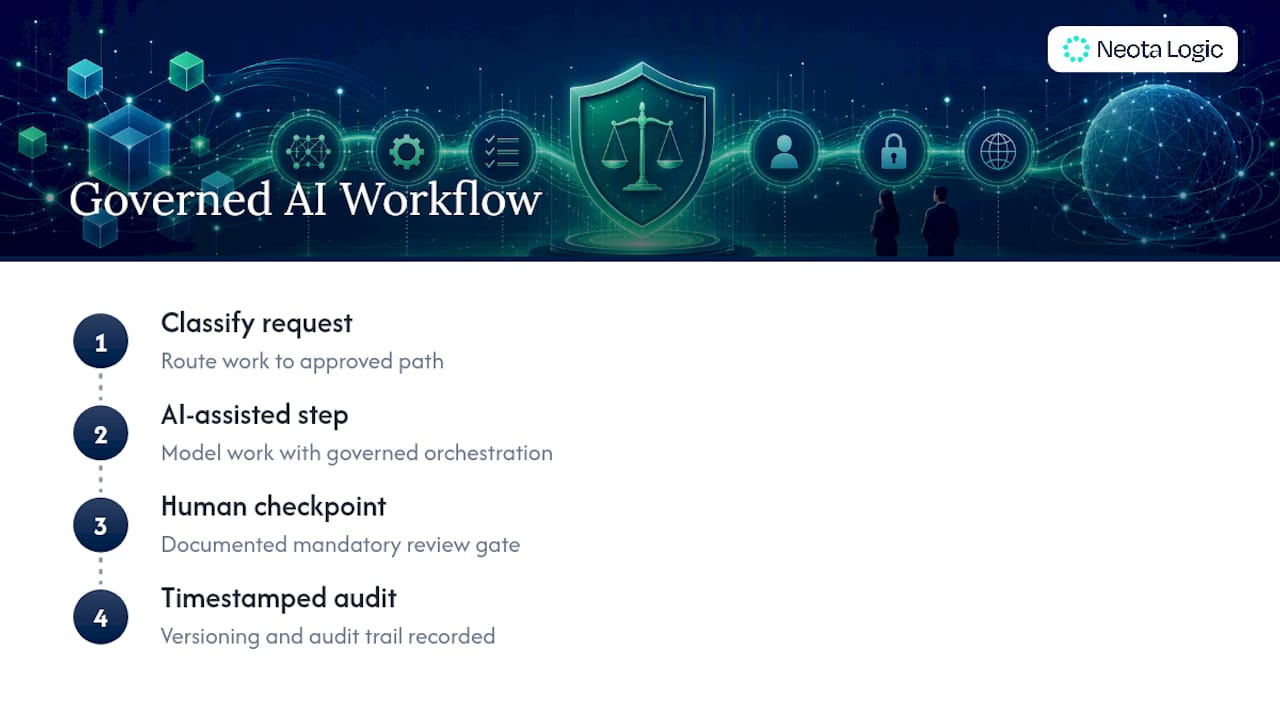
That’s the gap most firms hit after drafting a policy. The document says “mandatory review.” Nothing in the firm’s tech stack actually blocks output from reaching a client without it. Platforms built for governed AI orchestration close that gap by enforcing review gates, not just describing them. Versioning and audit trails give carriers and regulators exactly the evidence Section 5 above asks you to produce, without a manual logging burden on already-stretched associates.
Multi-model orchestration matters here too. A firm locked into one vendor’s model has no fallback when that vendor changes its data-training terms or gets acquired. Governed intake and routing also solve the shadow AI problem directly: work gets classified and directed to an approved path before an associate ever considers opening a personal chatbot account. Firms building toward this typically move from inventory, to a scoped pilot, to broader rollout, never straight to firm-wide deployment.
Ethical Considerations In AI Usage Within Legal Practice
Competence, confidentiality, and candor don’t get suspended because a machine drafted the first pass. ABA Formal Opinion 512 makes that explicit: the duty of competence now includes understanding the AI tools you deploy well enough to spot their failure modes, not just their capabilities.
Confidentiality risk shows up the moment a lawyer pastes client facts into a public tool with no data-use guarantee. That single act can waive privilege depending on the tool’s terms, and privilege doesn’t come back with an apology. Every prompt containing client information deserves the same scrutiny as an email to opposing counsel.
Candor toward tribunals means an attorney cannot file AI-drafted content without independently verifying every citation and factual claim. The sanctioned cases referenced earlier all trace back to skipping this one step. Fairness to opposing parties also enters here: using AI to generate volume that overwhelms a smaller opposing counsel raises questions courts have started asking out loud.
None of this argues against AI use. It argues against unsupervised AI use. A firm that builds verification into the workflow, rather than trusting individual diligence, removes the ethical exposure at its source instead of hoping every attorney remembers the rule on a busy Friday.
How AI Policy Shapes Liability And Malpractice Exposure
A written, enforced AI policy changes a malpractice claim’s shape entirely. Without one, a firm defending an AI-related error has to prove reasonable care case by case, with no institutional standard to point to. With one, the firm can show a documented process: an approved tool, a required review step, and a signed-off reviewer.
That documentation doesn’t eliminate liability. A lawyer who skips the mandatory review step is still exposed, arguably more so, because the policy proves the firm knew the standard and someone ignored it. But a policy with enforced logging turns “we had no idea this could happen” into “here is exactly what went wrong and who missed the check,” which is a fundamentally different conversation with a carrier.
Insurers are already pricing this. Firms answering “no” to a written AI policy question on a renewal application face harder underwriting conversations, and that trend will only sharpen as more claims tied to AI-assisted work work their way through the courts. A policy without enforcement mechanisms behind it offers weaker protection than one with logged, timestamped human review, because a document alone proves intent, not compliance.
The liability calculus also shifts for supervising partners specifically. Formal Opinion 512’s supervision language means a partner who assigns AI-heavy work without confirming a review process exists carries personal exposure, not just firm-level exposure.
Data Bias And Fairness In AI Applications
Bias in legal AI output isn’t a hypothetical fairness concern. It’s a specific risk to case strategy and client outcomes. A model trained predominantly on published appellate opinions, for instance, can skew toward outcomes and reasoning patterns that don’t reflect how a given trial court or jurisdiction actually rules.
This matters most in predictive and risk-scoring applications: litigation outcome prediction, settlement valuation tools, and any system informing decisions about who gets represented or how aggressively. A biased training set can quietly compound existing disparities in outcomes for underrepresented parties, and the lawyer relying on the tool’s output may never see the skew directly.
Mitigation starts with asking vendors a direct question during due diligence: what data trained this model, and has anyone tested it for demographic or jurisdictional skew? A vendor without an answer hasn’t necessarily done something wrong, but it also hasn’t done the work to know.
Practically, this argues for keeping high-stakes, outcome-affecting AI applications in a higher risk tier requiring more supervision, not less. A drafting assistant generating a first pass at a contract clause carries far less fairness exposure than a tool scoring settlement value or flagging case strength. Tier your approved-tools list accordingly, and route the second category through mandatory secondary review regardless of how confident the tool appears.
Integrating AI Policy With Cybersecurity Measures
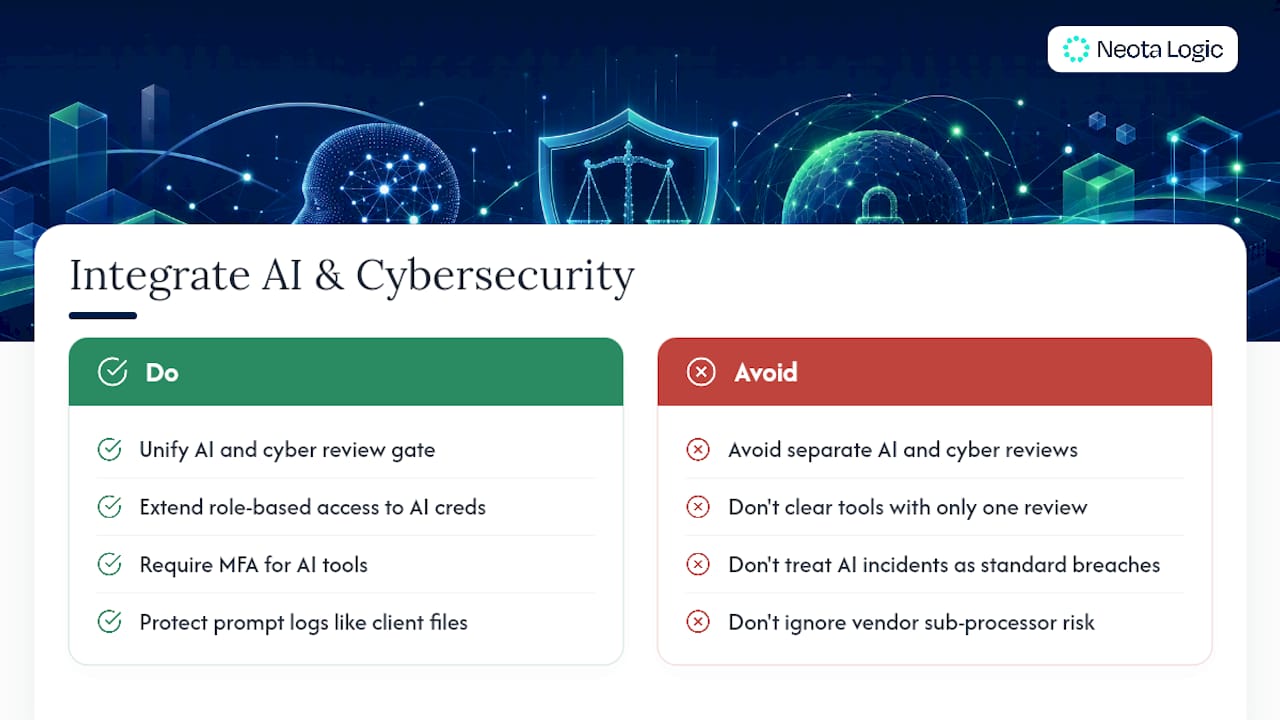
AI policy and cybersecurity policy can’t run as separate documents anymore. Every AI tool touching client data is also a new attack surface, a new data path, and a new set of access credentials someone has to manage.
Your vendor due diligence checklist and your information security policy should share the same review gate. A tool cleared by IT security but never reviewed for AI-specific risk, or vice versa, creates exactly the kind of gap attackers and plaintiffs’ counsel both look for.
Specific integration points matter more than general alignment. Access controls need to extend to AI tool credentials the same way they cover document management systems: role-based permissions, mandatory multi-factor authentication, and prompt logs that are as protected as email archives. Retention policies for AI interaction logs should follow the same encryption and access-control standard as the underlying client files, since a prompt log can contain the same confidential detail as the document it references.
Incident response plans need an AI-specific branch. A traditional breach playbook assumes a network intrusion or lost device. An AI-related incident might instead be a prompt leak, a vendor sub-processor breach, or a model output containing another client’s information due to a data-segregation failure on the vendor’s side. Firms that treat these as the same incident type will misdiagnose the containment steps and miss the right people to notify internally.
Transparency And Explainability Requirements For AI Tools
A lawyer cannot supervise what they cannot explain. That’s the practical core of explainability in a legal context, and it’s stricter than the general AI ethics conversation because a court may eventually ask a lawyer to justify a strategic decision informed by a tool’s output.
Transparency starts with the vendor relationship: does the tool disclose, even at a high level, what data informed a given output and what confidence the system assigns to it? Tools that function as a complete black box, with no visibility into reasoning or source material, belong in a higher scrutiny tier, particularly for anything touching legal analysis rather than pure formatting or scheduling.
Internally, explainability means the firm’s own audit trail needs to capture not just that a human reviewed AI output, but what that review actually checked. A reviewer sign-off with no notes attached proves far less than one documenting which citations were verified and which factual claims were checked against a primary source.
Regulatory pressure is moving this from best practice to requirement. The EU AI Act’s transparency obligations apply directly to firms using high-risk AI systems in EU-connected matters, and require documentation of how a system reaches its output. Firms operating internationally should build explainability documentation into their standard workflow now, rather than reconstructing it under deadline pressure when a regulator or opposing counsel asks the question first.
Quick Priorities If You’re Starting This Week
Name a policy owner today, publish a one-page approved-tools list, and require mandatory attorney sign-off on any AI-assisted client work immediately. Everything else can follow.
Run a two-week inventory and triage sprint before finalizing your tools table. You’ll find more embedded AI than you expect. Schedule baseline training within thirty days and draft a one-page incident decision tree before you need it, not after.
See How Neota Logic Maps Directly To Your Policy Sections
Neota Logic is built for exactly the controls this framework requires. Not a chatbot bolted onto your intranet. Governed AI infrastructure that turns approved-tools tracking, mandatory human review, and vendor orchestration into enforced workflow, not policy language sitting in a drawer.
Every request routes through classification before a model touches it. Every review gate logs who signed off and when. Every model call generates a timestamped audit trail your carrier can review at renewal without a scramble. Multi-model orchestration means your firm isn’t locked into one vendor’s terms or one vendor’s training practices, which matters more every time a vendor updates its data-use policy without warning.
Read the Beyond Efficiency blueprint for how governed workflows map to legal operations outcomes, then request a demo to see the audit trail and review gates in action against your own approved-tools list.
Sources
Start with ABA Formal Opinion 512 for supervision duties, the EU AI Act text for risk tiers, and the NYC Bar policy paper for sanctioned-case analysis. A carrier-aligned policy template speeds up drafting.
FAQ
What Is The 30% Rule In AI?
There’s no single recognized “30% rule” in legal AI governance. If you’ve seen the term, it likely refers to informal internal guidance capping AI-drafted content in a work product; treat it as firm-specific practice, not an established ethics standard.
What Is The Legal Policy For Law Firms Using AI?
A defensible policy names an owner, publishes an approved-tools list, mandates human review before any client-facing use, and documents vendor diligence, client disclosure, all anchored to guidance like ABA Formal Opinion 512.
Is Law Going To Get Taken Over By AI?
No. AI accelerates drafting and research, but ABA guidance requires a licensed attorney to supervise and remain responsible for every AI-assisted output, which keeps judgment and accountability squarely with lawyers.
Does AI Have Any Legal Restrictions?
Yes. The EU AI Act imposes risk-based obligations including transparency and documentation for high-risk systems, and existing legal ethics rules on confidentiality, competence, and candor already govern how lawyers can use AI tools.
Does A Governed Workflow Platform Replace My Firm’s AI Policy?
No. A written policy sets the rules; a governed platform like Neota Logic enforces them through audit trails, versioning, and mandatory review gates, turning policy language into a process your firm can actually prove.
Recommended
Ready to make your AI workflows defensible?
Book a demo and we'll walk one of your real processes through Neota.
Book demo