We recommend a governed AI-enabled knowledge layer, not a standalone chatbot, as the foundation for legal knowledge management. The main payoff is faster, context-aware answers with less rework; the main risk is hallucination and confidentiality exposure if sources go ungoverned. Start this week: inventory your knowledge sources, tier them by risk, and define governance controls before connecting any model.
TL;DR:
- Stanford found legal RAG tools hallucinate in 17% to 33% of cases; lawyers must verify outputs before client use or filing.
- Use vector search for broad topical questions and knowledge graphs for citation hierarchies and entity links; legal deployments often combine both.
- Plan a nine month rollout: inventory controls first, pilot one practice area in months three to five, then expand after measuring errors and time saved.
- Tie access to matter sensitivity, record model versions and data sources, and maintain an incident plan; application level login controls alone are insufficient.
- Track research time saved and first pass acceptance alongside audited outputs, confidentiality incidents, retrieval precision, and model provenance coverage, using lawyer feedback to locate gaps.
Table of Contents
- What does AI-integrated legal knowledge management actually look like?
- Core components: retrieval, indexing, metadata, and governance controls
- Risks, ethics, and regulatory expectations legal KM leaders must manage
- Integration and tech choices: where legal KM plugs into the firm stack
- Practical 6 to 9 month implementation roadmap for legal KM leaders
- Measuring success: KPIs and controls legal teams should track
- Neota Logic perspective: governed AI infrastructure for legal teams
- Training and change management strategies for legal professionals using AI tools
- Author perspective: prioritized call to action for GC and legal ops leaders
- How Neota Logic helps: governed workflows, orchestration, and a discovery sprint
- FAQ
- Sources
What does AI-integrated legal knowledge management actually look like?
A governed knowledge layer sits between your firm’s content and any AI model. It holds canonical matter records, client data, precedent documents, and enriched metadata that tells a system what a document is, who can see it, and how current it is. Without that layer, an AI tool is guessing at context instead of reasoning from it.
Retrieval-augmented generation (RAG) and knowledge graphs are the mechanisms that pull relevant material from this layer into a model’s working context at query time. They do not replace the knowledge layer; they consume it.
Vertical legal AI, built around legal taxonomies and citation structures, behaves differently from horizontal AI tools adapted for legal use. Legal context, jurisdiction, matter type, privilege status, determines what “correct” even means for a given answer.
- A knowledge layer organizes matter, client, and precedent data with structured metadata.
- RAG and knowledge graphs retrieve from that layer; they are not the knowledge management system itself.
- Vertical legal AI understands legal hierarchy and citation; horizontal tools often do not.
Core components: retrieval, indexing, metadata, and governance controls
Reliable legal AI output depends on four building blocks working together, not on model choice alone.
- Retrieval infrastructure: vector stores, index freshness, and chunking strategy determine what the model actually sees. Poor chunking of long case texts increases irrelevant retrievals and drives hallucination risk, while hierarchical topic-aware indexing improves grounding and citation traceability in legal corpora.
- Metadata and taxonomy: matter IDs, client sensitivity flags, jurisdiction tags, and canonical authorship let the system enforce access rules at the document level, not just the application level.
- Governance controls: scoped access, full audit trails, model-agnostic orchestration, and no-train defaults so client data never becomes training data for a third-party model.
Precision in retrieval is not a nice-to-have. When retrieval pulls the wrong clause or an outdated precedent, the model builds a fluent, confident answer on a bad foundation, and nothing downstream catches it without verification. We cover specific mitigation tactics in our guidance on legal AI hallucinations.
Pro Tip: Treat index freshness as a governance control, not an IT task: stale precedent data is a confidentiality-adjacent risk when it misleads a lawyer’s advice.
Risks, ethics, and regulatory expectations legal KM leaders must manage
Governance obligations are not abstract. ABA Formal Opinion 512 requires lawyers to maintain competence about the AI tools they use, protect client confidentiality, communicate appropriately with clients about AI use, and supervise outputs before relying on them. A knowledge management project that ignores these duties is building liability, not efficiency.
**Empirical evaluations show that leading proprietary legal AI research tools using retrieval-augmented generation hallucinate between 17% and 33% of the time, according to Stanford research on legal RAG systems. RAG reduces hallucination compared with ungrounded generation, but it does not eliminate it. That gap is the argument for mandatory human verification before any AI-assisted output reaches a client or a filing.
Concrete safeguards legal KM leaders should put in place:
- Informed consent practices when client matters involve AI-assisted drafting or research.
- Model provenance audits that log which model, version, and data sources produced a given output.
- Role-based access control tied to matter sensitivity, not just user login.
- An incident response plan for confidentiality or hallucination events.
We go deeper on operationalizing these duties in our governance framework for legal teams.
Integration and tech choices: where legal KM plugs into the firm stack
A knowledge layer only creates value when it connects to where lawyers already work. The integration points that matter most:
- Document management systems like iManage or SharePoint, where matter documents and precedent already live.
- Matter management and CRM systems that hold client relationship and billing context.
- Collaboration tools where lawyers draft, comment, and route approvals.
- Existing practice templates and clause libraries that should feed retrieval, not sit outside it.
Model-agnostic orchestration matters because it lets a firm route different tasks to different models, or switch providers, without rebuilding every integration. It also lets security teams apply on-prem or cloud controls selectively based on data sensitivity rather than accepting one vendor’s default posture.
On indexing choice: vector stores handle semantic similarity well for broad research questions; knowledge graphs handle structured relationships like citation hierarchy and entity links better. Most legal KM deployments end up hybrid, using graphs for authority and precedent structure and vector retrieval for broad topical search, an approach recent academic work on legal retrieval shows improves accuracy over either method alone.
Practical 6 to 9 month implementation roadmap for legal KM leaders
Rolling out governed legal AI works best as a gated sequence, not a single launch.
- Phase 0 (months 1 to 2): Alignment and inventory. Align legal ops, IT security, and risk on objectives. Inventory every knowledge source, tier each by sensitivity, and define baseline governance controls before any model connects to live data.
- Phase 1 (months 3 to 5): Limited-scope pilot. Deploy a pilot knowledge layer with RAG scoped to one practice area or document type. Require human verification on every output and instrument telemetry from day one.
- Phase 2 (months 6 to 9): Expand and formalize. Add integrations, expand model orchestration to additional use cases, automate routine workflows, and formalize audit procedures firm-wide.
Each phase needs a gate: Phase 0 does not end until governance controls are documented and signed off; Phase 1 does not end until verification error rates and research time savings are measured. Quick wins to track early include hours saved on first-draft research and template reuse rates across matters, both of which make the business case for Phase 2 funding. Our blueprint for building a high-performing legal function walks through sequencing this kind of rollout in more depth.
Pro Tip: Never skip the gate between Phase 0 and Phase 1 to save time. Ungoverned pilots create the confidentiality and hallucination incidents that end programs before they scale.

Measuring success: KPIs and controls legal teams should track
Two KPI categories matter, and neither works without the other.
- Operational KPIs: average research time saved, first-pass answer acceptance rate, and periodic precision and recall checks on retrieval output.
- Governance KPIs: number of AI outputs audited, confidentiality incidents involving client data, and coverage of model versioning and provenance logging.
- Combine lawyer satisfaction surveys with telemetry data so qualitative friction points inform where the knowledge layer needs better retrieval or metadata, not just more coverage.
Neota Logic perspective: governed AI infrastructure for legal teams
We build governed AI infrastructure for legal and compliance teams, not a point solution and not a chatbot. Governance is what differentiates our platform, not a feature list.
- Deterministic, governed workflows with full human oversight at every decision point.
- Complete audit trails and versioning so every AI-assisted action is reviewable after the fact.
- Model-agnostic orchestration that prevents vendor lock-in and lets firms apply controls selectively.
- No-code workflow automation that routes legal requests and applies decision logic without custom engineering.
These capabilities map directly to the roadmap above: audit trails satisfy supervision duties under ABA Formal Opinion 512, and model-agnostic orchestration supports the inventory and provenance practices the NIST AI Risk Management Framework recommends.
Training and change management strategies for legal professionals using AI tools
Technology rollout fails without a parallel change management plan. Lawyers trained in legal reasoning, not in evaluating AI output, need explicit instruction on what RAG systems do well and where they fail.
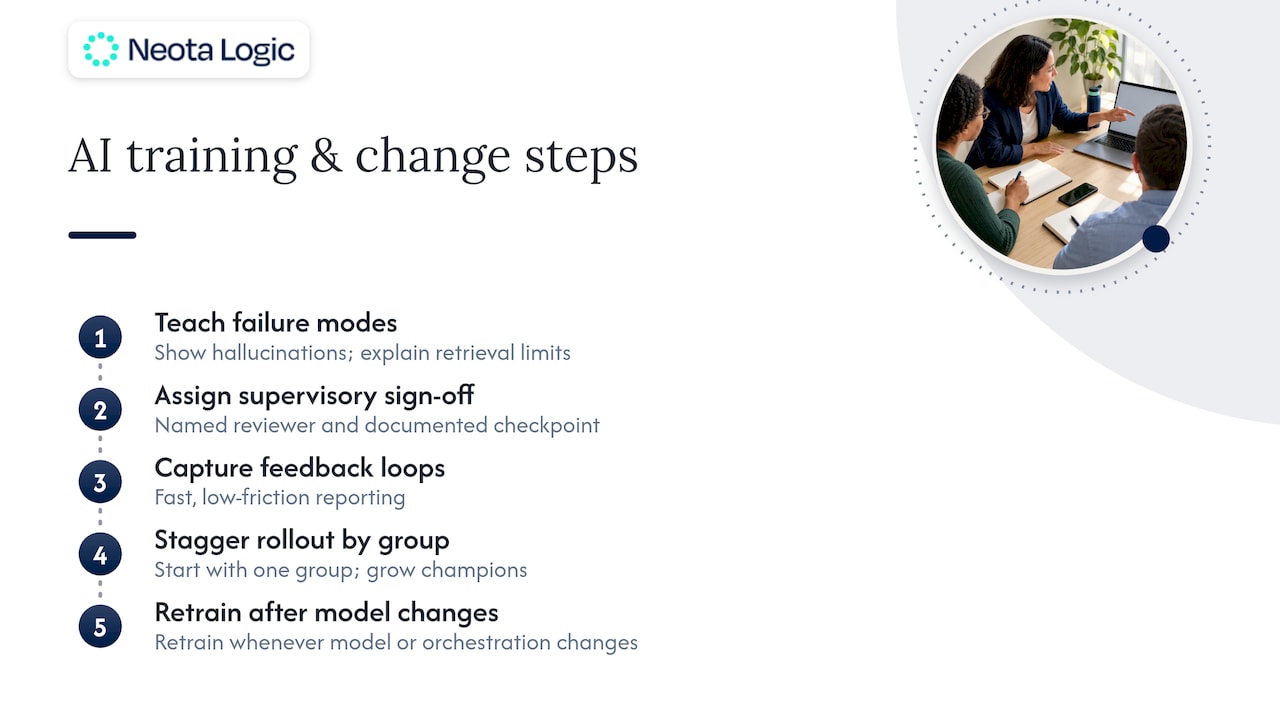
Start training with the failure modes, not the features. Show lawyers actual examples of hallucinated citations and explain why retrieval precision affects reliability. This builds the skepticism that catches errors before they reach a client.
Assign supervisory sign-off explicitly. ABA Formal Opinion 512 places the duty of supervision on the lawyer using the tool, so training should pair every AI-assisted workflow with a named reviewer and a documented checkpoint, not an informal “someone will check it.”
Build in feedback loops. Lawyers who flag a bad retrieval or a wrong citation should have a fast, low-friction way to report it, and that feedback should visibly improve the knowledge layer’s metadata or indexing over time. Silence after a reported error kills adoption faster than any technical flaw.
Stagger rollout by practice group rather than firm-wide. A single practice group that becomes fluent with governed AI tools, and can describe concrete time savings, becomes the internal advocate that makes the next group’s rollout easier. Firm-wide mandates without local champions tend to produce compliance theater instead of genuine adoption.
Finally, revisit training every time the underlying model or orchestration layer changes. A model upgrade can shift output behavior in ways that make last quarter’s training obsolete.
Author perspective: prioritized call to action for GC and legal ops leaders
Run the knowledge-source audit and governance sprint first. Get security, procurement, and legal ops sponsoring it together, not legal ops alone. Choose a measured pilot over a rip-and-replace rollout: smaller scope means faster signal and fewer governance gaps to clean up later.
— Patrick
How Neota Logic helps: governed workflows, orchestration, and a discovery sprint
We help legal and compliance teams turn the roadmap above into a working system instead of a slide deck. Our platform applies decision logic and audit trails to legal request intake and matter triage, and model-agnostic orchestration connects AI tools without locking you into one vendor.
A Discovery Sprint is the fastest way to find out where your governance gaps actually are before you commit to a build. Start with our Discovery Sprint and platform access details or review the full solutions overview to see which workflow fits your team first.
This article is general information, not a substitute for advice from a qualified lawyer. Consult a qualified legal professional about your own circumstances before acting on anything here.
FAQ
What is legal knowledge management?
Legal knowledge management is the practice of capturing, organizing, and making precedent, templates, and matter history reusable across a firm or legal department. When paired with AI, it becomes a structured knowledge layer that feeds context to retrieval and generation tools rather than letting them guess.
How is AI being used in knowledge management?
AI is used mainly through retrieval-augmented generation, which pulls relevant documents from a firm’s knowledge layer into a model’s context before it answers a question. This grounds answers in real precedent and policy rather than relying on a model’s general training alone.
Is there a legal version of ChatGPT?
Several vendors offer legal-specific AI research tools built on retrieval-augmented generation rather than general-purpose chat. Even these tools hallucinate at a notable rate according to Stanford research, so human verification remains necessary regardless of which tool a firm chooses.
What governance controls does Neota Logic provide?
Our platform provides deterministic, governed workflows with full audit trails, versioning, and model-agnostic orchestration, so every AI-assisted step remains reviewable and traceable. We built these controls specifically to meet the supervision and confidentiality duties legal teams face when adopting AI.
Sources
- Hallucination rates for legal RAG systems (Stanford research)
- ABA Formal Opinion 512 — generative AI tools and lawyer responsibilities
- NIST AI RMF cross-sectoral profile for generative AI
Recommended
Ready to make your AI workflows defensible?
Book a demo and we'll walk one of your real processes through Neota.
Book demo