An intake backlog in legal is not a staffing problem. It is a control problem. Requests arrive through email, chat, hallway conversations and forms, and no one governs how they are classified, routed or recorded. Hiring more people into that system gives you a bigger backlog with more people inside it. The fix is a governed intake layer: one front door, deterministic triage, human review where judgment is required, and a record of every action.
This guide is for general counsel and legal operations leaders. It does not explain AI. It explains how to stop the queue from growing, and how to do it in a way you can defend later.
TL;DR
- A backlog grows when requests enter through uncontrolled channels and are triaged by whoever sees them first.
- CLOC’s 2025 data shows 76% of legal departments still run intake manually and 85% face higher burnout risk.
- Clear the backlog in this order: one front door, classification rules, routing, automation of the routine tier, then reporting.
- Every automated step needs an audit trail, versioned logic and an explanation a regulator or court can follow.
- Speed without governance converts a backlog into a liability. Governance is what makes the speed safe.
Table of Contents
- What an intake backlog actually is
- Why the backlog is structural
- What the backlog costs beyond delay
- The 80/20 view of your queue
- A sequence for clearing the backlog
- Where AI helps and where it creates risk
- Audit trails are the part most teams underbuild
- Intake in private practice
- Our perspective
- How Neota Logic supports governed intake
- Measuring whether the backlog is really gone
- Common mistakes
- FAQ
- Sources
What an intake backlog actually is
A backlog is the gap between the rate requests arrive and the rate they are correctly resolved. Most teams measure only the second number. They count open tickets and call it the backlog.
That undercounts it. The real backlog includes:
- Unlogged requests. Anything sent to an individual lawyer’s inbox or a chat thread never enters the queue.
- Misclassified requests. A privileged question sits in a commercial queue. A simple NDA sits with a senior lawyer.
- Stalled requests. Waiting on a business answer, a missing document or an approval no one tracks.
- Reopened requests. Work that was closed without the facts needed to resolve it.
If you cannot count these four, you cannot size the problem. You also cannot prove to the CFO that you need resources, or prove to the board that the work is under control.
Why the backlog is structural
Demand is rising and the intake process has not changed. The CLOC State of the Industry report found continued growth in demand for legal services, with managing workload and internal bandwidth named as the top challenge. Its data shows 76% of legal departments still rely on manual processes for intake. It also shows 56% report being under-resourced and 85% face increased burnout risk from heavy workloads and intake bottlenecks.
Those figures describe a pattern we see repeatedly. The work is not hard. The routing is.
Three structural causes recur.
No single front door
When the business can reach legal five ways, it will use all five. Each channel has its own norms, its own owner and its own blind spots. A request in Slack has no required fields. A request by email has no SLA. A request by phone has no record.
Triage by availability
In most departments the person who sees the request first triages it. That person is often the most senior and the most overloaded. Triage becomes a tax on your most expensive talent, and the quality varies by who is on duty.
No decision logic written down
Every department has rules of thumb. Contracts under a threshold go to a template. Certain counterparties trigger a privacy review. Certain jurisdictions trigger local counsel. If those rules live in people’s heads, they cannot be applied consistently, audited or handed off.
What the backlog costs beyond delay
Delay is the visible cost. The less visible costs are larger.
- Business workarounds. Sales signs on its own paper. HR improvises a policy. Procurement skips the review. Each is a risk you did not see arrive.
- Privilege exposure. Requests that carry privileged facts travel through unmanaged channels. Privilege dies quietly when no one controls who sees what.
- Missed deadlines. A limitations date, a regulatory filing or a notice period sits unread in a shared inbox.
- Attrition. Lawyers who spend their day sorting mail leave. The burnout figure above is the early warning.
The same logic holds in private practice. Law firm intake failures tend to surface late, at document prep or at a filing deadline, not at the moment of intake. By then the cost has compounded.
The 80/20 view of your queue
Legal commentators often apply the 80/20 rule to case selection: a minority of matters drives most of the outcomes. Apply the same lens to a department queue. A small share of requests needs senior judgment. The rest is repeatable: standard NDAs, routine vendor questions, policy lookups, simple approvals.
Your job is to separate the two at the door. Route the judgment-heavy tier to the right lawyer with full context. Resolve the repeatable tier through governed workflows. Do not let the second tier consume the attention of the first.

A sequence for clearing the backlog
Order matters. Teams that start with a tool before they define the logic automate their confusion.
Step 1: Establish one front door
Pick a single intake channel and retire the others as entry points. Other channels can exist. They must redirect to the front door. A request that does not enter there does not exist for reporting purposes.
Require structured fields at submission: requester, business unit, request type, counterparty, deadline, amount at stake and whether the matter may be privileged. Fields that are optional will be left blank.
Step 2: Write the classification rules
Document how each request type is defined, who owns it and what the expected turnaround is. Keep the taxonomy short. Eight to twelve request types cover most departments. A taxonomy of sixty types will not be used.
Write the rules as decisions, not descriptions. If the contract value exceeds a stated amount, it goes to a named tier. If the counterparty is in a restricted jurisdiction, it triggers a compliance review. Rules like these can be executed the same way every time.
Step 3: Route by rule, not by availability
Once classified, a request is assigned by logic. Skills, workload, conflicts and escalation paths are inputs. The routing outcome is recorded with the reason it was chosen.
This is the point where deterministic logic matters. A probabilistic model that classifies a request differently on Tuesday than on Monday is not a triage system. It is a source of disputes.
Step 4: Automate the routine tier
Now automate. Standard agreements, routine approvals, policy answers and onboarding checks can run through governed workflows with no lawyer in the loop, provided a lawyer owns the logic and reviews exceptions.
AI can assist here. It can extract data from a submission, summarize a document or propose a classification. It does not decide. A defined rule or a named human decides, and the system records which.
Step 5: Instrument everything
Measure intake volume by type, time to triage, time to resolution, reopen rate, escalation rate and the share resolved without a lawyer. Review it monthly. Report it to the business quarterly.
This data does more than manage the queue. It justifies headcount, shows the board where risk concentrates and ends arguments about whether legal is a bottleneck.
Where AI helps and where it creates risk
AI can shorten triage. It can also create a new category of exposure if it runs outside governance. Consider what happens when a business unit pastes a privileged request into an unmanaged tool to get a faster answer. The privilege analysis becomes a problem. The output is not logged. No one can later say what the tool saw or why it answered as it did.
Lowenstein Sandler makes the structural point well. AI for legal is infrastructure, not a point solution, and the governance question is whether an organization can produce evidence tracing from board-level authorization to the runtime event. Policy adoption alone does not answer it. Fragmented logs do not answer it either.
There is a supervision dimension too. An IETF draft on legal AI evidence describes a structural evidence requirement: an attorney relying on AI assistance must be able to show, if challenged, that they supervised the tool and reviewed its output. Treat that as a design requirement for any intake automation. If your system cannot show who reviewed what, you cannot show supervision.
The governance test for intake automation
Before any automated intake step goes live, ask five questions.
- Audit trail. Does every classification, routing decision and approval produce a timestamped record?
- Versioning. Can you show which version of the logic ran on a given date?
- Explainability. Can you state, in plain terms, why a request went where it went?
- Human oversight. Is there a defined point where a named person reviews or overrides?
- Model independence. Can you swap the underlying AI model without rebuilding the workflow?
If any answer is no, the speed gain is borrowed against future risk.
Audit trails are the part most teams underbuild
Intake is where the record begins. A defensible file starts with who asked, what they asked, what the system did and who approved it. Skip that at the door and you rebuild it later from memory.
The discipline is familiar from other regulated fields. Compliance teams in anti-money-laundering work have long had to prove who did what, when and why for every decision. Legal departments adopting AI face the same expectation, and the same standard of record keeping applies.
A useful audit trail for intake has these properties:
- Complete. It captures the request, the classification, the routing, the human actions and the outcome.
- Immutable. Entries cannot be edited after the fact.
- Versioned. It links each action to the version of the rules and models in force.
- Retrievable. You can produce it for a matter in minutes, not weeks.
When outside counsel, a regulator or opposing counsel asks how a decision was made, the record answers. When it does not exist, the argument writes itself against you.
Intake in private practice
Law firms face a variant of the same problem. New matter requests, conflict checks and engagement paperwork stack up behind the same manual gatekeeping. The cost is not only delay. A conflict check run on incomplete information is a malpractice exposure, and a prospective client who waits too long goes elsewhere.
The human cost is real as well. Compensation data for intake roles shows non-attorney intake specialists typically earn $43,000 to $64,000 a year and intake attorneys $90,000 to $155,000 as of July 2026. Many firms are paying for skilled people to do sorting that rules can do. Redirect that talent to judgment work and let governed workflows handle the first pass.
For teams building the front end of the process, even a practical guide to lead intake workflows can help you think through capture fields and handoffs. Legal adds what generic guides omit: privilege, conflicts and a record that withstands scrutiny.
Our perspective
We see the same failure repeatedly. A department buys a chatbot or a ticketing tool, loads it with requests and calls the problem solved. Six months later the backlog is back, now with a new layer no one can explain.
The tool was never the issue. The missing piece was governance.
Neota Logic is governed AI infrastructure for legal and compliance teams. We are not a point solution and we are not a chatbot. Our position is that governance is the differentiator, not features. A feature can be copied in a quarter. A defensible record of every decision cannot be added after the fact.
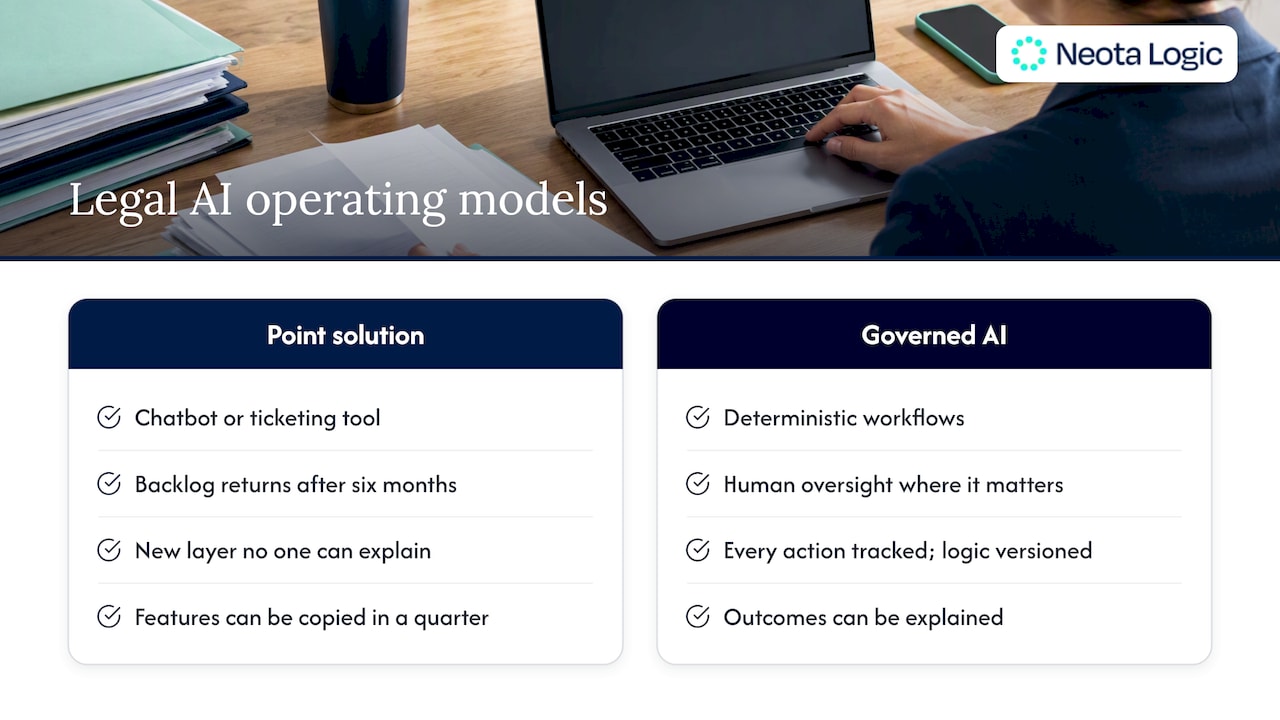
That is why we build around deterministic workflows, with human oversight at the points that matter. Legal experts define the logic. AI models support the work inside that logic. Every action is tracked, every version of the logic is preserved and every outcome can be explained. We work with multiple AI models so no department is locked to a single vendor, and the workflow survives when the model changes.
Our advice to a GC with a growing queue is direct. Do not start by asking which AI to buy. Start by asking what you would need to show a regulator, a court or your board about how a request was handled. Build backward from that answer. The intake layer then becomes the foundation for every other legal automation you add.
— Patrick
How Neota Logic supports governed intake
Neota Logic gives legal teams a single orchestration layer for request intake, matter triage, decision logic, document and contract automation, and AI governance, with audit trails and reporting built in. It connects to the document, CRM and communication tools you already run. You can see the full range of workflow and AI-enabled solutions or start a conversation with our team about a first intake use case.
Measuring whether the backlog is really gone
A cleared queue on one day proves little. Track these indicators for at least two quarters.
| Indicator | What it tells you |
|---|---|
| Time to triage | Whether the front door and routing rules work |
| Time to resolution by request type | Where capacity is actually constrained |
| Share resolved without a lawyer | How much of the routine tier is automated |
| Reopen rate | Whether intake captures the facts needed |
| Escalation rate | Whether classification rules are calibrated |
| Requests outside the front door | Whether shadow channels persist |
The last row is the one most teams skip. If lawyers still receive direct requests, the backlog is only hidden.
Common mistakes
- Automating before defining rules. You encode ambiguity at scale.
- Treating intake as an IT project. Legal owns the logic. IT supports it.
- Letting AI decide without a record. Output without an audit trail is not usable in a dispute.
- Skipping the business. If requesters find the front door harder than email, they will go back to email.
- Measuring only closed tickets. Unlogged and stalled work stays invisible.
FAQ
What causes an intake backlog in a legal department?
The cause is usually uncontrolled entry, not low effort. Requests arrive through many channels, get triaged by whoever sees them first and follow rules that exist only in people’s heads. Rising demand then turns that weak process into a queue.
How fast can a legal team reduce an intake backlog?
The first gains come from the front door and the classification rules, and those need discipline more than technology. Automating the routine tier follows once the logic is written and owned. Timing depends on how many request types you carry and how many channels you must retire.
Should AI triage legal requests on its own?
No. AI can extract, summarize and propose. A defined rule or a named human should decide, and the system should record which one did. That is how you keep supervision demonstrable if a decision is challenged.
What should an audit trail for legal intake include?
It should capture the request, the classification, the routing reason, every human review or override, the outcome and the version of the logic in force. Entries must be immutable and retrievable on demand. Anything less leaves gaps you will fill from memory.
Sources
Ready to make your AI workflows defensible?
Book a demo and we'll walk one of your real processes through Neota.
Book demo