Preserve matter-level context with governed, stage-based handoff workflows, not folders full of documents. The approach benefits GCs, legal ops leaders, and law firms who lose hours every week to reconstruction work. Pick one handoff. Map it. Run a pilot before you scale anything.
Neotalogic
Governed Legal Workflows, Built for Context
Neota Logic helps legal teams automate routine workflows while preserving human oversight, compliance, decision logic, and audit trails.
Table of Contents
Why Legal Handoffs Fail: The Knowledge-Leak Problem
Documents survive handoffs. Understanding does not. A file transferred from litigation to outside counsel carries the pleadings, the exhibits, the timeline. It rarely carries why a particular defense was abandoned, what materiality threshold governed a redaction call, or which assumption the whole strategy rests on. That gap is the real failure point in most legal handoff workflows.
Every handoff where systems store files but not the working understanding is a knowledge leak. The receiving lawyer has to rebuild the reasoning from scratch, and that reconstruction is where hours disappear.
Three failure modes show up constantly:
The operational cost compounds. Time-to-next-action stretches because the new owner has to ask clarifying questions before doing anything. Rework climbs because assumptions get re-litigated. Filings get inconsistent because two people working from partial context make different calls on the same fact pattern. None of this is a staffing problem. It is a design problem.
What an Effective Handoff Must Preserve
A handoff that actually works carries two categories of information: what happened, and why. Most legal workflow automation tools handle the first category. Almost none handle the second, and that is exactly where continuity breaks.
Explicit artifacts are the easy part:
Implicit reasoning is harder, and it is the part recipients actually need. An agent handoff protocol for AI-assisted legal research should preserve the identity of the task, the approved context package, and the trust rules governing what the next tool or person can rely on without re-verifying. Handoffs also need:
Skip the second category and every handoff becomes a reconstruction exercise.
Structure-First Design: Stages, Owners, Triggers, and Task Chains
Automating a broken process just makes the breakage faster. Design the structure before you automate anything.
Start with stages. A matter moves through discrete stages, intake, triage, assignment, drafting, review, filing, and each stage needs exactly one owner. Two owners means no owner. Most legal workflow automation tools handle isolated tasks well but don’t connect the stages and triggers that make a workflow actually function as a workflow rather than a set of unrelated scripts.
Here’s the design sequence that holds up in practice:
Pro Tip: Build the escalation rule before you build the happy path. Teams that design the exception process last end up debugging it in production, on a live matter, under deadline pressure.
Stage ownership and exception rules designed up front prevent brittle automations that quietly generate new work instead of removing it.
Pilot and Test: Scope, Trust Layers, QA, and Metrics
Don’t automate your whole intake process on day one. Pick one handoff, prove it works, then expand.
Track four numbers through the pilot:
Workflow automation of this kind reduces non-billable coordination work by automating intake, notifications, and deadline-driven tasks, but the metrics are what tell you whether continuity actually improved or whether you just moved the friction somewhere else.
Governance, Audit Trails, and Human Judgment
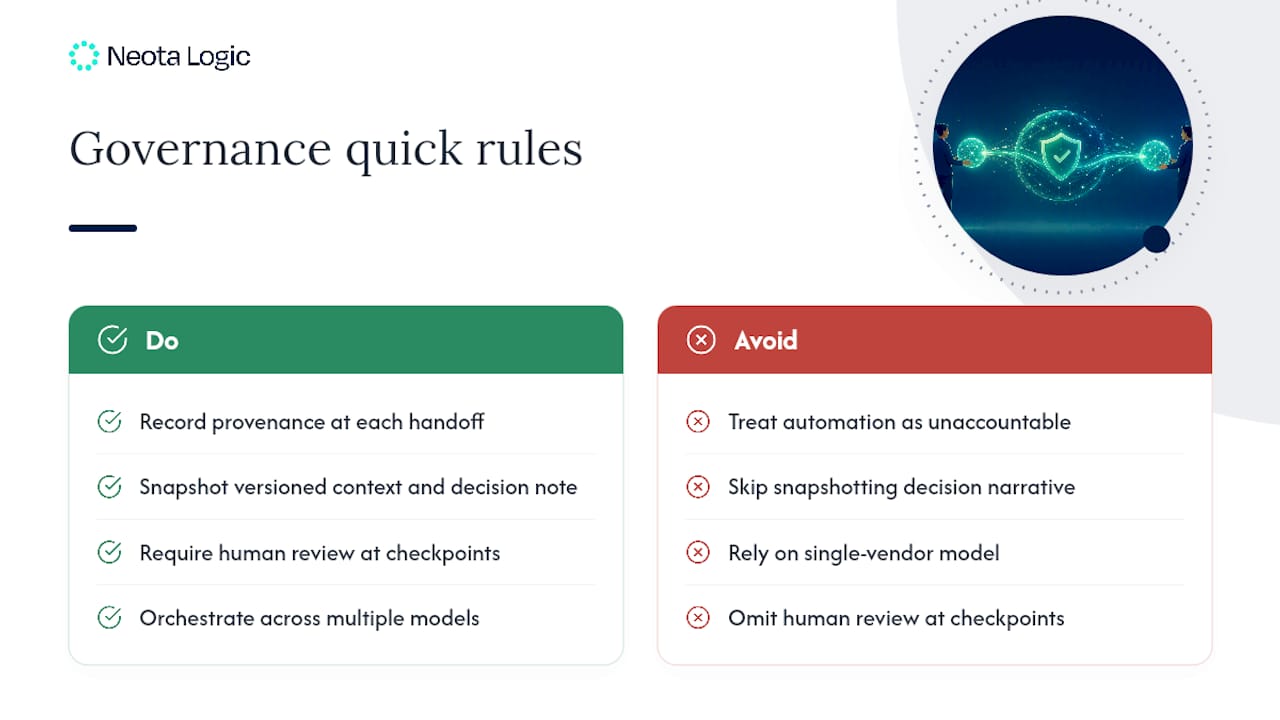
Automated does not mean unaccountable. Every governed handoff needs a provenance record: what context package moved, who or what produced it, and when.
Capture the snapshot at the moment of handoff, not after the fact. Versioning matters here. If a decision gets revisited six months later, a future reviewer needs to see how the earlier conclusion was reached, not just what the conclusion was. That explainability requirement is what separates a governed workflow from a black box with a nice interface.
Preserving implicit reasoning means snapshotting a short decision narrative attached to the context package, including materiality thresholds and the source of key judgments, so a future reviewer can reproduce the prior reasoning without starting over.
Human review stays mandatory at defined checkpoints: privilege calls, anything touching a materiality threshold, and any AI-generated output flagged above the pilot’s error-rate tolerance. That’s the judgment layer, and it doesn’t disappear just because a workflow runs faster.
Pro Tip: Build governance to work across multiple AI models, not one vendor’s tool. Model-agnostic orchestration keeps you from rebuilding your entire audit trail every time a vendor changes its pricing or shuts down a feature.
Policy controls that orchestrate several models under one governed layer also avoid the vendor lock-in that makes future migrations expensive.
A One-Page Handoff Map and Intake-to-Owner Checklist
A handoff map fits on one page, and it should stay that simple:
For the intake-to-owner checklist, confirm five things every time: who owns the matter now, what context package gets attached, where the next task lives, the expected response time, and the materiality threshold that governs escalation.
For QA, use a simple template: trust level assigned, sample size checked, error-rate threshold, and the remediation action if that threshold gets breached.
A Practitioner Perspective: Governance-First Wins
Govern before you automate. Teams that skip this step get a faster version of a broken process. In one pilot pattern, adding a decision narrative to the context package reduced clarifying questions at handoff significantly. Legal ops leaders show fast ROI by fixing the map first, not the software.
Neota Logic: Governed Workflow Automation Built for This
Everything in this playbook, stage ownership, triggers, trust levels, audit trails, is what Neota Logic’s workflow orchestration is built to run. Neota Logic is governed AI infrastructure for legal and compliance teams, not a point solution and not a chatbot. It orchestrates multiple AI models under one governance layer, so your legal handoff workflows don’t lock you into a single vendor’s roadmap.
A Discovery Sprint is where this starts. Neota’s team maps your current handoffs, configures the stages and triggers this article describes, and builds in the audit trail and explainability your compliance function will actually need six months from now. If you’re running law firm workflow solutions on spreadsheets and email threads, this is the alternative built for governance from the ground up, not bolted on after the fact. Visit Neota Logic’s pricing and services page to scope a Discovery Sprint, or explore Platform Features to see how the governance layer is structured before you commit to anything.
Sources
For deeper reading on the mechanics covered here, the law-firm inquiry handoff map from Peak Leverage walks through practical intake mapping. Legalboards’ workflow automation guide covers the stage-and-trigger model in more depth, and the arXiv paper on context continuity is the source behind the decision-narrative approach used in the governance section.
FAQ
What Is a Good Handoff Strategy?
A good handoff strategy names one owner per stage, attaches a packaged context snapshot (not just files) to every transition, and defines exception rules before launch. Continuity gets measured, not assumed.
What Happens During the Sales-to-Implementation Handoff?
In a legal ops context, this maps to intake-to-assignment: the receiving owner needs the original request, any commitments made, deadlines, and the reasoning behind scope decisions, packaged together rather than scattered across emails.
What Is the Handoff Process?
The handoff process is the structured transfer of a task or matter from one owner to the next, including the explicit record (documents, deadlines) and the implicit reasoning (why decisions were made) that lets the new owner continue without rebuilding the case from scratch.
What Are Handoffs in Business?
Handoffs are the points where ownership of a task, matter, or decision transfers between people or systems. In legal work, ungoverned handoffs are where context gets lost, rework spikes, and platforms like Neota Logic are built specifically to keep that transfer governed and auditable.
How Do You Measure Whether a Legal Handoff Workflow Is Working?
Track time-to-next-action, rework rate, and context-loss incidents before and after a pilot. If all three improve while user satisfaction holds steady or rises, the workflow is preserving continuity.
Recommended
Ready to make your AI workflows defensible?
Book a demo and we'll walk one of your real processes through Neota.
Book demo