Governed legal AI is artificial intelligence embedded in legal workflows with lifecycle governance, named human oversight, and immutable audit trails. It is infrastructure, not a chatbot. The immediate priority for any legal team is simple: adopt a governance lifecycle, name accountable owners, and build audit trails before the first matter runs through the system, as detailed in the AI Content Optimization Guide for Legal Marketers. NIST AI RMF, ABA Formal Opinion 512, and platforms like Neota Logic define what that looks like in practice.
TL;DR:
- Legal AI systems must operate within strict boundaries, including fixed inputs, data residency, role-based access, and clearly documented purposes.
- A comprehensive governance program requires controls such as system inventory, clear ownership, validation processes, technical safeguards, and version management.
- Regulatory frameworks like NIST, ABA, EU, and US guidance mandate detailed documentation, pre-deployment testing, continuous monitoring, and lifecycle oversight.
- Starting with a narrow, well-documented pilot helps build an audit trail that supports scaling, rather than rushing into broad deployment without proper controls.
- Monitoring output quality, control effectiveness, and operational metrics weekly or monthly can reveal governance issues before major errors or breaches occur.
Table of Contents
- What Governed Legal AI Actually Means
- The Six Components Every Governance Program Needs
- What Regulators and Standards Bodies Actually Require
- A Step-by-Step Playbook for Legal Ops and GCs
- The Metrics That Prove Governance Is Working
- Why Ungoverned AI Adoption Is the Real Risk in Legal Practice
- How Neotalogic Operationalizes Governed Legal AI
- Primary Sources for Governed Legal AI
- Sources
- FAQ
What Governed Legal AI Actually Means
Legal AI carries risks general enterprise AI does not. A hallucinated citation in a marketing draft is embarrassing. A hallucinated citation in a court filing is malpractice exposure. Client confidentiality, privilege, and candor to the tribunal all sit on top of every legal AI decision, which is why generic AI governance frameworks fall short here.
NIST’s AI Risk Management Framework organizes governance into four functions: GOVERN, MAP, MEASURE, and MANAGE. Legal teams should map each function to a concrete task, not a policy statement.
Scope matters as much as structure. A governed legal AI system should operate within defined boundaries.
- Bounded workflows with a fixed input type and a limited, known source set
- Data residency controls that match client and jurisdictional requirements
- Role-based access so only authorized reviewers see privileged material
- A documented purpose statement tied to a specific matter type or task
Treat these as the perimeter. Anything outside them is not governed, no matter how good the model is.
The Six Components Every Governance Program Needs
A governance program is not a policy document sitting in a shared drive. It is a set of working controls that produce evidence. Ten sections, laid out clearly, cover most of what auditors and regulators will ask for. Neotalogic’s own legal AI policy framework breaks this into ten sections legal teams can adapt directly.
- Acceptable-use policy tied explicitly to client consent language, not a generic IT policy.
- System inventory listing every model, its data sources, access permissions, and provenance.
- Named owners with supervisory duties, aligned to the accountability structure ABA Formal Opinion 512 requires.
- Pre-deployment validation, including adversarial testing before any matter touches the system.
- Technical controls, including pre-retrieval permissioning, evidence capture, and explainability payloads attached to every output.
- Versioning and decommissioning, with rollback capability and retention rules for every model and source-corpus version.
Pro Tip: Version your source corpus with the same discipline you version the model. Without a source and policy version identifier attached to each output, your audit trail shows what happened but not why the answer was reasonable at the time it was generated.
What Regulators and Standards Bodies Actually Require
Four bodies of guidance shape what legal teams must document today, and none of them treat AI governance as optional paperwork.
- NIST AI RMF and its generative AI profile call for documented legal and regulatory requirements, pre-deployment testing and evaluation, post-deployment monitoring, incident response, and formal decommissioning procedures.
- ABA Formal Opinion 512 requires reasonable efforts to prevent unauthorized disclosure of client information, informed consent that explains the tool’s purpose and risks, and supervisory and training duties placed squarely on managerial lawyers.
- The EU AI Act applies a risk-based approach, and high-risk classification depends on intended purpose, not merely on whether AI is involved. Compliance dates are phased, and jurisdiction determines which obligations apply.
- U.S. federal guidance, including White House direction on AI leadership, sets procurement and documentation expectations that flow down to any legal team working with government or regulated data.
Jurisdiction changes the answer. A workflow that is low risk under one framework can be high risk under another, so classify per use case, not per tool.
A Step-by-Step Playbook for Legal Ops and GCs
Start narrow. A bounded pilot with a clean audit trail beats an ambitious rollout with none.
- Pick one bounded workflow. Clear inputs, a limited source set, a deterministic decision path, and a named human sign-off point. Contract review triage is a common starting point.
- Map purpose and risk. Document intended use, foreseeable misuse, and classify the use case as low, medium, or high risk before deployment.
- Build the inventory. Version the model and the source corpus together. If either changes, the version number changes.
- Run adversarial testing. Test the full workflow, not just the model: representative matters, edge cases, prompt injection attempts, and escalation behavior. Set release thresholds before testing starts, not after results come in.
- Implement pre-retrieval permissioning. Filtering an answer after retrieval does not undo the exposure. Restrict what the model can see before it generates anything.
- Train supervisors and document policy. Supervisory duties under Formal Opinion 512 are operational, not a signature on a memo. Build them into daily checklists.
For deeper mapping of NIST’s lifecycle functions onto day-to-day legal ops tasks, Neotalogic’s governance guide for legal teams walks through each function against real workflow examples.
Pro Tip: Treat the first pilot as evidence-generation, not productivity theater. Auditors, security reviewers, and outside counsel will all ask to see the workflow’s paper trail before they ask about its accuracy.
The Metrics That Prove Governance Is Working
Accuracy metrics alone will miss governance drift. Legal teams should track three categories side by side, on a fixed cadence, with alert thresholds set in advance.
- Output quality: citation accuracy, hallucination rate, and refusal rate on out-of-scope requests.
- Control performance: unauthorized-access attempts, reviewer override rate, and incident response time.
- Operational health: version-to-version change logs, the percentage of outputs carrying full provenance records, and escalation rates.
Practitioner analysis of Formal Opinion 512’s operational demands makes a sharp point: reviewer overrides and escalation rates often surface governance failures long before a hallucination does. A workflow that looks accurate but shows rising overrides is already drifting from its approved scope. Set your monitoring cadence weekly for high-risk workflows and monthly for lower-risk ones, with disclosure policies defined before an incident happens, not during one.
Why Ungoverned AI Adoption Is the Real Risk in Legal Practice
Most legal AI failures trace back to the same root cause: teams governed the tool instead of the workflow. A vendor’s model card is not a governance program. One-time approval at procurement is not lifecycle governance. NIST’s framework exists precisely because model behavior changes over time, and a system approved in January can behave differently by June without anyone updating a policy.
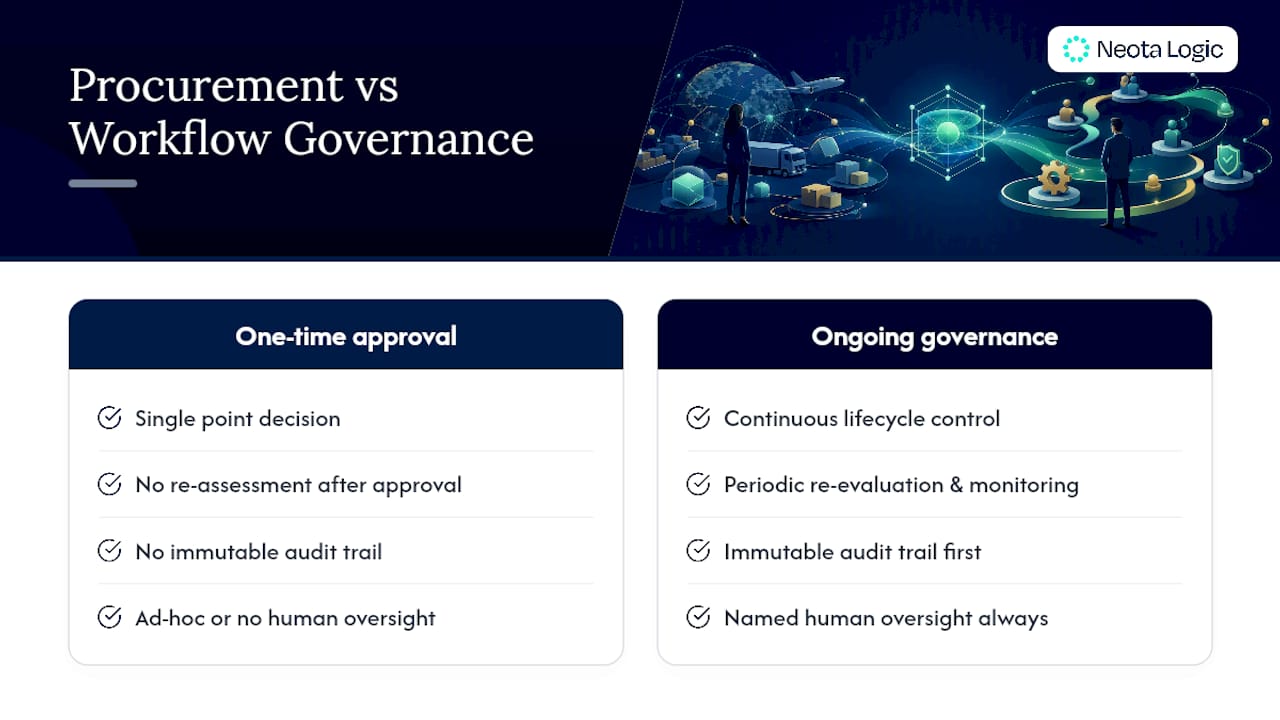
The pattern I see most often is legal teams treating AI governance as a compliance checkbox instead of an operational discipline. That is backwards. The firms getting this right build the audit trail first and the use case second. They know exactly what a system did, why it did it, and who signed off, before they scale it past a pilot. That discipline is what separates a defensible AI program from a liability waiting for the wrong matter to expose it.
Neotalogic’s approach reflects this directly. Governed workflows with immutable audit trails and named human oversight are not features bolted onto a chatbot. They are the infrastructure a legal team needs before AI touches a single privileged document. Multi-model orchestration matters here too: locking into one vendor’s model means locking into one vendor’s failure modes, and legal work cannot afford that kind of exposure.
— Patrick
How Neotalogic Operationalizes Governed Legal AI
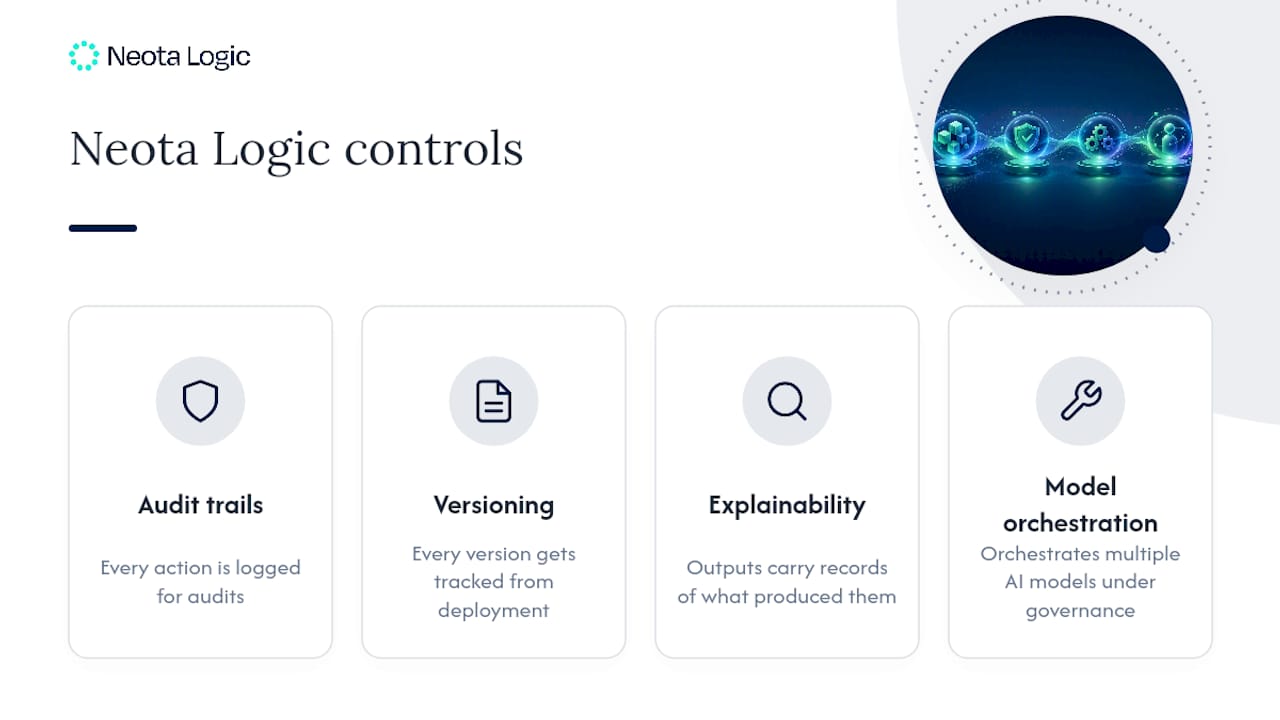
Neota Logic provides AI infrastructure designed for legal and compliance teams, focusing on governed workflows rather than point solutions or chatbots. Every workflow runs with audit trails, version control, and explainability built in from the first deployment, so the evidence a regulator or auditor asks for already exists.
This platform supports governed workflows for tasks such as intake and triage, contract automation, risk assessment, and compliance advisory by orchestrating multiple AI models under a governed layer to diversify risk exposure. Every action gets logged. Every version gets tracked. Every output carries a record of what produced it.
If your team is past the “should we use AI” question and into “how do we govern it,” the Neota Logic platform is built for that exact stage. Explore the solutions built for legal teams or request a demo to see how a bounded, governed workflow gets built and audited from day one.
Primary Sources for Governed Legal AI
Verify these claims directly at the source: NIST AI Risk Management Framework, NIST generative AI testing guidance, ABA Formal Opinion 512, EU AI Act implementation guidance, and White House AI policy direction.
Sources
- Artificial Intelligence Risk Management Framework (AI RMF 1.0)
- EU regulatory framework on AI (policy overview)
- NIST generative AI testing guidance
- Removing barriers to American leadership in AI (White House)
FAQ
Is there a legal version of ChatGPT?
There is no single “legal ChatGPT,” but there are governed platforms purpose-built for legal workflows, including Neota Logic, that add audit trails, human oversight, and compliance controls around AI models rather than exposing a general chatbot to client matters. General-purpose consumer chatbots lack the confidentiality controls Formal Opinion 512 requires.
What is the 30% rule in AI?
There is no established “30% rule” recognized in NIST, ABA, or EU AI governance guidance. Definitions of this term vary by source and context, so legal teams should rely on documented frameworks like the NIST AI RMF rather than informal rules of thumb.
What is the government version of ChatGPT?
Federal agencies do not use a single named “government ChatGPT.” Instead, White House and OMB guidance sets procurement and governance standards that agencies apply when adopting AI tools, including generative models used in legal and compliance functions.
Are there any laws governing AI?
Yes. The EU AI Act imposes binding, risk-based obligations with phased compliance dates in the European Union. In the United States, there is no single comprehensive federal AI law yet, but agency guidance, executive actions, and professional-conduct rules like ABA Formal Opinion 512 create binding obligations for lawyers using AI.
What does Neota Logic cost?
Current pricing for Neota Platform Access is available on the Neota Logic site rather than published in this article. Contact Neota Logic directly through the pricing page for current details.
Recommended
Ready to make your AI workflows defensible?
Book a demo and we'll walk one of your real processes through Neota.
Book demo