If you operate in the EU market, or your AI system affects people located there, Regulation (EU) 2024/1689 almost certainly applies to you. That is the verdict most legal teams need first: territorial reach is broad, and “we’re not an EU company” does not exempt you. The single next action is to classify your system’s risk tier and run it through the EU AI Act Compliance Checker before you build another workflow on top of unclear footing.
Three things demand attention this quarter:
- Confirm your risk classification (prohibited, high-risk, limited-risk, or general-purpose AI).
- Start technical documentation and record-keeping now, not after an inquiry lands.
- Build human oversight into any high-risk workflow before deployment, not as a retrofit.
Pro Tip: Treat the Compliance Checker output as a starting map, not a legal opinion. It tells you where to look, not what to file. Confirm findings against the actual regulation text before you commit resources.
Key Takeaways
Meeting EU AI Act compliance requires classifying every AI system by risk tier, documenting decisions continuously, and embedding human oversight before deployment, not after enforcement begins.
| Point | Details |
|---|---|
| Confirm scope first | Determine whether you’re a provider or deployer and whether EU territorial triggers apply before building further. |
| Classify by risk tier | Sort each AI system into prohibited, high-risk, transparency-obligated, or limited-risk categories using the official Compliance Checker. |
| Prioritize documentation | Technical documentation and post-market monitoring are the controls enforcement authorities request first. |
| Track the phased timeline | Full application lands August 2, 2026, with staggered dates for prohibitions and GPAI obligations under Article 113. |
| Use governed workflows | Platforms like Neota Logic automate classification, human oversight checkpoints, and audit logging as part of daily legal work. |
Table of Contents
- Understanding EU AI Act Compliance: Who Is in Scope
- The Four Risk Tiers: Where Your AI System Lands
- Core Obligations for High-Risk AI Systems
- Conformity Assessment, CE Marking, and Key Dates
- Enforcement Structure: Who Investigates and What Happens Next
- A 90/180/360-Day Compliance Checklist
- Bringing AI Act Obligations Into Existing Governance Systems
- What Actually Trips Up Compliance Teams
- How Neota Logic Turns AI Act Rules Into Governed Workflows
- Sources
- FAQ
Understanding EU AI Act Compliance: Who Is in Scope
Scope confusion is the single most common way organizations delay compliance until it’s too late. The Act separates obligations by role, and misidentifying your role is a real liability. A provider develops or has an AI system developed and places it on the market under its own name. A deployer uses an AI system under its own authority in the course of a professional activity. Territorial scope extends to providers placing systems on the EU market regardless of where they are established, and to any operator whose AI system’s output is used within the EU.
Run this check first:
- Does your organization build, brand, or substantially modify the AI system? You are likely a provider.
- Does your organization use a system built by someone else, without altering its intended purpose? You are likely a deployer.
- Does the system’s output affect people located in the EU, even if your company has no EU office? Territorial scope likely applies.
One nuance trips up otherwise careful teams: customizing or integrating a third-party model beyond its stated purpose can convert a deployer into a provider, with the full weight of provider obligations attached. A US-based HR software vendor that licenses a hiring-screening model and retrains it on client data has likely crossed that line. A law firm that simply uses an off-the-shelf drafting assistant, unmodified, is far more likely to remain a deployer with lighter obligations.
The Four Risk Tiers: Where Your AI System Lands
Regulation (EU) 2024/1689 sorts every AI system into one of four tiers, and your obligations scale sharply from one tier to the next.
- Prohibited practices: social scoring, manipulative subliminal techniques, and most real-time remote biometric identification in public spaces for law enforcement.
- High-risk systems: AI used in recruitment, credit scoring, critical infrastructure management, biometric identification, and law enforcement risk assessment.
- Transparency-obligated systems: chatbots, emotion-recognition tools, and deepfake generators, which must disclose that a person is interacting with or viewing AI-generated content.
- Limited-risk / other: spam filters, inventory forecasting, and similar tools with minimal obligations beyond general good practice.
General-purpose AI (GPAI) models get their own regime layered on top of these tiers:
- Baseline transparency: technical documentation and disclosure of training data summaries for all GPAI providers.
- Systemic-risk threshold: models trained above a defined compute threshold face additional obligations, including adversarial testing and incident reporting.
- Downstream responsibility: a business that fine-tunes a GPAI model for a high-risk use case inherits high-risk obligations on top of the GPAI baseline.
Core Obligations for High-Risk AI Systems
Articles 8 through 16 of the Act, along with the annexes referenced in the Service Desk, spell out what high-risk providers and deployers must actually build. Translating legal language into operational controls is where most compliance programs stall.
| Legal requirement | What it actually means in practice |
|---|---|
| Risk management system | Continuous process to identify, evaluate, and mitigate risks across the system’s lifecycle, not a one-time assessment |
| Technical documentation | Detailed records of design choices, training data, and performance metrics, kept current through every update |
| Record-keeping / logging | Automatic logs that capture inputs, outputs, and decision points for traceability during an audit |
| Data governance | Checks on training and testing data for relevance, representativeness, and error rates |
| Human oversight | Defined checkpoints where a person can intervene, override, or halt the system before harm occurs |
| Robustness and cybersecurity | Testing against adversarial inputs and defined resilience thresholds for accuracy and security |
Concrete controls that satisfy these requirements include a documented risk register reviewed quarterly, automated dataset quality checks run before each retraining cycle, immutable audit logs tied to each decision output, and clear human-in-the-loop rules that specify who can override an automated recommendation and under what conditions.
Pro Tip: Don’t try to satisfy every obligation at once. Start with technical documentation and post-market monitoring. These are the two areas enforcement authorities ask about first, and they are also the two most likely to expose gaps in every other control you have.
Conformity Assessment, CE Marking, and Key Dates
The Act applies from August 2, 2026, but the Commission’s Implementation Guidance confirms application is staggered under Article 113, with some prohibitions and GPAI obligations phased in on separate timelines and full high-risk conformity requirements following on a later schedule.
Key dates to track:
- Prohibited-practice bans and foundational governance obligations took effect earliest in the rollout sequence.
- GPAI transparency obligations followed on their own schedule ahead of the general application date.
- Full high-risk system obligations, including conformity assessment and CE marking, become enforceable as the Act reaches general application on August 2, 2026.
For AI embedded in regulated products such as medical devices or machinery, conformity assessment typically integrates with existing sectoral CE marking processes. Registration in the EU database is expected for standalone high-risk systems prior to market release. The Implementation Guidance advises reconciling AI Act requirements with sectoral rules rather than treating them separately. Significant changes to a system after deployment require reevaluation to ensure continued compliance. That is one of the more commonly missed obligations once a system is live.
Enforcement Structure: Who Investigates and What Happens Next
The European AI Office holds direct enforcement authority over general-purpose AI models, including the power to request technical documentation, mandate corrective action, and issue financial penalties. National market surveillance authorities handle enforcement for high-risk systems within their own jurisdictions, supported by the European Artificial Intelligence Board, Advisory Forum, and Scientific Panel, which coordinate harmonized interpretation across member states.
What these authorities can do during an inspection:
- Demand technical documentation, risk assessments, and audit logs within a defined response window.
- Order corrective measures, including withdrawal of a system from the market.
- Levy financial penalties for confirmed non-compliance, scaled to the severity and nature of the violation.
Pro Tip: Build your audit-readiness file before you ever get a request letter. That means a current risk register, dataset documentation, human oversight logs, and an incident register you can hand over within days, not weeks.
A 90/180/360-Day Compliance Checklist
Compliance work compounds fastest when it’s sequenced. Here’s a practical order of operations for legal and compliance teams starting from scratch.
- Must, Day 1 to 90: Inventory every AI system in use, classify each by risk tier, and run ambiguous cases through the Compliance Checker. Owner: compliance lead with input from engineering.
- Must, Day 1 to 90: Assign human oversight roles for any system that touches high-risk categories, and document the override process in writing.
- Do, Day 90 to 180: Build technical documentation and data governance records for every high-risk system, prioritizing those closest to full application dates.
- Do, Day 90 to 180: Stand up logging and audit-trail infrastructure that captures decisions automatically rather than relying on manual notes.
- Consider, Day 180 to 360: Pursue conformity assessment and registration for systems requiring it, and align sectoral CE marking processes where they overlap.
- Consider, Day 180 to 360: Formalize post-market monitoring and incident reporting into a recurring review cycle, not a one-off project.
Triage by impact, not by ease. A recruitment screening tool touching thousands of candidates deserves attention before an internal scheduling assistant, even if the scheduling tool is simpler to fix first.
Bringing AI Act Obligations Into Existing Governance Systems
Compliance fails most often when it lives in a spreadsheet disconnected from how work actually gets done. The Act’s own guidance treats it as complementary to GDPR and existing product safety law, which means the smart move is folding AI Act tasks into quality and risk management systems you already run, not building a parallel bureaucracy.

A workable process map looks like this: intake of a new AI use case, classification against the four risk tiers, a documented risk assessment, technical documentation and data governance checks, deployment with defined human oversight, and continuous post-market monitoring. Each stage needs an owner and a paper trail.
This is where governed workflow platforms earn their keep. A platform like Neota Logic’s can route an AI use case through classification logic, capture the human oversight decision at each checkpoint, and log every action automatically for audit purposes, turning what would otherwise be manual, error-prone paperwork into a system that produces its own evidence trail.
- Intake, classification, and human oversight checkpoints all generate audit-ready records without extra manual entry.
- Change-control integration means a substantial modification automatically triggers a reassessment task, not a missed deadline.
Pro Tip: Don’t build AI Act compliance as a side project. Attach it to whatever change-control or quality management process already governs your organization’s other regulated work. Duplicate systems are how obligations get missed.
What Actually Trips Up Compliance Teams
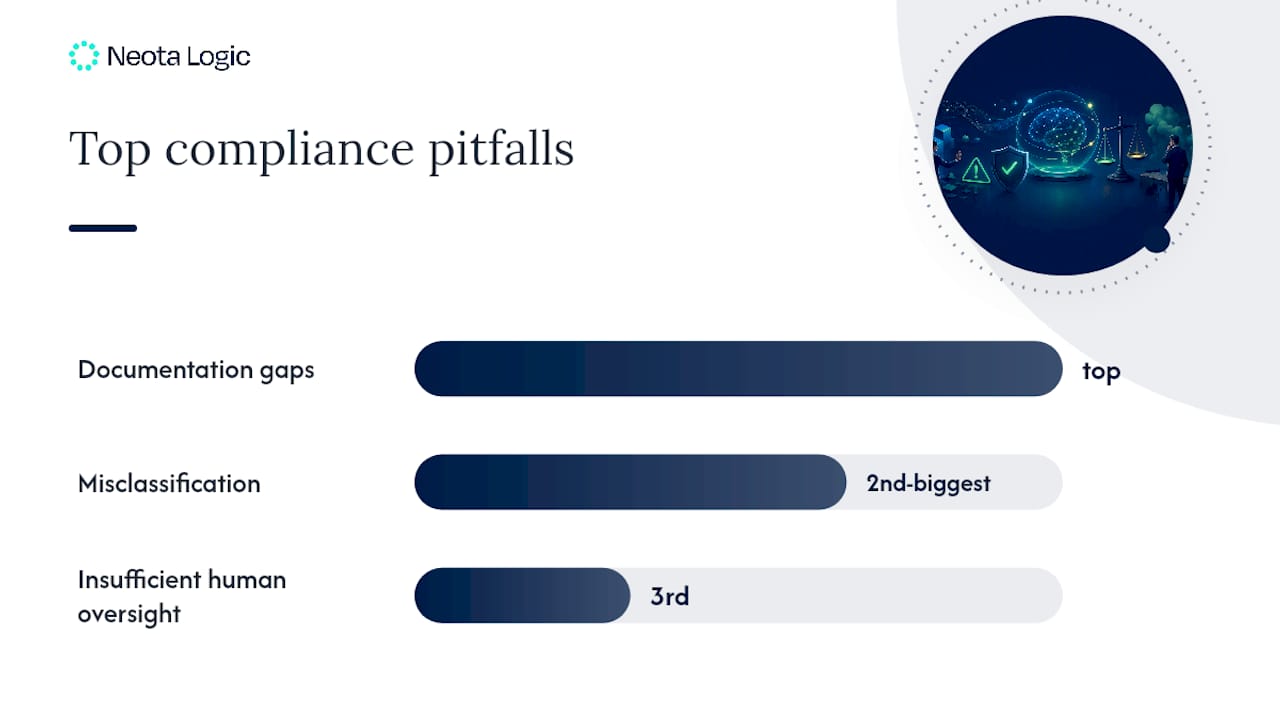
Documentation gaps sink more compliance programs than any dramatic regulatory failure. Teams over-invest in classification debates and under-invest in the unglamorous work of keeping records current after deployment. Misclassification is the second-biggest risk. Treating a high-risk system as limited-risk because it “seems fine” is a common and expensive misjudgment. Insufficient human oversight is third: a documented override process that nobody actually follows in practice will not survive an inspection.
Fix these first:
- Reconcile your risk inventory against actual system behavior, not marketing descriptions.
- Test whether your human oversight process functions under real operating pressure, not just on paper.
- Fold AI Act tasks into enterprise risk management rather than treating them as a standalone compliance sprint.
How Neota Logic Turns AI Act Rules Into Governed Workflows
Neota Logic gives legal and compliance teams a faster route to audit-ready compliance than building oversight processes from scratch in spreadsheets and email chains. Its governed workflow platform routes legal requests through classification logic, applies decision rules consistently, and logs every human-in-the-loop decision automatically, so the audit trail your AI Act obligations require gets built as a byproduct of daily work, not as a separate project.
Because Neota Logic orchestrates multiple AI models rather than locking you into one vendor, your compliance posture doesn’t depend on a single model’s roadmap. Teams using governed workflows over ad-hoc prompting reduce reliance on manual disclosure and oversight steps that tend to break down under audit pressure. If your organization is mapping core obligations like risk management, documentation, and human oversight onto real systems, request a demo to see how that mapping works inside a live workflow.
Sources
Bookmark these before your next audit cycle:
- AI Act | Shaping Europe’s digital future
- Implementation Guidance — EU AI Act
- Regulation (EU) 2024/1689 (Artificial Intelligence Act) — Official text
- EU AI Act Compliance Checker | AI Act Service Desk
This article is general information, not a substitute for advice from a qualified lawyer. Consult a qualified legal professional about your own circumstances before acting on anything here.
FAQ
Does the EU AI Act Apply to the US?
Yes, if a US company places an AI system on the EU market or its output affects people located in the EU, territorial scope applies regardless of where the company is headquartered.
Is the EU AI Act Being Enforced?
Yes. The European AI Office has direct enforcement authority over general-purpose AI models, and national market surveillance authorities enforce obligations for high-risk systems within their jurisdictions.
Is the EU AI Act Mandatory?
Yes, it is a binding regulation, not voluntary guidance. Obligations apply directly across all EU member states without requiring separate national legislation.
Who Regulates the EU AI Act?
The European AI Office regulates general-purpose AI models, national market surveillance authorities regulate high-risk systems in their territories, and the European Artificial Intelligence Board coordinates harmonized enforcement across the bloc.
What Should Legal Teams Do First Under the Act?
Classify every AI system in use by risk tier using the official Compliance Checker, then prioritize technical documentation and human oversight controls for anything landing in the high-risk category.
Recommended
Ready to make your AI workflows defensible?
Book a demo and we'll walk one of your real processes through Neota.
Book demo