An escalation workflow is a governance-controlled conditional branch that moves a matter to a higher authority when risk, value, or urgency exceed the current owner’s mandate. It works only when it enforces delegation of authority, not when it just routes a task somewhere else. The single most important move: place escalation after intake and triage, define a named owner and a response clock for every trigger, and assign those triggers this week.
TL;DR:
- Automated escalation workflows must include a named owner, response deadline, fallback route, and documented decision trail to function as governance controls.
- Escalation triggers should be based on specific thresholds or automatic flags, and policies should assign approval rights to roles rather than individuals for longevity.
- Testing and mapping current processes before automation, using real exceptions and shadow pilots, helps prevent accelerating broken workflows.
- Escalation processes need to incorporate audit trails, version control, and clear documentation to meet regulatory and compliance standards.
- Governed AI platforms like Neota Logic support standardized decision logic, recordkeeping, and vendor independence, ensuring effective escalation enforcement.
Table of Contents
- What escalation workflows are and where they sit in legal operations
- When to escalate: triggers, thresholds, and delegation of authority
- Core components of an effective escalation path
- Implementing and testing escalation rules in practice
- Governance, metrics, and common failure modes to monitor
- How governed AI and deterministic workflows reduce stalled work
- Escalation examples across corporate law, litigation, and compliance
- Integrating escalation workflows with legal case management software
- Legal and regulatory considerations shaping escalation design
- What actually moves the needle on stalled work
- Neota Logic: governed workflows and next steps
- Sources
- FAQ
What escalation workflows are and where they sit in legal operations
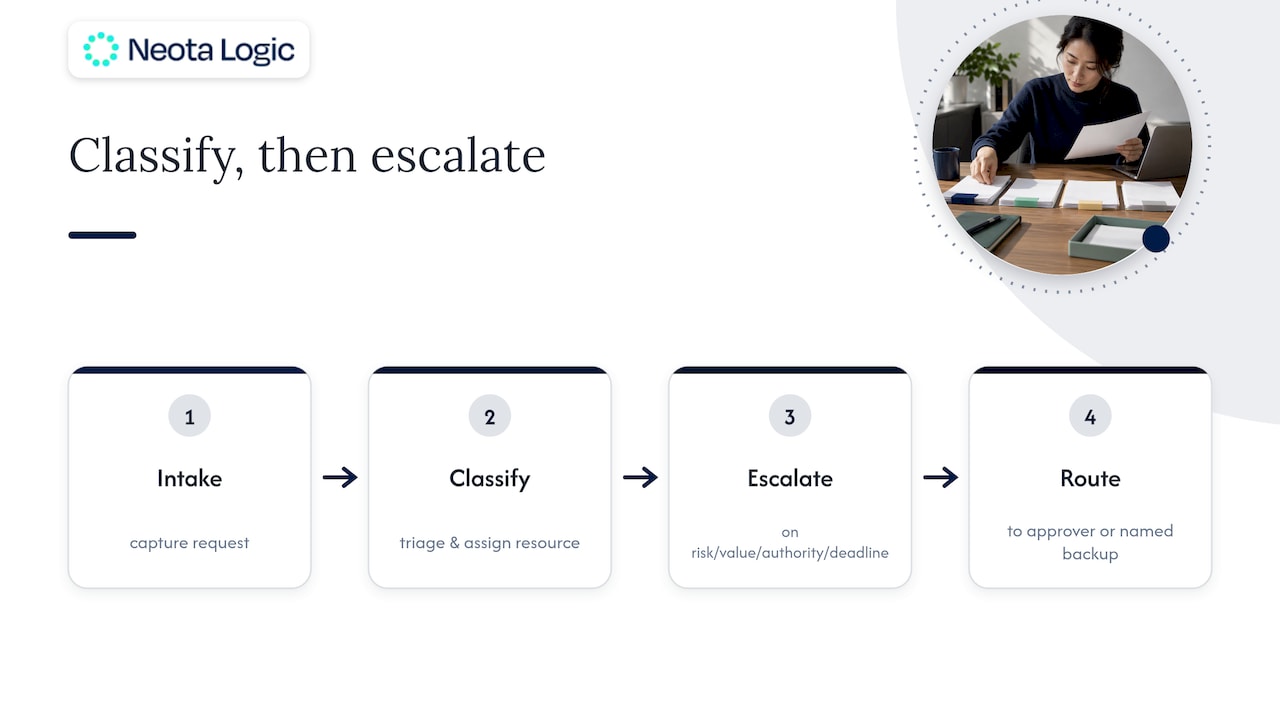
Routing and escalation are not the same thing. Routing sends a request to a person or team. Escalation activates only when a defined condition is met: a risk flag, a value threshold, an authority gap, or a missed deadline. CLOC’s Core 12 frames the sequence as capture the request, understand the work and risk, assign the right resource, apply documented process, then automate and measure. Escalation belongs after triage and assignment, never before it.
A contract above a set value should escalate to a director once legal ops has already classified it. A compliance disclosure with a regulatory flag should escalate to the compliance officer immediately, before any other routing happens. A signature blocker that misses its clock should escalate to the named backup approver, not sit in an inbox. Each case follows the same shape: classify first, escalate second.
When to escalate: triggers, thresholds, and delegation of authority
Two kinds of triggers drive escalation. Automatic triggers fire on sight: regulatory flags, sanctioned counterparties, “never accept” contract terms. Threshold triggers fire on a number: contract value above a set figure, deviation from a standard clause, missed SLA. The Association of Corporate Counsel recommends starting with a written delegation-of-authority policy that assigns approval rights to roles rather than to named individuals, so the workflow survives staff turnover without a rebuild.
Delegation of authority makes escalation accountable. Without it, routing only moves delay upward without resolving it. A starter list legal ops can copy and adapt:
- Contract value exceeds the role’s approval limit
- Counterparty appears on a sanctions or watch list
- Clause deviates from an approved standard template
- Regulatory disclosure deadline falls within 48 hours
- Signature or approval step has no response after the SLA clock expires
Core components of an effective escalation path
Every escalation rule needs the same fields, whether it is written into a policy manual or built into a platform. Skipping any of these turns escalation into a notification instead of a governed decision.
- Named owner: a role, not a person, so the assignment survives a personnel change.
- Achievable deadline: a response clock tied to the trigger, not an open-ended “as soon as possible.”
- Communication channel: a defined path (a queue, a case system, a designated inbox), not an email sent into the void.
- Fallback route: a backup approver or committee if the primary owner does not respond within the clock.
- Approval matrix: the mapping from trigger type to authority level, documented and versioned.
- Audit trail entry: who was notified, when, what decision was made, and what evidence supported it.
CLOC’s legal ops technology roadmap recommends that every escalatable task carry a named owner, an achievable deadline, a communication path, and a governance process, overseen by a program manager who keeps actions on time rather than letting them drift. Build the audit trail before you build the automation. If you cannot answer “who decided this and when” from the record, the workflow is not ready to run unattended.
Pro Tip: Write the fallback route before the primary route. If you cannot name who acts when the first owner goes silent, the rule is not finished.
Implementing and testing escalation rules in practice
Start by mapping the current process exactly as it works today, not as the policy manual says it should work. Interview the people who actually approve contracts, disclosures, and exceptions, and use their answers to build the escalation matrix: trigger, owner, clock, fallback.
- Run the mapped rules in shadow mode first, logging what would have escalated without changing anyone’s job.
- Pull real exceptions from the last quarter and use them as test cases before automating anything.
- Assign a program manager and a steering committee to own the rollout, per CLOC’s technology roadmap guidance on centralized responsibility.
- Collect every failure from the shadow pilot in one place and update the matrix before turning automation on.
Automating a broken process only makes the breakage faster. A prior CLOC review of legal ops maturity found that escalation rules commonly fail when teams automate unclear processes rather than testing handoffs first. Map, pilot, automate, iterate, in that order, and never skip the pilot to save time.
For teams evaluating platforms to support this rollout, Neota’s legal team workflows page covers process mapping and governance features relevant to this stage.
Governance, metrics, and common failure modes to monitor
An escalation workflow that no one measures is a policy document, not a control. The ACC legal operations maturity model identifies overdue volume, time-to-acknowledgment, time-to-decision, re-escalation rate, and exception rate as the diagnostic metrics for escalation workflows, and treats feeding those results back into playbooks and delegation-of-authority updates as a mark of mature legal operations.
Three failure modes recur. A silent threshold sits in a policy document but triggers nothing in the system that actually routes work, so nobody escalates until someone complains. A dead-end escalation names an owner who has moved teams or left the company, and the matter stalls at the exact point meant to unblock it. Approver fatigue sets in when thresholds are set too low, flooding senior counsel with matters that should have stayed at the first level, which trains people to ignore the queue. Each failure traces back to a component from the checklist above: no automatic trigger, no fallback route, or a threshold that needs recalibration.
How governed AI and deterministic workflows reduce stalled work
Governed AI infrastructure for legal and compliance teams emphasizes governance: every action carries an audit trail, every workflow version is recorded, and every automated decision remains explainable to the people who have to defend it later.
Classification and routing logic inside a governed workflow can name the correct approver at intake, apply the delegation-of-authority rules consistently, and log the decision path automatically rather than relying on someone to remember to document it. That combination, deterministic decision logic plus a recorded trail, is what turns an escalation policy into something a compliance officer can actually audit. Neota’s Workflows product applies this governance layer to routing and audit trail generation directly.

Escalation examples across corporate law, litigation, and compliance
Escalation triggers look different by practice area, even when the underlying components stay the same.
In corporate and transactional law, escalation commonly fires on contract value thresholds, deviation from approved templates, or unusual indemnification language. A software development NDA with an unfamiliar IP ownership clause is a clear example: guides to NDA and IP ownership terms note that ownership assignment language should route to senior counsel automatically, since a mistake there is expensive to unwind after signature.
In litigation, escalation typically fires on deadline proximity, settlement authority limits, or discovery disputes that touch privileged material. A paralegal flags a filing deadline within 48 hours, and the matter escalates to the responsible partner with the clock already running rather than waiting for a status check.
In compliance, escalation triggers on regulatory disclosure requirements, sanctions hits, and whistleblower reports. The Legal Sector Affinity Group’s AML guidance requires documented accountability, defined roles, and preserved evidence of action for these matters, which means the escalation record has to hold up to a regulator’s review, not just a manager’s glance.
The components stay constant across all three: named owner, response clock, fallback route, and recorded decision. Only the triggers and thresholds change by practice area.
Integrating escalation workflows with legal case management software
An escalation rule that lives only in a policy PDF will not fire on its own. It needs a system of record where triggers can be tested against real data, and a case management platform is usually that system.
Start by confirming the platform can enforce a response clock, not just display a due date. A due date that nobody monitors is decoration. The clock needs to trigger a notification, and if the notification goes unanswered, it needs to trigger the fallback route automatically.
Second, confirm the platform preserves version history on the approval matrix itself. Delegation-of-authority policies change when roles change, and an auditor will eventually ask what rule applied on a specific date, not just what rule applies today.
Third, avoid rebuilding your intake process around the software’s default categories. Map your own triggers first, then configure the platform to enforce them, following the same mapping discipline covered in Neota’s governance-first intake playbook. Software that forces a generic taxonomy onto a specific delegation-of-authority policy tends to produce escalation rules nobody trusts, which defeats the purpose of automating in the first place.
Finally, treat the integration as a governance project, not an IT project. The steering committee that owns the escalation matrix should sign off on the platform configuration before it goes live, the same way it would sign off on a policy change.
Legal and regulatory considerations shaping escalation design
Escalation workflows are not just an efficiency tool. In regulated matters, they are part of how an organization demonstrates it took reasonable steps to catch a problem before it became a violation.
The Legal Sector Affinity Group’s AML guidance lists defined responsibilities, documented procedures, and reporting timelines as requirements for anti-money-laundering compliance in the legal sector, and it states that implementation must be documented and auditable. An escalation workflow that cannot produce a timestamped record of who was notified, when, and what they decided does not meet that bar, regardless of how fast it moves the matter along.
Privilege is a related concern. A compliance escalation that routes a privileged communication through an unsecured channel or an unauthorized reviewer can waive privilege before anyone realizes a problem exists. The fix is structural: the approval matrix should specify which roles are authorized to view privileged material at each escalation tier, and the audit trail should record who accessed what.
Jurisdiction matters too. A delegation-of-authority policy built for one regulatory regime will not automatically hold up in another. Multinational teams should confirm that escalation thresholds and reporting timelines match the rules of the jurisdiction where the matter actually sits, not just the jurisdiction where headquarters is located.
What actually moves the needle on stalled work
Most legal teams already own an escalation policy. What they lack is enforcement, and that gap is where delays actually live.
If I had one week, I would do three things. First, write delegation of authority into role definitions and pick three automatic triggers to enforce immediately. Second, run a two-week shadow pilot using last quarter’s real exceptions as test cases, not hypotheticals. Third, set thresholds deliberately: too low, and you burn out your senior approvers; too high, and risk slips through untouched.
— Patrick
Neota Logic: governed workflows and next steps
Governed workflows support corporate legal teams and law firms. The platform is model-agnostic, so a team is never locked into a single AI vendor to keep its decision logic running. Every routing decision and every escalation carries an audit trail and a version history, which is what a compliance officer needs to see when a regulator asks how a matter was handled.
For a team mapping its own delegation-of-authority policy into a workflow, that combination matters more than any single feature:
- Governed decision logic applies approval matrices consistently, without a human having to remember every threshold.
- Audit trails and versioning provide a defensible record for every escalated matter, not just a notification log.
- Model-agnostic architecture means governance rules do not depend on one AI provider staying in business.
See the Neota Logic solutions overview to review workflow types, or check platform access and discovery sprint options to start mapping your own escalation matrix.
Sources
- Streamlining contract approvals: Navigating the intersection of legal ops & CLM technology | ACC
- CLOC core 12
FAQ
What does escalation mean in law?
Escalation in law means moving a matter to a person or committee with greater authority once a defined trigger is met, such as a risk flag, a value threshold, or a missed deadline. It is a governance mechanism, not a routing step, and it works only when the authority receiving the matter is clearly named in advance.
What is a legal workflow?
A legal workflow is the sequence that moves a request from intake through review, approval, execution, and post-execution control. Escalation is the conditional branch inside that workflow, activated when risk, authority, or urgency exceeds what the current owner can decide alone.
What is the best workflow software for law firms?
There is no single best option; the right choice depends on whether the platform can enforce delegation of authority, preserve audit trails, and support governed AI decision logic without locking a team into one vendor. Neota Logic is built specifically around those governance requirements for corporate legal teams and law firms, using a model-agnostic approach to avoid vendor lock-in.
Recommended
- Launch Jira Legal Workflows in 2–4 Weeks: Governance Steps for GCs
- Navigating the Bottlenecks in Legal Operations Without Slowing the Business — A Fireside Chat
- Prompting vs Governed Workflows: Why Clever Prompts Still Get Lawyers Sanctioned
- GCs: Legal Process Mapping in 7 Steps, KPI Driven, Governance First
Ready to make your AI workflows defensible?
Book a demo and we'll walk one of your real processes through Neota.
Book demo