Legal ops must issue two documents before anything else: a written retention schedule and a legal-hold playbook that maps directly to IT controls. Without both, deletion decisions are indefensible and hold compliance is unprovable. Every other process in this guide, from data mapping to audit logging, exists to support those two artifacts.
TL;DR:
- Legal operations are responsible for issuing a retention schedule and a legal hold playbook that directly link to IT controls to ensure defensible data deletion and preservation.
- Most retention schedule failures occur at the scoping stage, often missing personal devices, backups, and messaging apps that contain relevant data.
- Retention periods must be justified by legal or business purposes, with regulations like GDPR, Rule 37(e), and statutory minimums guiding the retention and deletion timeline.
- Automated system controls and documented workflows are essential to enforce retention policies, prevent manual errors, and produce audit logs for compliance.
- A legal hold overrides the scheduled deletion when litigation is reasonably anticipated, requiring clear documentation, acknowledgment, and systematic tracking.
Table of Contents
- What a data retention policy is and why legal ops should own it
- Legal holds vs retention: when a hold trumps the schedule
- Regulatory and case-law anchors for retention decisions
- Step-by-step: building a defensible retention schedule
- Operationalizing retention: roles, IT controls, and automation
- Demonstrating defensibility: what to log and report
- Why governance, not good intentions, makes retention defensible
- Where to evaluate governance-first retention tools
- FAQ
- Sources
What a data retention policy is and why legal ops should own it
A data retention policy sets rules for how long we keep categories of data, who owns each category, and how deletion happens. Five elements make a policy enforceable: scope (which systems and data types it covers), ownership (who decides and who executes), retention periods (tied to a legal or business reason, not a guess), deletion methods (automated or manual, with proof), and exceptions (holds, audits, regulatory inquiries).
Legal ops owns this because the downside of getting it wrong lands on legal ops. Under-retention destroys evidence before a duty to preserve exists, which risks sanctions under Rule 37(e). Over-retention does the opposite kind of damage: it inflates storage cost, expands the data available to opposing counsel in discovery, and creates privacy exposure that regulators increasingly scrutinize.
The core components of a defensible policy include:
- Scope statement naming the systems, departments, and data categories covered.
- Retention periods tied to a cited legal requirement or a documented business purpose, specifying exact durations.
- Ownership assignment naming who approves exceptions and who executes deletion.
- Deletion method specifying automated purge, manual review, or archival transfer.
- Exception process for legal holds, audits, and regulatory requests.
Rule 37(e) limits sanctions for electronically stored information lost through the routine, good-faith operation of a system, but only when reasonable preservation steps were taken first. That single qualifier, reasonable steps, is the entire game. A retention policy with no documented rationale gives opposing counsel an opening to argue the loss was not routine at all.
Legal holds vs retention: when a hold trumps the schedule
A retention schedule tells you when data would normally be deleted. A legal hold overrides that schedule the moment a duty to preserve arises, and that duty attaches when litigation is reasonably anticipated, not when a complaint is filed. ABA analysis of recent preservation litigation shows courts expect organizations to act on that anticipation immediately, including disabling auto-delete and preserving personal devices and accounts.
Once the duty attaches, legal ops needs to execute four steps in sequence, including issuing a written hold notice as advised in this carta de preservación de evidencia.
- Identify the trigger event and document the date litigation became reasonably anticipated.
- Scope the hold by naming custodians, data sources, backup systems, and any third parties or personal accounts likely to hold relevant material.
- Issue the hold notice in writing, with explicit instructions, and confirm receipt from every custodian individually.
- Track and release the hold through periodic reminders, acknowledgement logs, and a formal release notice once the matter closes.
The scoping step is where most holds fail. A hold that names only the corporate email system misses the data that actually ends up in dispute: messaging apps, personal devices used for work, and backups that were never meant to be a long-term archive. Practical ESI preservation guidance from the ABA recommends identifying custodians early and capturing backups and metadata before the routine retention schedule has a chance to run.
Documentation matters as much as the hold itself. A hold with no acknowledgement log is a hold we cannot prove existed.
Regulatory and case-law anchors for retention decisions
Three legal frameworks should anchor every retention period you set, and each one answers a different question.
Rule 37(e) answers the discovery question: what happens when data is lost. The committee note focuses on reasonable preservation steps and proportionality rather than demanding perfect preservation, and remedies apply only when lost electronically stored information cannot be restored or replaced through other discovery. This matters for retention design because it rewards documented, routine deletion rules and penalizes ad hoc or inconsistent ones.
GDPR’s storage limitation principle answers the privacy question: how long is too long. Storage beyond a minimal retention period requires a documented justification, especially for sensitive data categories like video surveillance or biometric records, according to EDPB guidance on video devices. The UK ICO’s storage limitation guidance reinforces the same principle from a different regulator: there are no fixed time limits in the law itself, so controllers must set their own periods, document the justification, and delete or anonymize data once the purpose has been served.
Statutory minimums answer the compliance question, and they vary by category and by jurisdiction:
- Tax records typically carry multi-year statutory minimums set by national tax authorities.
- Employment records often carry separate minimums tied to labor law in each jurisdiction.
- Corporate governance records (board minutes, charter documents) frequently carry indefinite or very long retention expectations.
None of these three frameworks hands you a single number. They hand you a method: document the purpose, pick a period that purpose actually justifies, and be ready to show your reasoning.
Step-by-step: building a defensible retention schedule
A defensible schedule is built in a fixed order, and skipping steps is what produces the gaps that get exposed in a deposition.
- Run a data inventory and classification exercise. Identify every system holding regulated or discoverable data, and classify each data type by business purpose, not by department name.
- Apply a high-water-mark approach. When a data type is subject to more than one retention requirement, for example a statutory minimum and a longer business need, retain for the longest applicable period and record which requirement drove that decision.
- Draft explicit rules for deletion, archival, and extension. State exactly what triggers a deletion, what triggers an archive instead, and what triggers a retention extension, such as an open regulatory inquiry.
- Build an exceptions process. Name who can approve an exception, what evidence they need, and how the exception gets logged against the schedule.
- Set a review cadence and assign sign-off authority. Annual review is common; name the specific role, not just “legal,” that signs off on each category.
Pro Tip: Write the justification for each retention period into the schedule itself, next to the period, not in a separate memo nobody will find during a document request.
The high-water-mark step deserves extra attention because it is where most schedules either succeed or collapse under scrutiny. Say a data category carries a statutory minimum of seven years for tax purposes but the business also wants it for ten years to support warranty claims. The defensible answer is ten years, documented with both justifications attached, not a silent choice of one number over the other. ABA guidance on protecting firm data frames this the same way: minimization has to follow a mapped inventory and a documented purpose, never a blanket rule applied without evidence.
Review cadence closes the loop. A schedule that was correct three years ago may now be wrong, because the business purpose changed or a new jurisdiction entered the picture. Build the review into a calendar with a named owner, not an informal habit that depends on someone remembering.
Operationalizing retention: roles, IT controls, and automation
A schedule is only as good as the people and systems enforcing it day to day, and that enforcement needs named owners and hard technical controls, not goodwill.
Five roles need explicit documentation:
- Legal ops owner, who maintains the schedule and approves exceptions.
- Records owner, typically a business unit lead, who confirms business purpose for each category.
- IT owner, who implements deletion, archival, and hold-related system changes.
- Custodian, the individual employee responsible for complying with a hold notice.
- External counsel, brought in when a matter requires scope decisions beyond internal policy.
IT controls translate the policy into something a system actually enforces. At minimum, legal ops should require: automatic suspension of scheduled deletion the moment a hold is issued, immutable archive storage for held data so it cannot be altered or purged, searchable cold storage so held data can be retrieved without a multi-week IT project, and a documented procedure for capturing backup snapshots at the moment a hold begins.
Pro Tip: Test your auto-delete suspension control on a live system before you need it in a real matter. A control that only works in theory fails exactly when the stakes are highest.
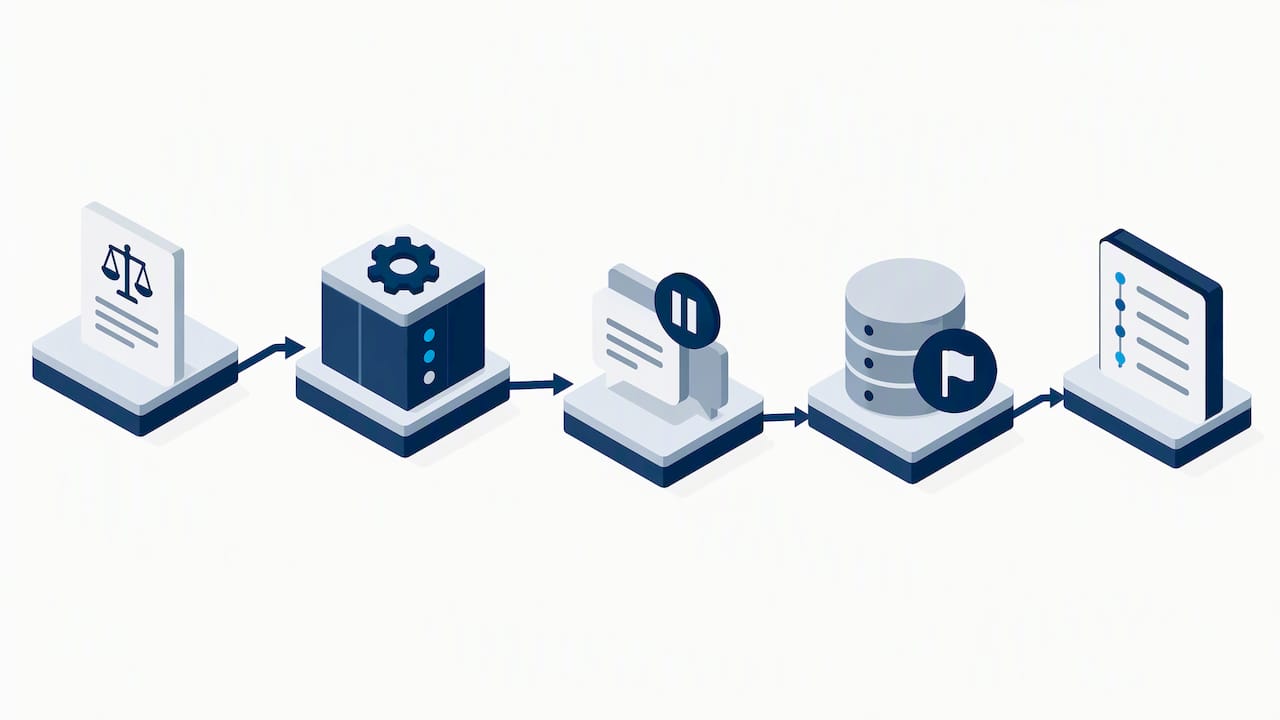
This is where manual tracking breaks down. A spreadsheet of custodian acknowledgements cannot disable auto-delete on a messaging platform or flag a backup job in real time. Workflow automation that maps a hold decision directly to system-level controls, and logs every action it takes, closes that gap. It turns a legal decision into an enforced technical state, with a record of exactly when and how that enforcement happened, which is the evidence a court actually wants to see.
Demonstrating defensibility: what to log and report
Courts and regulators do not take your word that a program worked. They want the paper trail.
- Signed retention schedule, version-dated, showing who approved each category.
- Hold issuance log, showing when each hold went out and to whom.
- Custodian acknowledgement records, proving notice was received, not just sent.
- Automated hold-status logs, showing the technical controls activated and when.
- Deletion certificates, confirming what was purged, when, and under which schedule entry.
A program with a documented preservation plan, captured metadata, and logged hold compliance is better positioned to defend against spoliation claims, according to ABA practical guidance on preserving ESI. Track hold compliance rate, count of overdue deletions, and number of exceptions granted as ongoing health metrics, and keep the narrative ready: what the schedule said, when the hold issued, and what the logs show happened in between.
Why governance, not good intentions, makes retention defensible
Most retention failures are not policy failures. They are enforcement failures, where a legal decision never reached the system that needed to act on it. Connecting legal intent directly to technical enforcement removes the human step most likely to break under deadline pressure.
Audit trails and explainability matter more than any single feature. A log that shows exactly when a hold was issued, who acknowledged it, and which system control activated because of it is the difference between a defensible program and an assertion. Model-agnostic governance keeps that enforcement layer independent of any single AI vendor, which protects the audit trail itself from vendor change.
— Patrick
Where to evaluate governance-first retention tools
Retention and legal-hold programs fail at the handoff between legal decision and system enforcement. That handoff is exactly where governed workflow automation earns its place: it turns a hold decision into an enforced technical state across your systems and produces the audit log that proves it happened, instead of leaving that proof to memory or a shared spreadsheet.
We built our solutions around governed, human-overseen workflows rather than a single point tool, so retention schedules, hold triggers, and IT controls stay connected and auditable as your program scales. If your current process depends on someone remembering to flag a backup or disable a delete job, that is a governance gap worth closing before the next matter arrives. Review pricing and plan options or start with a demo to see how a governed workflow maps to your existing retention schedule.
This article is general information, not a substitute for advice from a qualified lawyer. Consult a qualified legal professional about your own circumstances before acting on anything here.
FAQ
How long can data be retained?
There is no single legal limit on how long data can be retained. Under storage limitation principles described by the UK ICO, retention periods must be justified by a documented business or legal purpose and reviewed regularly, with deletion or anonymization once that purpose ends.
What is the average length of a legal hold?
A legal hold lasts for the duration of the matter that triggered it, from when litigation is reasonably anticipated until formal release, and that span varies case by case. There is no standard average length; the hold ends only when legal ops issues a documented release notice.
What is the 7-year retention policy?
A seven-year period often appears in retention schedules because it aligns with common statutory minimums for tax and financial records in several jurisdictions, though the exact requirement depends on the specific law and jurisdiction involved. Legal ops should confirm the applicable statutory period for each record category rather than apply a flat seven-year rule across all data.
What should a data retention policy include?
A data retention policy should include scope, ownership, retention periods tied to documented justification, deletion methods, and an exceptions process for holds and audits. It should also define how legal holds override scheduled deletion and how that override gets logged.
Sources
Some data sources cause a disproportionate share of preservation failures, and they share a common trait: nobody designed them with litigation in mind.
- Agenda E-19 (Appendix B) Rules September 2014
- Litigation risks of failing to preserve personal data (American Bar Association)
- ICO guidance on storage limitation
Mitigations are concrete and available now. Extend enterprise retention and hold capability to approved messaging platforms before a matter arises, not during one. Write BYOD policy terms that give the organization the right to collect from personal devices when a hold applies. Collect data from departing employees immediately, before equipment is wiped or accounts are closed. Add preservation and retention clauses to vendor contracts covering any third-party platform that stores company data.
One operational tension deserves a direct answer: a pending deletion request (from a privacy regulation, for instance) never overrides an active legal hold. The hold controls until it is released, and that priority should be written into the policy itself, not left to judgment in the moment.
Recommended
Ready to make your AI workflows defensible?
Book a demo and we'll walk one of your real processes through Neota.
Book demo