Corporate legal operations is the discipline that runs the business side of a legal department: intake, contracts, spend, vendors, technology, and data. Its purpose is singular. It frees lawyers to practice law while turning the department from a cost center into a measurable, strategic partner to the business. The function rests on a handful of core processes, a small but pointed team, and technology that must be governed, not just adopted. What follows is the map and roadmap.
TL;DR:
- Focus on automating routine processes like intake, contract management, and financial controls to maximize legal department efficiency without expanding headcount.
- Measure success with speed, cost, and capacity metrics such as contract turnaround time, spend variance, and matter volume per attorney, using baseline data before investing in new tools.
- Build governance and pilot narrowly before scaling AI and automation tools to ensure controls like audit trails, explainability, and version history are embedded from the start.
- Organize legal operations teams based on department size, with roles for process design, contract management, financial analysis, and technology ownership reporting directly to the general counsel.
- Prioritize early stakeholder involvement, clear communication, and staged rollouts to overcome resistance and secure ongoing buy-in for process and technology changes.
Table of Contents
- What Does Corporate Legal Operations Actually Cover?
- What Are the Day-to-Day Functions Legal Ops Runs?
- Which Metrics Prove Legal Operations Is Working?
- How Should a Legal Operations Team Be Structured?
- How Should Legal Departments Govern AI and Automation Tools?
- How Do Maturity Models Help You Prioritize?
- What Are the Biggest Barriers to Legal Ops Success?
- What Does a 12-Month Legal Ops Roadmap Look Like?
- How Do You Get Stakeholder Buy-In for Legal Ops Change?
- How Should Legal Departments Budget and Manage Costs?
- How Does Legal Operations Fit Into Broader Corporate Strategy?
- How Do You Train and Develop a Legal Ops Team?
- What Data Privacy and Security Risks Does Legal Ops Manage?
- What’s Next for Corporate Legal Operations?
- Why Governance Comes Before Technology Spend
- A Governance-First Path to Legal Operations Maturity
- Sources
- FAQ
What Does Corporate Legal Operations Actually Cover?
Corporate legal operations exists to make the legal department run like a business unit, not a bottleneck. Its primary goal is efficiency that compounds into strategic capacity. Every hour saved on routine contract review or invoice reconciliation is an hour a lawyer can spend on risk, deal structure, or advising the board. The American Bar Association frames this directly: adding a real operations function is what converts legal from overhead into a strategic business partner, but it requires deliberate investment in people, process, and technology, not just a new job title.
The responsibilities fall into recognizable buckets:
- Intake and triage — capturing requests from the business and routing them to the right resource, internal or external.
- Matter and contract lifecycle management — tracking work from request to resolution, including contract drafting, negotiation, and renewal.
- Financial operations — e-billing, budget management, and outside counsel spend analysis.
- Vendor and law firm management — panel selection, rate negotiation, and performance review.
- Business intelligence — dashboards and reporting that give the general counsel a real-time view of department performance.
Legal operations reports through the general counsel or chief legal officer and works constantly with finance, procurement, and IT. That cross-functional reach is what separates the function from a simple administrative role.
What Are the Day-to-Day Functions Legal Ops Runs?
Legal operations owns a set of repeatable processes, and how well each one runs determines whether the department feels fast or feels stuck. Four areas carry most of the weight.
- Intake and triage. Every request needs one door in, a consistent classification method, and a service level agreement attached to it. Departments without a formal intake process routinely lose track of low-priority requests while urgent matters sit in an inbox. A structured triage workflow assigns severity and routes work automatically, whether that means a paralegal, outside counsel, or a self-service template.
- Contract lifecycle management. This spans drafting, negotiation, execution, and renewal tracking. Document automation removes the manual drafting burden on routine agreements like NDAs and vendor contracts, and it gives lawyers a consistent starting point instead of a blank page.
- Financial controls. E-billing systems enforce outside counsel guidelines automatically, budgets get tracked against actual spend in real time, and outside counsel panels get reviewed on a fixed cycle rather than an ad hoc one.
- Service delivery and vendor coordination. Legal departments increasingly route lower-complexity work to alternative legal service providers rather than law firms, a shift the 2025 CLOC State of the Industry report documents across company sizes.
Get these four right and the rest of the function, reporting, technology selection, team design, follows naturally. Get them wrong and no dashboard will fix it.
Which Metrics Prove Legal Operations Is Working?
The metrics that matter fall into three categories: speed, cost, and capacity. Cycle time on contract turnaround, average intake-to-resolution time, and outside counsel spend against budget are the baseline three. Add matter volume per attorney, percentage of spend under e-billing guidelines, and win rate on rate negotiations, and you have a dashboard a CFO would recognize.
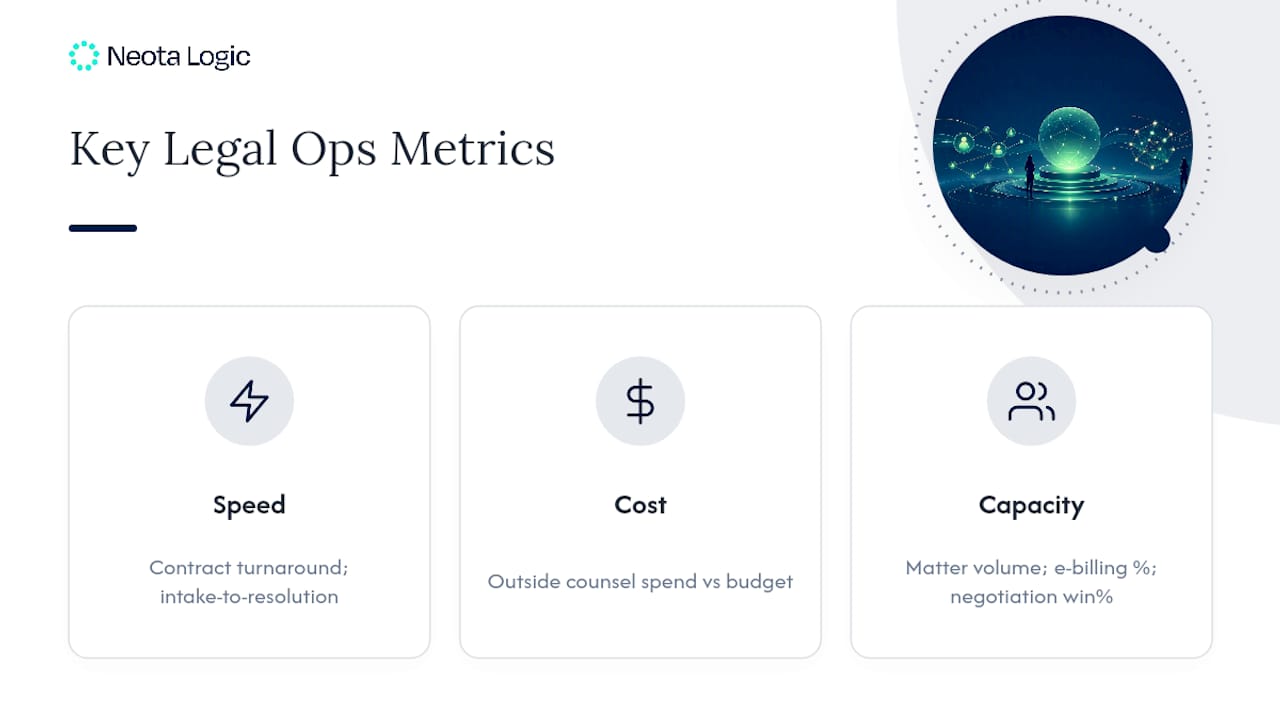
Statistic to build a baseline against: the 2025 CLOC State of the Industry report puts median legal operations team size remains small, often around five full-time employees, even as a large majority of departments expect demand for legal services to keep growing. That gap between flat headcount and rising demand is exactly what metrics need to close: proving that process and technology, not additional hiring, absorbed the increase.
Start by measuring what already exists in your e-billing and matter management systems before buying anything new. A three-month baseline on cycle time and spend variance gives you a defensible starting point. From there, build a one-page dashboard the general counsel can bring into a budget conversation. The translation into C-suite language matters as much as the numbers themselves: “we reduced average contract turnaround by four days” reads as an operational note; “we recovered four days of deal velocity per contract, department-wide” reads as business impact. Same fact, different audience.
How Should a Legal Operations Team Be Structured?
Team structure follows department size and maturity, not a fixed template. A department of five in-house lawyers might have one legal operations generalist wearing every hat. A department of fifty might have distinct roles for intake, technology, and vendor management.
The recurring roles, regardless of scale, include:
- Legal operations manager or director — owns process design and cross-functional coordination.
- Contracts or CLM specialist — manages the contract lifecycle and document automation tooling.
- E-billing and financial analyst — tracks spend, enforces guidelines, and reports variance.
- Technology or systems owner — administers matter management, intake, and workflow platforms.
- Data and reporting lead — builds and maintains the metrics dashboard.
Reporting lines matter more than headcount. Legal operations should report to the general counsel or chief legal officer directly. Without that sponsorship, the function struggles to get budget authority or the mandate to change how lawyers work. Sizing heuristics are simple in practice: below ten attorneys, one generalist; between ten and fifty, two to four specialists covering contracts, finance, and technology; above fifty, a dedicated director with a small team beneath them, delegating execution while retaining strategic oversight of vendor relationships and technology roadmap.
How Should Legal Departments Govern AI and Automation Tools?
Technology choices should map to specific bottlenecks, not to whatever tool is trending. Intake automation solves the “where does this request go” problem. Contract lifecycle management platforms solve document velocity. Matter management systems solve visibility across active work. Workflow orchestration engines solve the handoffs between all three.
AI adoption inside legal departments is accelerating fast. The 2025 CLOC State of the Industry report finds a significant portion of legal operations teams have already implemented AI tools, and many more are actively considering it. That speed creates a governance problem before it creates a productivity gain. Governed AI needs four non-negotiable controls: audit trails on every automated decision, version history on every workflow change, plain-language explainability for why a request was routed or a document was flagged, and model-agnostic orchestration so the department is never locked into a single AI vendor’s roadmap or pricing.
Pilot before you scale. A narrow, well-scoped intake-to-triage workflow run over six to twelve weeks gives you real data on cycle time and adoption before wider rollout, a pattern that consistently reduces the risk of a failed enterprise rollout.
Pro Tip: Assign data ownership and a single source of truth for matter metadata before you automate anything. Poor taxonomy, not weak technology, is the leading cause of failed contract and matter management rollouts.
How Do Maturity Models Help You Prioritize?
Maturity models measure legal operations across dimensions like analytics, technology ownership, and service delivery, then place a department on a scale from ad hoc to optimized. The ACC Legal Operations Maturity Model is the most widely used framework for this benchmarking.
A quick self-assessment works better than a formal audit for most departments starting out:
- Score each dimension honestly on a one-to-five scale rather than aspirationally.
- Identify the two lowest-scoring dimensions that also touch the highest business risk.
- Commit budget and staff time to those two before adding a third initiative.
Departments should not chase advancement across every dimension simultaneously; focus by size and strategic priority produces faster, more durable gains than spreading effort thin.
What Are the Biggest Barriers to Legal Ops Success?
Four barriers show up in nearly every legal operations rollout, and none of them are primarily technical.
- Resistance from lawyers. Attorneys who built their practice on individual judgment often view standardized workflows as a threat to autonomy. Frame automation as removing drudgery, not oversight, and involve senior lawyers in workflow design from day one.
- Budget constraints. Legal operations rarely gets a blank check. Start with the metrics from your baseline audit to justify each subsequent investment rather than requesting a lump sum upfront.
- Data quality. Matter and contract data scattered across email, shared drives, and spreadsheets undermines any dashboard before it launches. Fix data ownership before buying analytics tools.
- Integration complexity. New systems that do not talk to existing document management or CRM platforms create more manual work, not less.
The fastest way through all four is a visible quick win: automate one high-volume, low-risk workflow, like NDA intake, publicize the time saved, and use that credibility to fund the next initiative.
What Does a 12-Month Legal Ops Roadmap Look Like?
A staged rollout beats a big-bang implementation every time. Trying to fix intake, contracts, financial controls, and technology all in the same quarter produces change fatigue and half-finished projects.
- First 90 days. Audit your current intake process end to end. Establish baseline metrics on cycle time, spend, and matter volume. Run one small automation pilot on a narrow, well-defined workflow, ideally something like NDA intake or routine vendor contract review.
- Months three through six. Scale the pilot that worked and kill the one that did not. Appoint or hire into the core roles: a contracts specialist, a financial analyst, or a technology owner, depending on where your baseline showed the biggest gap. Build a formal vendor evaluation framework for outside counsel and alternative legal service providers.
- Months six through twelve. Move to enterprise-level integrations connecting matter management, e-billing, and document systems. Formalize governance policies for any AI or automation tools now in production. Reassess maturity against the ACC framework and set the next year’s priorities based on where the score moved and where it did not.
How Do You Get Stakeholder Buy-In for Legal Ops Change?
Change management determines whether a legal operations initiative survives its first budget cycle. Lawyers are trained to be skeptical of process standardization, and that skepticism is not irrational. It comes from years of matters where judgment mattered more than templates.
The strongest engagement tactic is early involvement, not late-stage announcement. When senior attorneys help design an intake workflow or select a contract template, they defend it later instead of resisting it. Identify two or three influential lawyers early and give them a real voice in workflow decisions, not just a demo at the end.
Communication needs to run on two tracks simultaneously. The general counsel needs data: cycle time reductions, spend variance, capacity gained. Individual attorneys need something more personal: how much less time they will spend on repetitive contract review each week. Translate the same initiative into both languages, because a dashboard that impresses a CFO will not persuade a litigator who just wants fewer emails.
Sequence matters as much as messaging. Announcing a full technology rollout before running a pilot invites skepticism the pilot data could have preempted. Run the pilot quietly, gather the metrics, then bring the results to a wider audience as proof rather than promise. Departments that skip this step tend to face the same objections twice: once before launch, based on speculation, and once after launch, based on frustration with a tool nobody was consulted on.
Legal operations leaders who treat change management as a parallel project, with its own timeline and its own owner, consistently see faster adoption than those who treat it as an afterthought to the technology rollout.
How Should Legal Departments Budget and Manage Costs?
Legal operations budgeting splits into two distinct categories that get conflated too often: the cost of running the operations function itself, and the cost of legal services the function is meant to control.
Outside counsel spend is usually the largest controllable line item in any legal department budget. E-billing systems that enforce guidelines automatically, flagging rate increases, block-billed entries, or out-of-scope work before invoices get paid, typically produce the fastest, most visible savings of any legal operations initiative. Panel reviews on a fixed annual or biannual cycle keep that spend honest over time rather than letting it drift.
Technology spend needs its own discipline. Buying a matter management platform, a CLM system, and an AI orchestration tool in the same fiscal year, without integration planning, is a common and expensive mistake. Sequence purchases against your maturity assessment and your roadmap rather than against what a vendor’s sales cycle happens to push that quarter.
Budgeting for the operations function itself should follow the same logic you would apply to any other business unit: headcount tied to measurable workload, technology spend tied to a documented bottleneck, and a renewal or expansion budget tied to metrics from the prior cycle, not to inertia. The Thomson Reuters Institute consistently finds that law departments name efficiency as a top budget priority, and that technology investment is viewed less as a cost center and more as a direct lever for expanding capacity without expanding headcount.
Build a contingency line for one thing every legal operations budget eventually needs: unplanned litigation or regulatory spend that displaces planned technology or process work. Departments that budget as if every year will look like the baseline year are the ones caught flat when it doesn’t.
How Does Legal Operations Fit Into Broader Corporate Strategy?
Legal operations cannot function as an island. Its highest-value work happens at the seams with finance, compliance, and procurement, not inside the legal department alone.
Finance integration starts with spend data. Outside counsel invoices, settlement reserves, and contract-related financial commitments all need to flow into the same reporting structure finance uses for the rest of the business, not a separate legal-only spreadsheet. When legal operations data speaks the same language as finance data, budget conversations move faster and carry more weight.
Compliance integration runs in the opposite direction. Legal operations often owns or co-owns the workflow infrastructure that compliance teams use for policy attestations, conflict checks, and regulatory filings. A governed workflow platform built for legal intake can frequently extend to compliance intake with minimal rework, since the underlying need, structured requests, defined approval steps, an auditable record, is the same.
Procurement integration shows up most in vendor management. Legal operations negotiates outside counsel rates using the same leverage and benchmarking discipline procurement applies to any other major spend category. Departments that treat outside counsel selection as a purely legal decision, disconnected from procurement’s vendor management expertise, routinely leave negotiating leverage on the table.
The strategic case for this integration is straightforward: a legal department whose data, workflows, and vendor relationships are visible to finance and compliance gets treated as a business partner in planning conversations. A legal department that operates in isolation gets treated as a line item to be managed, which is precisely the perception legal operations exists to change.

How Do You Train and Develop a Legal Ops Team?
Legal operations is a distinct discipline, and treating it as a landing spot for underused paralegals or IT staff undersells what the role requires. Effective training programs cover three areas: process design, financial literacy, and technology administration.
Process design training teaches team members to map a workflow before automating it, since automating a broken process just makes the breakage faster. Financial literacy training, covering budget variance analysis, e-billing guideline enforcement, and outside counsel rate benchmarking, gives the team the vocabulary to have credible conversations with finance. Technology administration training goes beyond “how to use the software” into governance basics: who can change a workflow, how changes get logged, and how to explain an automated decision to an auditor or regulator.
Cross-training across these three areas matters more than deep specialization in any one, particularly for smaller teams where a single person may own intake, contracts, and vendor management simultaneously. Rotating team members through different responsibility areas over twelve to eighteen months builds a bench that can cover for absences and adapt as the department’s priorities shift.
External development matters too. Conferences and working groups run by organizations like the Corporate Legal Operations Consortium and the Association of Corporate Counsel give legal operations professionals access to benchmarking data and peer practices that no internal training program can replicate on its own. Budgeting for at least one external conference or certification track per team member per year keeps the team’s practices current against a fast-moving field.
What Data Privacy and Security Risks Does Legal Ops Manage?
Legal operations sits on some of the most sensitive data in the entire company: privileged communications, litigation strategy, M&A due diligence, and personal data tied to employment and regulatory matters. That concentration of sensitive information makes legal operations a high-value target and a high-stakes point of failure if governance is weak.
Any workflow or AI tool that touches legal request intake needs access controls that mirror the sensitivity of the underlying matter, not a one-size-fits-all permission model. A contract renewal request and a whistleblower complaint should never route through the same access tier. Audit trails are not optional in this context; they are the mechanism by which a department proves, after the fact, exactly who saw a document and when, a requirement that matters enormously if privilege is ever challenged in litigation.
Vendor and AI tool selection needs the same scrutiny. Any third-party platform processing legal department data should carry clear data residency terms, defined data retention and deletion policies, and contractual limits on how vendor-side AI models can use submitted data for training. A platform that cannot explain, in plain language, how a document flows through its system and who can access it at each step is not ready for privileged legal work, regardless of what else it offers.
Data minimization is worth building into intake design from the start: only capture the fields a workflow actually needs to route and resolve a request, rather than defaulting to broad data collection that expands the department’s exposure if a system is ever breached.
What’s Next for Corporate Legal Operations?
The clearest trend across current industry benchmarking is acceleration, not novelty. The 2025 CLOC State of the Industry report shows 83% of legal departments expecting demand for legal services to keep rising, while median team size holds around five full-time staff. That gap is the defining pressure legal operations will face over the next several years: doing meaningfully more without a proportional increase in headcount.
AI orchestration across multiple models, rather than reliance on a single vendor’s tool, is emerging as the practical answer to that pressure. Departments that build governed, model-agnostic workflows now will have more flexibility as the underlying AI models themselves continue to change, rather than being locked into whatever a single vendor decided to ship this year.
Expect governance requirements to tighten rather than loosen. As AI-assisted decisions touch more of the intake-to-resolution pipeline, boards and regulators alike will ask harder questions about explainability and audit trails. Departments that build those controls in now, rather than retrofitting them under pressure later, will be the ones positioned to scale without a governance crisis interrupting the process.
Why Governance Comes Before Technology Spend
Legal operations does not fail because departments pick the wrong software. It fails because they buy technology before they understand their own process, and then they buy AI tools before they build governance around them. That order is backwards, and reversing it is the single highest-leverage move a general counsel can make this year.
The two lessons that hold up across every legal operations rollout: pilot narrow before you scale wide, and assign data ownership before you automate anything. Skip either step and the rollout stalls regardless of the vendor. Governance, not features, is what separates a tool a department can trust with privileged data from one it cannot.
— Patrick
A Governance-First Path to Legal Operations Maturity
The approach outlined above, pilot narrow, govern early, scale deliberately, is exactly what Neota Logic is built for. Neota Logic is governed AI infrastructure for legal and compliance teams, not a point solution and not a chatbot. Every workflow runs with audit trails, version history, and plain-language explainability built in, so a general counsel can show exactly how a request was routed, who touched it, and why an AI model recommended a given path.
Orchestrating across multiple AI models rather than locking a department into one vendor’s roadmap gives legal operations teams the flexibility to adopt better models as they emerge, without rebuilding their workflows from scratch. No-code workflow and document automation means intake, matter triage, and contracting can be governed and improved without waiting on a development queue. This is one valid implementation path for departments ready to move past pilots and into production, built specifically for the audit and compliance requirements legal work demands. Explore the Neota Logic platform or review options for legal teams to see how a governed workflow maps onto your own intake and contract processes.
Sources
- Legal Operations: Transforming Legal Departments into Strategic Business Partners
- 2025 CLOC State of the Industry report
- ACC Legal Operations Maturity Model
FAQ
What Are Corporate Legal Operations?
Corporate legal operations is the function that manages the business side of an in-house legal department, covering intake, contract and matter lifecycle management, financial controls, vendor management, and technology, so lawyers can focus on legal judgment rather than administrative work.
What Does a Legal Operations Professional Do?
A legal operations professional designs and runs processes like intake triage, e-billing enforcement, and contract automation, while building the metrics and dashboards that show the general counsel where the department stands on cost, speed, and capacity.
What Does a Corporate Legal Department Do?
A corporate legal department manages a company’s legal risk, contracts, litigation, regulatory compliance, and transactional work, using in-house counsel supported by outside law firms and, increasingly, a dedicated legal operations function to manage the administrative and technology layer.
What Does “Corporate Legal” Mean?
“Corporate legal” refers to the in-house legal function within a company, as distinct from an outside law firm, responsible for the organization’s contracts, compliance, governance, and risk matters on an ongoing basis.
Is Governance-First AI Different From a Standard Legal Tech Tool?
Yes. A governance-first platform like Neota Logic builds audit trails, versioning, and explainability into every automated workflow from the start, rather than treating those controls as an add-on after adoption.
Recommended
Ready to make your AI workflows defensible?
Book a demo and we'll walk one of your real processes through Neota.
Book demo