A contract request intake is a structured, auditable front door that captures the facts legal needs to decide, route, and act. A correct intake acknowledges the requester immediately, states a service level, and routes the request to the right reviewer without a phone call or hallway conversation. The rest of this guide gives you a field-level template and a rollout plan built for governed automation.
Neota Logic
Make Contract Intake Auditable
Neota Logic helps legal teams route requests through governed workflows, apply decision logic, and track actions for auditing.
Table of Contents
What Fields Belong on a Contract Intake Form
A usable contract intake form collects enough detail to triage without forcing the requester to write a memo. Group the fields so the form reads like a conversation, not an interrogation.
Requester and approval fields:
Contract metadata:
Commercial and risk flags:
A published university template shows this grouping in practice, with a rush requested field and budget approval checkbox sitting alongside a question asking whether the request is an amendment, extension, or renewal. Attachments should specify accepted formats (PDF or Word) and require the counterparty’s draft when one exists. Internal-only fields, including conflict check status, matter owner, and priority, stay hidden from the requester view but travel with the record.
Designing an Intake Process People Actually Use
An intake process only works if requesters use it instead of emailing a lawyer directly. Design for the person filling out the form, not for the lawyer reading it.
Law-firm intake guidance makes a similar point for client-facing templates: grouping fields and documenting conflict checks matters, but the template is only as good as the workflow behind it. A form with no SLA and no tracking will get bypassed within a month.
Pro Tip: Run a short training session with your highest-volume requesting departments before launch. Adoption follows familiarity, not mandate.
Governance matters here too. If the intake form is optional, people will route around it the first time it feels slow. Make it the only path to legal review, and back that policy with visible turnaround times.
Routing, Triage, and Delegation of Authority (DOA)
Intake data is only useful if it drives consistent routing. A Delegation of Authority (DOA) policy should assign approval rights to roles, not individuals, and set thresholds by risk factors like contract value and counterparty type, a principle legal ops governance guidance states directly.
This structure turns intake from a form into a record. Every decision, not just the final signature, becomes traceable.
What Intake Automation Should Actually Solve
Automation that only digitizes a PDF form misses the point; instead, consider the agentic transformation approach to AI agents redesigning enterprise operations to achieve effective process automation. The real job is turning intake answers into structured data that feeds your contract lifecycle management (CLM) system, matter tracking, and reporting, while keeping every decision explainable.
A centralized intake platform in one organization processed over 20,000 contract-related requests between 2021 and 2024. That volume only becomes manageable when structured data, not email threads, drives the workflow. The same case study makes a practitioner point worth repeating: use the data intake generates to find bottlenecks, rather than chasing full bespoke coverage for every edge case.
Rolling Out Intake Improvements in 90 Days
A phased rollout beats a big-bang launch. Start narrow, measure, and expand.
Pro Tip: Treat the first 90 days as a feedback loop, not a finished product. The fastest-adopted intake programs change their form at least once a month during rollout.
Expect bypass attempts. A narrow pilot that proves faster turnaround for one group builds the credibility to expand to the next department.
How Governed AI Workflows Meet the Intake Challenge
Governed AI workflow platforms give legal teams a way to automate intake triage without losing control of the decision trail. We build intake and routing logic in a no-code environment, so legal owns the workflow instead of waiting on a development queue.
Governance is the differentiator, not features. An intake workflow is only defensible if every routing decision can be explained and traced after the fact.
When evaluating any intake automation vendor, require audit trails, version history, explainability at the decision level, and model flexibility. A workflow that cannot show its own reasoning will not hold up under audit.
Handling Exceptions and Manual Overrides
No intake workflow handles every request correctly on the first pass. A contract that touches an unusual jurisdiction, a counterparty with no entity record, or a value estimate that changes mid-review will not fit the standard routing path, and the workflow needs a documented way to handle that.
Build an explicit override path into the workflow rather than letting staff work around the system informally. A reviewer with the right role should be able to reassign a request, change its risk tier, or pause automated routing, and that action should be logged with a reason and a timestamp, the same way an approval is logged. Without that record, an override looks identical to a process failure during an audit.
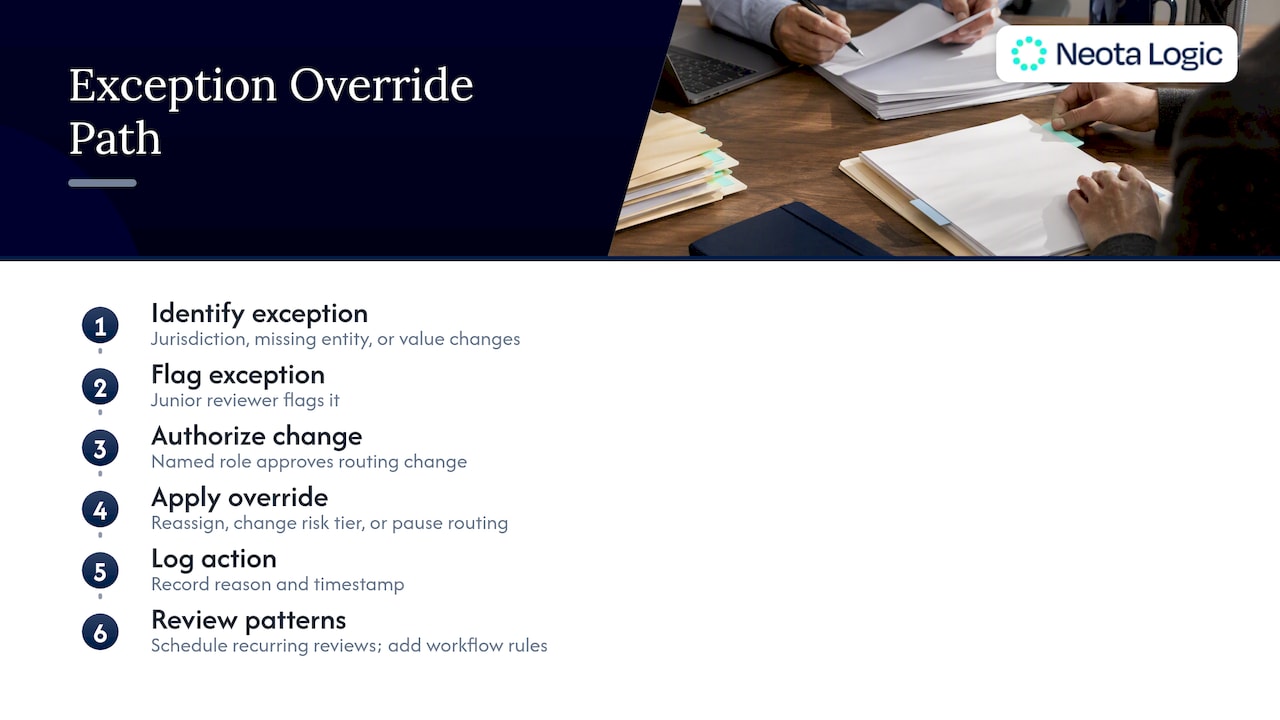
Set a rule for who can override and under what conditions. A junior reviewer should be able to flag an exception, but only a named role, such as senior counsel or the legal ops lead, should be able to approve a change to the default routing. This keeps the exception path from becoming a second, ungoverned intake system.
Review overrides on a schedule, not just when something goes wrong. If the same type of exception appears repeatedly, that is a signal the standard workflow needs a new rule, not that staff need to keep working around it. Centralized intake data makes this pattern visible in a way that email-based requests never do, which is part of why a documented exception process matters as much as the primary workflow.
What Legal Ops Should Prioritize First
Start with visibility, not perfect coverage. A form that tells requesters where their contract sits in the queue will earn more trust in month one than a form that handles every edge case but gives no status update. Plain language beats legal precision on an intake form. Get one department to a visibly faster turnaround, then use that result to pull the next department in. The data you collect will tell you where to automate next, often in places you did not expect.
How We Can Help You Build a Governed Intake Workflow
We build no-code, governed workflows that classify and route contract requests, apply DOA thresholds automatically, and keep an audit trail behind every decision. The platform is model-agnostic, so organizations are not locked into one AI vendor as needs change.
If you are ready to pilot a governed intake workflow, start with a Discovery Sprint or review our solutions overview to see how the pieces fit together.
FAQ
Can I request a copy of my contract?
Yes. Most intake workflows include a request type for document retrieval, separate from a new drafting or review request, and route it to whoever holds the executed copy.
What is an intake checklist?
An intake checklist is the set of required fields and documents a request must include before legal will begin review, covering requester details, contract metadata, risk flags, and attachments. A well-structured checklist groups these fields so the requester can complete them without legal training.
Is a request for proposal a contract?
No. A request for proposal (RFP) is a procurement document used to solicit bids before a contract exists, while the contract itself is the binding agreement signed after a vendor is selected.
What is intake at a law firm?
Intake at a law firm is the process of collecting a prospective client’s or matter’s details, running a conflict check, and deciding whether and how to proceed. Law-firm intake guidance recommends documenting the conflict check with the names searched, the databases reviewed, and the date it was run.
Sources
These sources informed the field checklist and governance guidance above, and they are worth reading in full if you are building or refining your own intake process.
Ready to make your AI workflows defensible?
Book a demo and we'll walk one of your real processes through Neota.
Book demo