Start CLM integration by prioritizing CRM and eSignature, standardizing contract metadata, and phasing work under legal-owned governance. This sequence protects auditability while you connect the systems that touch the most contracts. Skip the bolt-on AI experiments. Build a governed foundation first, then automate.
Neotalogic
Build Governed Legal Workflows
Neota Logic helps legal teams automate routine work with human oversight, compliance controls, and audit trails across governed workflows.
Table of Contents
Which systems should your CLM connect to first?
Not every integration deserves equal attention. Some connections touch every contract that moves through your organization. Others solve a narrow problem for one team. Legal ops leaders need to rank these before committing engineering time.
The systems worth connecting, in rough order of impact:
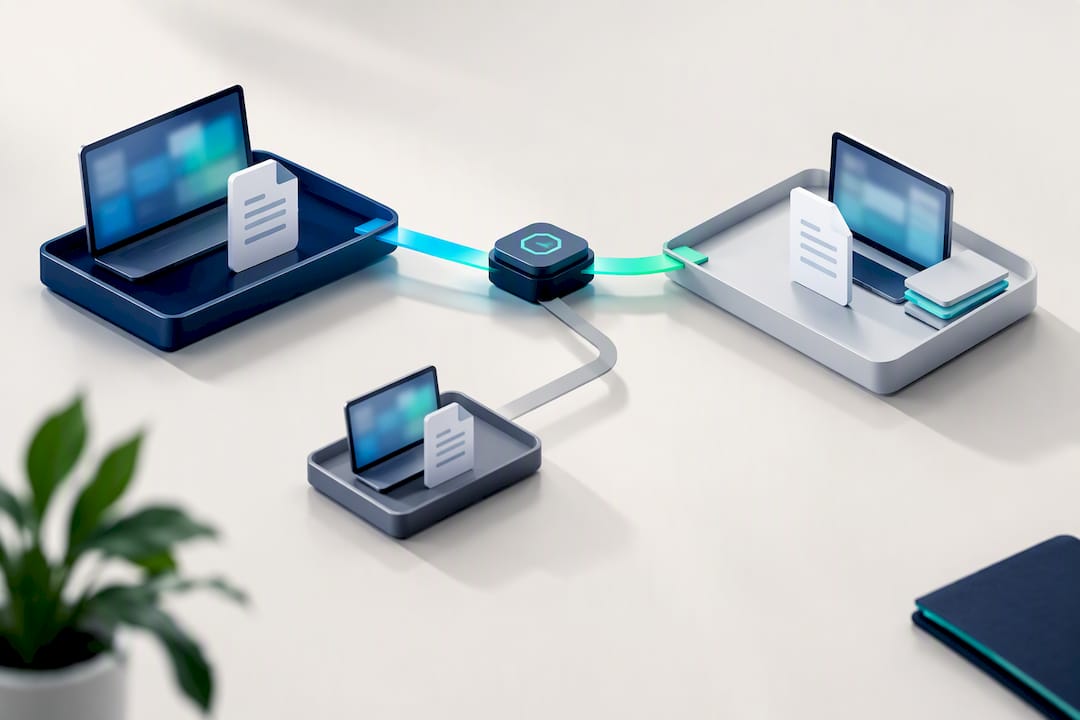
CRM and eSignature integrations move first because practitioners recommend starting with the two or three highest-value systems rather than connecting everything at once. Field-level data matters here: party names, effective dates, contract status, dollar value, and obligation deadlines need clean, bi-directional sync. A one-way feed from CRM to CLM is easy. Getting signed-status and amendment history back into CRM is where most projects stall.
How do you sequence a CLM integration project?
A phased rollout with clear ownership beats a big-bang deployment every time. A phased approach with sandbox testing and assigned ownership reduces integration failures and helps the CLM become the single source of truth for contract data.
Follow this sequence:
Before signing with any vendor, ask: does the platform expose open, versioned REST APIs? Does it support real-time webhooks or only batch polling? Can you get field-level audit logs for every sync event? Best-practice integration features include pre-built connectors, open versioned REST APIs, real-time webhooks, field-level mapping, audit logs, and role-based access controls, and a vendor that cannot answer these questions plainly is not ready for a legal-team deployment.
Pro Tip: Run your first integration invisibly. Let sales request contracts from inside the CRM they already use, and keep the CLM mechanics behind the scenes.
What API and security patterns keep integrations stable?
Integration failures rarely come from bad intentions. They come from unversioned schemas, missing retry logic, and authentication choices made without a security review. NIST recommends treating API development and deployment as an iterative life cycle, with pre-runtime protections like specifications and schemas paired with runtime protections like authentication, validation, and rate limiting.
Build these patterns into every integration from day one:
Automation correlates with measurable operational gains: CLM maturity research shows automation correlates with faster response times and fewer missed contractual obligations. That correlation only holds when the underlying integration is reliable, which is why the pre-runtime and runtime controls above are not optional extras.
Every sync event, every authentication attempt, and every retry needs a log entry. Legal teams cannot defend a contract’s chain of custody without one.
What governance rules apply to CLM integrations and AI?
Integration governance is not a compliance afterthought; for practical AI-driven legal content workflows, refer to the AI Content Optimization Guide for Legal Marketers. It determines whether your legal team can explain, defend, and reverse every automated action a system takes on a contract. EDRM’s Information Governance Reference Model recommends integrating policy, IT, legal, and records stakeholders to balance value, risk, and cost across the information lifecycle. That model applies directly to CLM integration decisions.
Apply this checklist before any integration touches production data:
Traceable inputs and outputs, plus a recorded human approval, are what separate a governed workflow from a black box.
Neota Logic’s approach reflects this structure directly. The platform orchestrates multiple AI models inside a governed workflow, logs every action for audit purposes, and lets legal teams classify and route requests without surrendering oversight to a single vendor’s model.
What common mistakes derail CLM integration projects?
Most failed integration projects share the same handful of root causes. Recognizing them early saves months of rework.
The fix for each is straightforward. Narrow your initial scope to CRM and eSignature. Start with data cleanup and canonical field definitions before any sync runs. Choose iPaaS or a governed orchestration layer over custom point-to-point code where volume justifies it. Name one owner per integration, with an SLA. Track adoption metrics for the first ninety days, not just at launch.
Pro Tip: Treat data cleanup as its own project phase with its own deadline. Teams that skip it end up debugging bad data instead of debugging the integration.
How do you measure whether your integrations are working?
An integration that nobody measures is an integration nobody can defend when a renewal is missed or a deal stalls. Set baseline and target KPIs before launch, not after.
Track these metrics on a standing dashboard:
Set alert thresholds for sync failures and define an incident response step for each. Automation correlates with faster response to legal requests and fewer missed obligations, but that research also finds many organizations still run mostly manual CLM processes, leaving room to close the gap. Tie every metric back to a business outcome: faster deal cycles, less revenue leakage from missed renewals, and fewer headcount hours spent chasing signatures manually.
Why governed integration beats feature chasing
Most CLM integration advice focuses on connectors and features. That misses the real risk. An integration that moves fast but cannot explain its own decisions is a liability waiting for an audit or a dispute. Legal teams that own integration policy, not just IT, keep control of what matters: defensibility.
Governed automation does not slow you down. It gives you a record you can stand behind when a regulator, opposing counsel, or your own general counsel asks how a contract term got approved. Start with a discovery sprint. Scope your first two integrations before you scope the rest.
A governed path to your first CLM integrations
Legal teams do not need another point solution bolted onto an already crowded stack. There is governed AI infrastructure built for corporate legal and compliance teams, not a chatbot layered on top of your CLM.
Neota’s platform gives legal ops leaders what a phased integration strategy requires:
If you are ready to scope your first two integrations properly, start with a Discovery Sprint to define your data model and rollout plan before any code ships.
Sources
FAQ
What are examples of CLM tools?
CLM tools generally fall into categories: dedicated contract lifecycle platforms, document automation systems, and governed workflow orchestration layers like Neota Logic that connect contract processes to CRM, eSignature, and finance systems. The right category depends on whether you need standalone contract storage or a governed layer that automates decisions across your stack.
What are the four types of workflows?
Workflow types are commonly grouped as sequential, parallel, conditional, and event-driven, based on how tasks move from one step to the next. A CLM integration typically uses conditional workflows for approval routing and event-driven workflows for triggers like signature completion.
What is a CLM in AI?
A CLM in an AI context refers to contract lifecycle management software that incorporates AI for tasks like clause extraction, risk flagging, or request triage, layered with governance controls that log and explain each automated decision. Definitions vary, but the common thread is pairing contract data with a decision-support layer that stays auditable.
What are the stages of CLM?
CLM stages typically include request and intake, drafting and negotiation, approval, execution, and post-signature obligation management. Integration work should map each stage to the systems it touches, since request intake often connects to CRM while execution connects to eSignature tools.
Recommended
Ready to make your AI workflows defensible?
Book a demo and we'll walk one of your real processes through Neota.
Book demo