Citizen development governance is the set of policies, roles, and technical controls that let non-professional developers build applications on low-code and no-code platforms without creating security gaps, compliance failures, or unmanaged technical debt. Get it right and you keep the speed citizen development promises. Get it wrong and you inherit shadow IT at scale.
Three actions matter more than any others right now:
Deloitte’s research on citizen development identifies the CoE and a holistic governance model as the two factors that separate organizations that scale citizen development safely from those that drown in uncontrolled app sprawl.
Key Takeaways
Citizen development governance succeeds when a named CoE owns policy, risk-tiering matches controls to app impact, and platform features enforce the rules automatically.
- Name a CoE owner: One accountable owner sets platform standards and policy instead of leaving governance to informal consensus.
- Apply risk-tiering: Match review depth to app impact so low-risk tools move fast and high-risk apps get full scrutiny.
- Build lifecycle controls in: Require sandbox testing, named ownership, and a decommissioning date before any app reaches production.
- Measure with real KPIs: Track app inventory, owner coverage, time-to-production, and incident rate to prove governance is working.
- Choose platforms that enforce, not just document: Neota Logic embeds RBAC, audit trails, and approval workflows directly into legal request intake and triage automation.
Table of Contents
- Why Citizen Development Governance Matters
- Core Components of an Effective Governance Framework
- How Do You Roll Out Governance in Six Steps?
- What Controls Should Apps Pass Through Before Production?
- What KPIs Prove Governance Is Working?
- Which Platform Features Reduce Governance Overhead?
- Example: Governed Intake-to-Triage Workflows for Legal Teams
- Change Management and Communication Strategies
- Budgeting and Resource Allocation for Governance
- Conflict Resolution and Escalation Paths
- Examples of Citizen Development Governance Done Well
- Sources
- FAQ
Why Citizen Development Governance Matters
Citizen development moves fast because it removes the traditional IT bottleneck. Business teams build the tools they need instead of waiting months for a development sprint that may never get scheduled. That speed is real, and so is the risk it introduces if nobody is watching.
Every ungoverned citizen-built app is a potential entry point for shadow IT, unmanaged data exposure, or a compliance gap nobody notices until an audit forces the question. A study on governing low-code platform adoption based on 30 practitioner interviews found that quality problems, shadow IT, and technical debt accumulate specifically where organizations skip role demarcation between citizen developers and technical experts.
Benefits governance protects:
Risks governance prevents:
Track your app inventory count and incident rate as your two baseline metrics. Both tell you, in plain numbers, whether governance is closing gaps or falling behind adoption.
Core Components of an Effective Governance Framework
A governance framework isn’t a single policy document. It’s a working system with interlocking parts, and skipping one weakens all the others.
The risk-tier matrix is where this framework earns its keep. Classify apps by business impact and technical complexity, then match controls to the tier:
Map responsibilities clearly: the CoE sets policy, IT guardians handle security and integration, business owners hold day-to-day accountability, and compliance signs off on regulated use cases. Vague ownership is how apps outlive the people who understand them.
How Do You Roll Out Governance in Six Steps?
Standing up governance doesn’t require a year-long initiative. It requires sequencing.
Resource checklist for your first governed app:
Most organizations can get a first governed app into production within 8 to 10 weeks. Scaling to a full portfolio of governed apps typically takes two to three additional quarters, largely because certification and platform vetting take longer than the policy work itself.
What Controls Should Apps Pass Through Before Production?
Every citizen-built app should move through the same lifecycle, regardless of who built it or how simple it looks.
The flow: sandbox → development → security and compliance review → user acceptance testing (UAT) → production → monitoring → decommissioning.
Each gate needs a concrete checklist, not a verbal nod:
Ownership is the single most common failure point. An app with no named owner becomes an orphan the moment its builder changes roles or leaves the team, and orphaned apps are where technical debt quietly accumulates. Require every app record to list an owner and a next-review date before it ever reaches production, and revisit that ownership at each periodic audit.
What KPIs Prove Governance Is Working?
Governance without measurement is a policy nobody can defend in front of leadership. A compact KPI set tells you whether the program is closing gaps or losing ground.
Core metrics to track:
Audit checklist for periodic reviews:
Set your baseline in the first quarter of the program, then report against it monthly through a CoE dashboard, with a deeper quarterly review for leadership. Quixy’s governance guidance notes that organizations applying structured KPI tracking alongside RBAC and approval workflows see measurably less shadow IT within the first few reporting cycles.
Which Platform Features Reduce Governance Overhead?
The platform you standardize on does a meaningful share of governance work for you, or it doesn’t. Look for:
Connect citizen-built apps to enterprise data through managed connectors and service accounts, never through a builder’s personal credentials. This is where platform choice actually reduces work: a tool with built-in audit trails removes the need for manual log review entirely, shifting governance effort from a human process to a system feature.
Example: Governed Intake-to-Triage Workflows for Legal Teams
Legal and compliance teams face a sharper version of the citizen development problem: the apps they build often touch privileged information, regulated data, or client-facing decisions. A governed intake-to-triage workflow shows how the framework above holds up under that pressure.
A corporate legal department builds a citizen-developed intake form that routes incoming requests to the right attorney based on matter type and urgency. Under a governed model, the workflow has a named business owner, a sandboxed testing phase using synthetic data, an audit log recording every routing decision, and an approval gate requiring compliance sign-off before the form touches live client data.
Neota Logic’s orchestration model applies exactly this pattern: legal request intake and matter triage run through governed workflows with full audit trails, so every automated routing decision is traceable and defensible.
Teams running this kind of governed intake workflow often report meaningfully faster time-to-triage and a visible reduction in backlog, without losing the audit trail a compliance review demands.
Pro Tip: Build your legal review checkpoint directly into the approval workflow itself, not as a separate manual step. When the review gate is part of the automation, nobody can accidentally skip it under deadline pressure.
Change Management and Communication Strategies
A governance framework fails if the people it governs never hear about it, or hear about it as a restriction rather than a partnership. Communication has to start before the first policy document, not after.
Announce the CoE and its mandate at the leadership level first, so business unit heads understand governance as organizational support, not IT overreach. Frame the message around what citizen developers gain: faster approval for low-risk apps, clear platform choices instead of guesswork, and a support structure when something breaks.
Run a short roadshow across departments explaining the risk-tier model in plain terms. Most resistance to governance comes from misunderstanding, not opposition. Once teams see that a simple scheduling tool clears review in days while a client-facing app gets deeper scrutiny, the logic becomes obvious rather than arbitrary.
UNDP’s guidance on participatory development makes a point worth borrowing directly: sustained buy-in depends on stakeholder consultation before rules take effect, not after. Involve a handful of active citizen developers in drafting the policy itself. Their fingerprints on the framework make adoption far smoother than a mandate handed down cold.
Keep communication ongoing, not a one-time launch event. A quarterly newsletter from the CoE, highlighting a governed app that shipped successfully, does more for adoption than any policy memo. Recognition works better than enforcement as a first lever, and enforcement stays available for the cases recognition doesn’t fix.
Budgeting and Resource Allocation for Governance
Governance needs a real budget line, not a volunteer committee borrowing hours from other jobs. Underfunding the CoE is the single fastest way to watch a governance program stall within its first year.
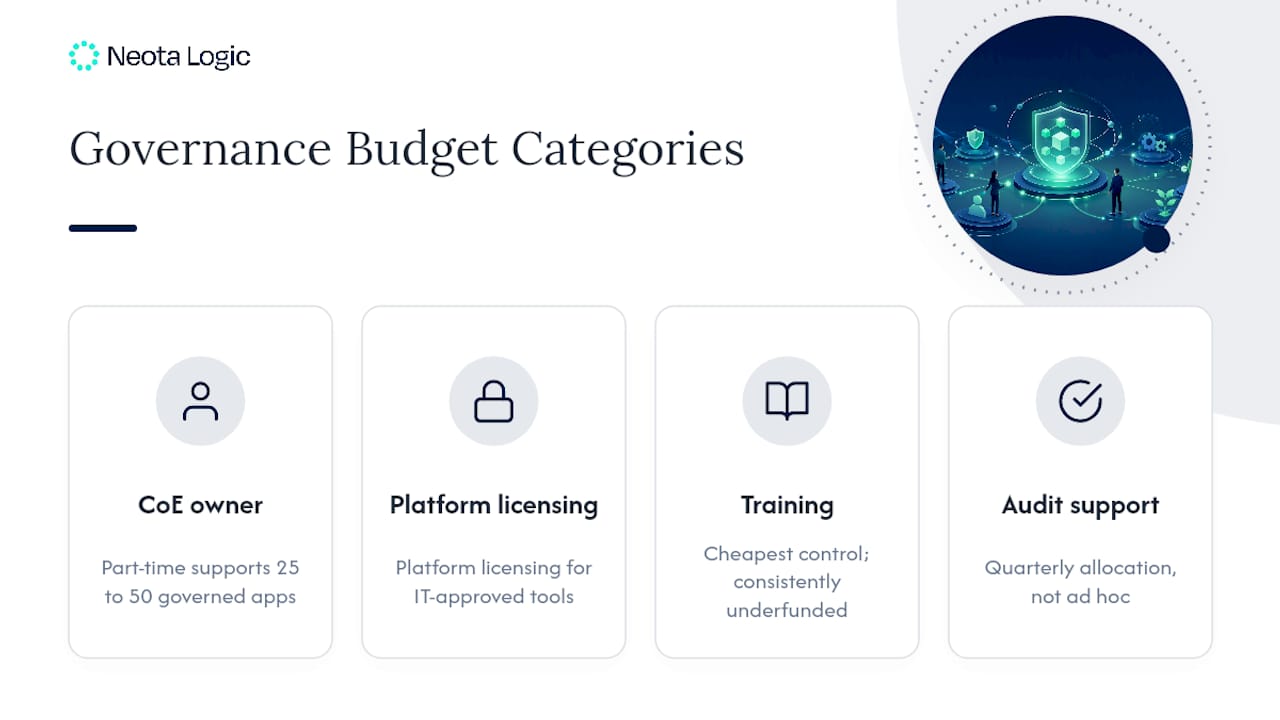
Budget for four categories: the CoE owner’s time (ideally a partial or full role, not a side project), platform licensing for the IT-approved tools list, training and certification content, and periodic audit support from security or compliance staff.
Most organizations start lean. A part-time CoE owner and a small training budget can support the first 25 to 50 governed apps. As the app inventory grows, the CoE role typically needs to become full-time, and audit support needs a dedicated quarterly allocation rather than an ad hoc request.
Resist the temptation to fund platform licensing while skipping training. An IT-approved platform with strong RBAC and sandboxing still fails if nobody has been trained to use its guardrails correctly. Training is the cheapest control in the entire framework and consistently the most underfunded.
Tie budget requests to the risk the program prevents, not just the efficiency it creates. Leadership responds better to “this budget line prevents the kind of shadow IT incident that triggers a compliance investigation” than to a generic efficiency pitch. Revisit the budget annually against your inventory growth and incident rate. If app volume doubles and the CoE budget stays flat, governance capacity is quietly falling behind adoption.
Conflict Resolution and Escalation Paths
Governance breaks down fastest when nobody knows what happens after a rule gets broken. A citizen developer bypasses the approval gate, or a business unit deploys an app on an unapproved platform. What happens next needs to be written down before it happens, not improvised in the moment.

Build a three-tier escalation path. First, the CoE owner and the business owner resolve minor policy deviations directly, usually through a corrective conversation and a remediation deadline. Second, repeated or higher-risk violations escalate to a joint IT and business leadership review. Third, breaches involving regulated data or compliance exposure go straight to legal and security leadership, bypassing the first two tiers entirely.
Document thresholds clearly: what counts as a minor deviation versus a reportable breach depends on the risk tier the app sits in, not on how the violation feels in the moment. A low-tier app missing a training certification is a minor issue. A high-tier app moving regulated data through an unapproved connector is not.
Multi-tiered governance structures used in decentralized systems, like the delegated voting and checks-and-balances model in Cardano’s governance framework, offer a useful analogy: clear delegation and defined thresholds prevent every disagreement from becoming a crisis that lands on the same desk.
Publish the escalation path alongside the governance policy itself, not in a separate document nobody reads. When citizen developers know exactly what happens if something goes wrong, they’re far more likely to self-report early problems instead of hiding them until an audit finds them.
Examples of Citizen Development Governance Done Well
The organizations that scale citizen development successfully share a pattern: they build the CoE before the app volume forces their hand, not after.
A common early move is starting with a single, well-scoped pilot department rather than an organization-wide rollout. The pilot department gets an approved platform, a lightweight risk-tier policy, and a CoE liaison who reviews every app for the first two or three months. Once that pilot proves the model works at small scale, the CoE codifies what worked into standard policy before opening access more broadly.
Deloitte’s research on citizen development points to organizations that treat suitability, scalability, supportability, security, and accessibility as five distinct evaluation criteria for every app, rather than a single blanket security review. That granularity is what separates governance that scales from governance that becomes a bottleneck the moment app volume grows.
The common thread across successful implementations isn’t the specific platform chosen. It’s the sequencing: CoE first, risk-tiering second, training third, then scale. Organizations that reverse that order, opening access broadly before the CoE and risk-tiers exist, almost always end up retrofitting governance onto an app inventory that’s already grown too large to audit cleanly. Retrofitting costs far more time than building governance in from the start.
Author perspective: balancing speed and safety
Governance that only restricts will lose to the speed citizen development promises. The frameworks that actually hold up treat governance as adaptive and co-owned by business and IT, not dictated by either alone. Centralize the risk-tier policy; decentralize day-to-day ownership. That split, revisited often, is what keeps both sides invested.
When Legal Teams Need Governed Automation
Legal and compliance teams face the sharpest version of this problem: the apps and workflows they build touch privileged data, regulated processes, and decisions that need a defensible audit trail. A governance framework only works if the platform underneath it actually enforces the controls you’ve written down.
Neota Logic was built specifically for this. Role-based approval workflows, full audit trails, and governed integration of multiple AI models mean the controls this article describes aren’t a policy document sitting in a shared drive. They’re enforced at the platform level, on every legal request intake and matter triage workflow that runs through it. If your legal or compliance team is ready to move from ad hoc citizen-built tools to a governed automation platform, schedule a demo of Neota Logic and see how governed workflows hold up under an actual audit.
Sources
- Deloitte: 5 Keys to Success with Citizen Developers
- AIS Insights: Governing Citizen Development to Address Low-Code Platform Challenges
- Quixy: How to Implement and Govern Citizen Development
- UNDP: Participatory Development Models
- Cardano: Governance Framework
Consult your CoE or legal team for jurisdiction-specific compliance requirements before finalizing policy.
FAQ
What Is Meant by Citizen Development?
Citizen development is the practice of non-professional developers, typically business users, building applications on low-code or no-code platforms without writing traditional code.
What Does Citizen-Centric Governance Mean in This Context?
It means governance designed around the people actually building and using the apps, balancing their need for speed with the controls IT and compliance require, rather than imposing rules built solely for professional developers.
What Does a Citizen Developer Actually Do?
A citizen developer builds functional business applications, workflows, or automations using low-code or no-code tools, usually to solve a problem within their own department rather than for organization-wide deployment.
What Is the Best Low/No-Code Platform for Governed Development?
The best platform depends on your risk profile and industry, but the strongest options share RBAC, sandboxing, audit trails, and governed data connectors as built-in features rather than add-ons. For legal and compliance teams specifically, Neota Logic’s platform is built around governed workflows and audit trails from the ground up.
How Long Does It Take to Stand Up Governance From Scratch?
Most organizations can get a first governed app into production within 8 to 10 weeks, with full-portfolio governance maturity typically taking two to three additional quarters as training and platform vetting scale up.
Recommended
Ready to make your AI workflows defensible?
Book a demo and we'll walk one of your real processes through Neota.
Book demo