The best rules engine software for a legal team is the one that can prove, months later, why a decision came out the way it did. Raw speed does not settle that. Language support does not settle it either. Most lists rank engines on developer features. General counsel and legal ops leaders should rank them on governance: audit trails, versioning, explainability and human oversight.
This comparison covers the engines buyers shortlist most often, from open source to enterprise decision platforms. It then explains where a rules engine stops and governed AI infrastructure begins. We build Neota Logic, so we state our position plainly. We also treat the other options fairly.
TL;DR
- A rules engine executes logic. A legal team also needs intake, routing, approvals, human review and a defensible record. Judge tools on that full chain.
- Open-source engines such as Drools, GoRules ZEN and json-rules-engine are capable. They hand your team the governance work: versioning, approvals, audit and rollback.
- Enterprise decision platforms such as InRule, IBM ODM and FICO Blaze Advisor bring governance tooling. They are built for IT-led decisioning, and pricing is by quote.
- Neota Logic is governed AI infrastructure for legal and compliance teams. Deterministic workflows, full audit trails and a model-agnostic design are the core.
- Pick on audit trail, versioning and explainability first. Features come second.
Table of Contents
- What a rules engine does for a legal team
- How we judged the options
- Rules engine comparison at a glance
- Open-source rules engines
- Enterprise decision platforms
- Where a rules engine stops
- Neota Logic: governed AI infrastructure for legal and compliance
- Perspective: governance is the differentiator
- Build your shortlist
- See governed workflows in action
- FAQ
- Sources
What a rules engine does for a legal team
A business rules engine separates decision logic from application code. Rules live in a central repository. Applications call them. When a regulation changes, you change the rule once. IBM describes this model as rules that can be reused across workflows and updated in response to new regulations without changing application code, with an auditable trail of the rules behind a decision.
That description fits legal work well. Think of the decisions your team repeats:
- Does this contract request need legal review, or can the business self-serve?
- Which matters go to outside counsel, and which stay in-house?
- Does this supplier trigger enhanced due diligence?
- Does this vendor use AI, and under which policy?
- Which regulatory obligation applies to this jurisdiction and data type?
Each decision is a rule set. Each rule set changes. Each change needs an owner, a date and a record. That is the requirement. A rules engine is one component of meeting it.
How we judged the options
We skipped feature checklists. Every engine on this list can evaluate a condition. The differences that matter to a legal buyer sit elsewhere.
- Audit trail. Can you reconstruct which rule version fired, on which inputs, with what result, and who approved the rule?
- Versioning. Can you roll back? Can you show the rule set as it stood on a given date?
- Explainability. Can a non-engineer read why a decision happened? Can you hand that explanation to a regulator or opposing counsel?
- Business-user authoring. Can legal ops change a rule without a developer ticket?
- Human oversight. Does the system route exceptions to a person and record the review?
- AI governance. If a model touches the decision, is that step controlled, logged and replaceable?
This tracks the definition James Taylor gives of a business rules management system: technical and business-user authoring, declarative syntax, a repository with versioning, management and audit, testing and simulation, and deployment as a decision service. Legal teams should treat the repository and audit items as non-negotiable.
Rules engine comparison at a glance
| Option | Type | Best fit | Governance posture | Cost model |
|---|---|---|---|---|
| Drools | Open source, Java | Engineering-led teams with Java stacks | Strong engine. Approvals, audit and rollback are yours to build or buy as a commercial edition | Open-source license |
| GoRules ZEN Engine | Open source core, JSON decision models | Cross-platform product teams | Lightweight. Governance depends on the surrounding setup | Open-source core, commercial offerings exist |
| json-rules-engine | Open source, JavaScript | Web applications with simple conditions | Minimal. No legal governance layer | Open source |
| InRule | Enterprise decision platform | Regulated industries with IT-led decisioning | Governed authoring and audit readiness | Quote-based |
| IBM ODM | Enterprise rules management | Large enterprises already on IBM | Mature repository and audit | Quote-based |
| FICO Blaze Advisor | Enterprise decision platform | Financial services decisioning | Mature, built for credit and risk | Quote-based |
| Neota Logic | Governed AI and workflow infrastructure | Corporate legal, law firms, compliance | Audit trails, versioning, explainability and human review built in | Subscription, by demo |
Neota Logic’s commercial terms are handled in a demo, not on this page.
Open-source rules engines
Open source is the fastest way to start. It is also the most expensive way to discover your governance gaps. Sevenlake’s guide lists Drools, OpenL Tablets, GoRules ZEN Engine, Microsoft RulesEngine and json-rules-engine as the main open-source choices, and each takes a different approach.
Drools
Drools is the best-known open-source rules engine. It supports Java inference, DRL, decision tables and DMN. The Drools documentation describes DMN models as an OMG standard notation with graphical decision requirements diagrams, and notes that DMN tables and Drools-native tables are different assets that are not interchangeable.
Drools is a serious engine. For a legal team, the question is who runs it. You need Java engineers, a deployment pipeline and an approval process around rule changes. The engine will execute. It will not tell your general counsel who signed off on version 14 of the conflicts rule.
OpenL Tablets
OpenL Tablets expresses rules as spreadsheet-style tables. That is friendly to business analysts who live in Excel. It is also a risk. Spreadsheets drift, and spreadsheet logic is hard to defend when someone asks who changed a cell and why. Wrap it in change control before you use it for anything that touches regulatory posture.
GoRules ZEN Engine
GoRules uses JSON decision models that run across platforms. It suits product teams that want a small footprint and a visual decision editor. Legal teams can use it for narrow, well-bounded decisions. It is not an intake, triage and review system.
Microsoft RulesEngine and json-rules-engine
Microsoft RulesEngine targets .NET with JSON rules. The json-rules-engine library handles JavaScript conditions and events. Both are developer libraries. They suit embedding a few rules in an application. They are the wrong tool when the rule owner is a lawyer.
What to check before adopting open source
Sevenlake’s checklist is sound. Check the license and the boundary of any commercial edition. Check project activity and support. Check rule ownership, testing, versioning, approvals, audit and explanation features, integrations, and deployment and rollback. Score each against your own record-keeping obligations. If three or more are gaps, you are building a governance product, not adopting a rules engine.
Enterprise decision platforms
Enterprise platforms close many of the governance gaps. They also cost more and take longer to stand up.
InRule
InRule sells enterprise business rules, a decision engine and decision automation. Its recent browser-based authoring launch positions the product as a governed decision modeling workspace for regulated organizations in financial services, insurance, healthcare and government. The emphasis on traceability and audit readiness is the right one. The buyer profile skews toward IT and operations decisioning, not legal request management.
IBM Operational Decision Manager
IBM ODM is a mature business rules management system. It suits large enterprises that run IBM middleware and have a central decision-management team. Expect a heavy implementation. Legal departments rarely own it. They usually become a customer of a platform that IT runs.
FICO Blaze Advisor
Blaze Advisor comes out of credit and risk decisioning. It is strong where decisions are numeric, high-volume and tied to models. Legal workflows are narrative, document-heavy and exception-driven. The fit is partial.
Pricing on enterprise platforms
Expect quotes, not price lists. RFP Wiki’s October 2026 comparison reports that FICO Platform and Blaze Advisor have no public official dollar price, are sold through enterprise quotes, and that pricing depends on use case, deployment model, organization size, usage, environments, support and bundled components. The Digital Project Manager reaches a similar view: InRule, IBM ODM and other decision-management products generally use pricing on request, and some offer demos or trials. Build your business case around total cost of ownership, including the people who maintain the rules.
Where a rules engine stops
A rules engine answers one question: given these inputs, what does the rule say? Legal operations ask harder ones.
- Who submitted the request, and was it classified correctly?
- Which rule set applied on that date?
- Did a model contribute to the outcome, and which one?
- Did a lawyer review the exception? When? What did they decide?
- Can we produce all of this on demand, in a form a court or regulator accepts?
A rules engine plus a workflow tool plus an AI vendor plus a spreadsheet of approvals does not answer these. The seams between tools are where records go missing. Privilege dies quietly in those seams, and the argument that your controls were not reasonable writes itself.
That is the gap we build for.
Neota Logic: governed AI infrastructure for legal and compliance
Neota Logic is not a point solution and not a chatbot. It is governed AI infrastructure. It sits between legal experts and the AI tools they want to use, and it puts the controls in the workflow.
Here is what that means in practice.
- Deterministic workflows. Decision logic is explicit. The same inputs produce the same path. Legal owns the logic.
- Audit trails. Every action is tracked: intake, classification, routing, rule application, model involvement and human review.
- Versioning. Workflows and rules are versioned, so you can show what was in force when a decision was made.
- Explainability. A reviewer can follow why a request went where it went. That is the evidence you hand to a regulator.
- Human oversight. Exceptions route to people. The review is recorded.
- Model-agnostic design. We integrate multiple AI models. You are not locked to one vendor, and you can swap a model without rebuilding the process.
- No-code authoring. Legal and compliance professionals build and change workflows and document automation themselves.
- Integrations. The platform connects to the document, CRM and communication tools your team already uses.
The solution set covers workflows, document automation, advisory solutions, AI-enabled solutions and more. Use cases include legal request intake, matter triage, contract automation, risk assessment, compliance advisors, onboarding processes, supplier management and AI governance.
Rules engine or governed workflow platform?
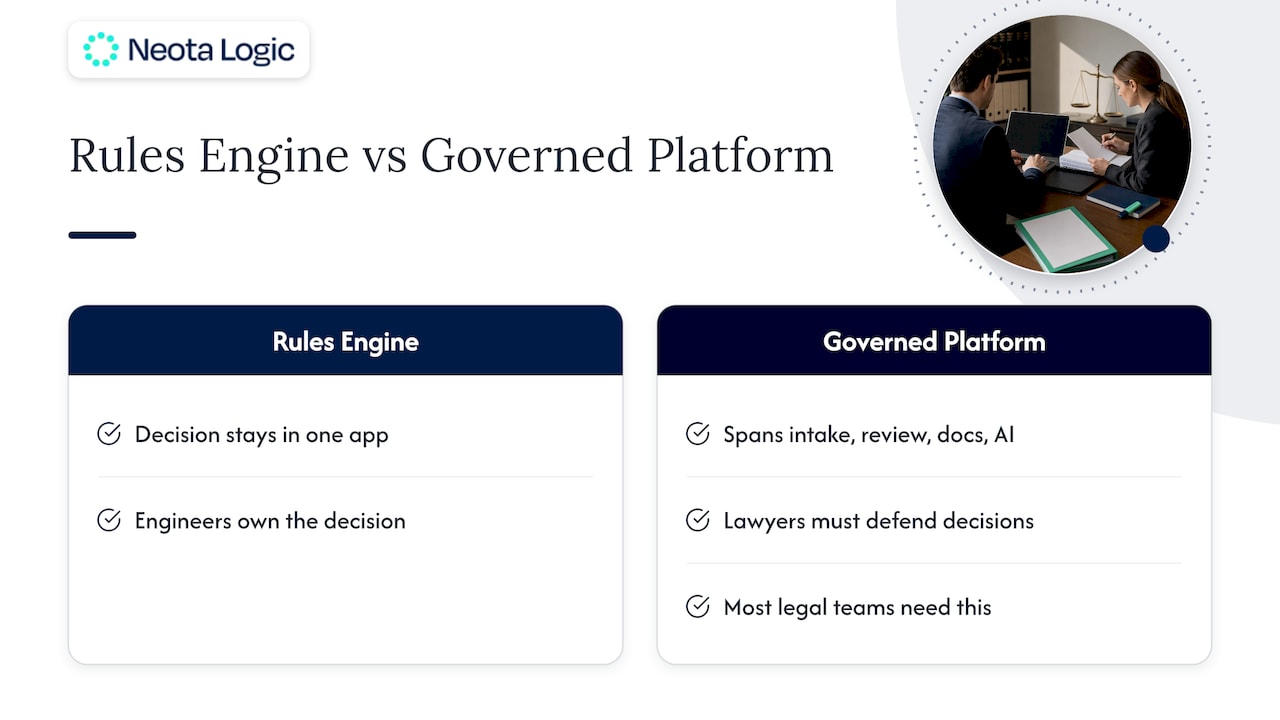
Use this test. If the decision lives inside one application and engineers own it, a rules engine is enough. If the decision crosses intake, review, documents and AI, and a lawyer must defend it later, you need governed infrastructure. Most legal departments have the second problem.
Perspective: governance is the differentiator
We do not think feature lists decide this category. Every vendor claims no-code authoring, integrations and AI. The test comes when something goes wrong. A regulator asks how your team classified a request. Opposing counsel asks whether a model saw privileged material. A board member asks who approved the AI policy.
Ungoverned AI use creates malpractice exposure and weakens the reasonable-measures argument you rely on to protect privilege. A rules engine alone does not fix that. It executes logic. It does not capture the human decisions around the logic. It does not control which model sees which data.

Our position is simple. Governance comes before capability. Deterministic workflows come before probabilistic outputs. A model supports a decision. A lawyer owns it. Every step leaves a record. If a tool cannot show you the audit trail, the version history and the explanation, it is not ready for legal work.
If your organization is adopting AI faster than it is writing controls, start with the controls.
— Patrick
Build your shortlist
Run every candidate through the same five checks.
- Reconstruction test. Pick a past decision. Ask the vendor to reproduce the rule version, inputs and outcome from the system. No screenshots.
- Change test. Ask a legal ops analyst, not an engineer, to change a rule. Time it. Check the approval record afterward.
- Rollback test. Revert a rule set to last quarter. Confirm the system shows what was live and when.
- AI test. Insert a model into a step. Confirm you can log it, restrict its data, route its output for review and replace it.
- Exception test. Send in an edge case. Confirm it reaches a named person and the review is captured.
The IBM guidance on rules management recommends keeping rules in a central repository apart from application code, simulating changes before implementation and retaining an audit trail. Make the vendor demonstrate each of those, not describe them.
If you are also scoping the wider automation program around these tools, resources on AI agents and automation can help you frame what to automate first. Keep legal decisions inside the governed layer.
See governed workflows in action
We offer the Neota platform, deployment and services, and a Discovery Sprint to scope your first governed workflow. Start with one high-volume process, such as legal intake or contract review, and prove the audit trail on real work. See the Neota platform and services options, or start at neotalogic.com to request a demo.
Bring a real use case to the demo. We will show you the audit trail, the version history and the explanation for it.
FAQ
What is the best rules engine software for legal teams?
The best choice records the rule version, inputs, outcome and human review for every decision. Open-source engines like Drools execute well but leave governance to you. Enterprise platforms add governance for IT-led decisioning. For corporate legal and compliance teams, we recommend governed infrastructure such as Neota Logic, built around audit trails and oversight.
Is Drools a rules engine?
Yes. Drools is an open-source business rules engine that supports DRL, decision tables and DMN models. It runs on Java. It is a strong engine, but approvals, audit and rollback are processes your team has to build or buy separately.
Can a rules engine replace a legal workflow platform?
No. A rules engine evaluates logic. A legal workflow platform handles intake, routing, documents, review and records around that logic. Legal teams that stop at the engine usually rebuild the missing pieces by hand.
What should I check before adopting an open-source rules engine?
Check the license and any commercial-edition boundary, project activity and support, rule ownership, testing, versioning, approvals, audit and explanation features, integrations, and rollback. If your team must build most of those, the cost advantage disappears.
Do rules engines make AI use safe?
Only when the AI step sits inside controlled logic. The model must be logged, limited in the data it sees, replaceable, and followed by human review on exceptions. A rules engine alone does not enforce those controls.
Sources
- What is Business Rules Management? | IBM
- A Realistic View of Business Rules Engines (Features), Business Rules Community
- Open-Source Business Rules Engines: A Practical Guide, Sevenlake
- Drools Documentation
- InRule launches irAuthor Web
- InRule vs FICO (2026), RFP Wiki
- 10 Best Decision Management Software for 2026, The Digital Project Manager
Ready to make your AI workflows defensible?
Book a demo and we'll walk one of your real processes through Neota.
Book demo