The best legal AI platform is the one your team can defend. Research assistants such as Harvey, CoCounsel, and Lexis+ AI lead on research and drafting. Spellbook leads on in-Word contract work. Neota Logic leads where the question is governance: deterministic workflows, model-agnostic orchestration, versioning, and a full audit trail on every action. Which one you need depends on the work, and most teams need more than one layer.
This comparison is written for general counsel and legal operations leaders. It skips the primer on AI. It covers what each category does, where each one fails, and the criteria that decide a purchase.
TL;DR
- Adoption is no longer the question. 94% of law firms are using or exploring GenAI and 88% of general counsel use AI. Governance is the open question.
- Research and drafting assistants (Harvey, CoCounsel, Lexis+ AI) are strong at their job. They are not a governance layer.
- Contract tools (Spellbook, Legora, Ironclad) work at the document level. They do not govern intake, routing, or decisions across a department.
- Neota Logic is governed AI infrastructure. It orchestrates multiple models inside deterministic workflows with audit trails, versioning, and explainability.
- Score every vendor on security, workflow fit, and accuracy with your own matters. Do not buy on a demo.
Table of Contents
- How we sorted the market
- Research and drafting assistants
- Contract and document tools
- General-purpose assistants
- Neota Logic: governed AI infrastructure
- Side-by-side comparison
- What “vendor-agnostic” must mean
- Security and confidentiality checks
- Accuracy is a workflow problem
- How to run the evaluation
- Our perspective
- Where Neota fits in your stack
- How to choose
- FAQ
- Sources
How we sorted the market
Legal AI is sold under one label and built as four different things. Compare like with like.
- Research and drafting assistants. Grounded in legal content. Used by lawyers one query at a time.
- Contract and document tools. Built for drafting, redlining, review, and contract lifecycle work.
- General-purpose assistants. Claude, Gemini, Copilot, and ChatGPT. Broad, fast, and ungoverned by default.
- Governed orchestration platforms. Infrastructure that routes legal work, applies decision logic, calls AI models under control, and records everything.
Most lists mix these four into one ranking. That is a category error. A research assistant and an orchestration platform do not compete for the same budget line. They answer different questions. One asks, “Can a lawyer get a good answer?” The other asks, “Can the department prove how the answer was produced?”
Research and drafting assistants
Harvey
Harvey is pitched as an AI platform with agents for contract intelligence, bulk document analysis, and legal research, and it is used in pilots at many large firms. It offers configurable agents and custom workflows. A published model inventory covers Anthropic, OpenAI, Google, and early-access Mistral families, with an Auto mode that selects models per request.
Strength: breadth. One interface covers research, drafting, and analysis.
Limit: it is a lawyer-facing assistant. Model selection happens inside the vendor’s product. Your department does not own the decision logic around it.
Thomson Reuters CoCounsel
CoCounsel is positioned for research-heavy, litigation-focused work and grounds its analysis in Westlaw and Practical Law content. If your litigators live in Westlaw, the fit is natural.
Strength: content depth and citation grounding.
Limit: it extends one publisher’s ecosystem. It is not built to route intake or encode your department’s own rules.
Lexis+ AI with Protégé
Lexis+ with Protégé combines LexisNexis primary law, secondary sources, Practical Guidance, Shepard’s validation, Word drafting, and multi-step workflows. Shepard’s validation matters. Citator checks are the control that catches bad authority.
Strength: the research corpus and validation.
Limit: the same as CoCounsel. It serves the individual lawyer’s research task, not the department’s operating model.
Contract and document tools
Spellbook
Spellbook is built for transactional lawyers. It works inside Microsoft Word for drafting, redlining, and clause analysis. Its early-access Autonomous Contract Management extends into intake, review, and insight.
Strength: it meets the transactional lawyer in the tool already open.
Limit: Word is the boundary. A request that begins in an email and ends in a signed approval needs more than a Word add-in.
Legora and Ironclad
Legora’s Agent is positioned to plan and execute work across matter types, including contract lifecycle work. Ironclad’s Jurist focuses on end-to-end contract work. Both aim at the lifecycle. Both ask you to accept the vendor’s workflow shape.
General-purpose assistants
Claude, Gemini, Copilot, and ChatGPT are all in use at law firms. The American Bar Association has reviewed these tools for legal work. They are fast and flexible.
They are also where ungoverned use starts. A lawyer pastes a draft into a consumer account. The prompt leaves the control environment. No log exists. Confidentiality is now an argument instead of a fact. Privilege dies quietly.
The ABA’s Formal Opinion 512 is direct on this point. It says lawyers using generative AI must consider their obligations on competence, confidentiality, client communication, and fees. A general counsel cannot show compliance with those duties without records.
Neota Logic: governed AI infrastructure
Neota Logic is not a chatbot and not a point solution. It is the layer that sits between your legal experts and the AI models they use. The platform classifies and routes legal requests, applies decision logic, calls AI where AI belongs, keeps humans in the review step, and records every action.
What that means in practice:
- Deterministic workflows. The path a matter takes is defined by your rules. The model does not decide the route. The model does a bounded task inside it.
- Audit trails. Every request, decision, model call, and human approval is tracked. When a regulator, a court, or your board asks how a result was reached, you have the record.
- Versioning. Workflows and logic are versioned. You can show which rules were live on which date.
- Explainability. Decision logic is explicit. A reviewer can read why a request went where it went.
- Model agnosticism. Neota uses multiple AI models. A model change does not mean a rebuild.
- Integration. The platform connects to existing document, CRM, and communication tools.
The product lines cover AI-enabled solutions, workflows, advisory solutions, and document automation. Use cases include contract automation, risk assessment, a compliance advisor, onboarding processes, supplier management, and AI governance.
Neota does not replace Harvey, CoCounsel, or Lexis+ AI for research. It governs how AI is applied to the work around research. For intake, triage, approvals, and compliance, it is the stronger choice because governance is its design center, not an add-on.
Side-by-side comparison
| Platform | Category | Best for | Governance posture |
|---|---|---|---|
| Neota Logic | Governed orchestration | Intake, triage, decision logic, compliance workflows, AI governance | Deterministic workflows, audit trails, versioning, human oversight, multi-model |
| Harvey | Research and drafting assistant | Broad research, drafting, bulk document analysis | Vendor-managed model routing |
| CoCounsel | Research assistant | Westlaw-based litigation research | Grounded in Westlaw and Practical Law |
| Lexis+ AI with Protégé | Research assistant | Lexis-based research, Shepard’s validation, Word drafting | Grounded in LexisNexis content |
| Spellbook | Contract drafting tool | Transactional drafting and redlining in Word | Document-level |
| Legora, Ironclad | Contract lifecycle | End-to-end contract work | Vendor-defined workflow |
| Claude, Gemini, Copilot, ChatGPT | General-purpose | Ad hoc tasks | Depends entirely on your configuration |
The last column is the one that decides disputes. Capability gaps close every quarter. Governance gaps show up after an incident.
What “vendor-agnostic” must mean
Many vendors say they are model-agnostic. Test the claim.
Databricks’ guidance says a genuinely vendor-neutral agent platform decouples agent logic from model choice, makes model selection a configuration parameter, routes through an abstraction layer, and applies unified governance. Its checklist is useful: portable agent definitions, multi-provider routing, open SDKs, deployment flexibility, and whether a model change requires code changes.
One more caution. OpenAI’s engineering guidance notes that switching providers does not automatically resume an agent session or reconcile saved work. Portability must be tested at the workflow level. API compatibility is not proof.
Ask every vendor three questions:
- Who chooses the model for a given task, you or the vendor?
- If you swap the model, what in the workflow changes?
- Does the audit trail record which model produced which output?
A vendor that cannot answer the third question cannot support a defensible record.
Security and confidentiality checks
Security review comes before feature review. Contractual commitments and technical controls should cover encryption, tenant separation, incident notification, retention, deletion, and access. SOC 2 Type II or ISO 27001 evidence should match the specific product you are buying, not the vendor’s parent company or a different module.
Check these items in writing:
- Is customer data used to train any model?
- Where is data processed and stored?
- Which subprocessors, including model providers, touch your prompts?
- How long are prompts and outputs retained, and who can delete them?
- Can you export the full audit log?
The last item is the one most often missing. A log you cannot export is a log you do not control.
Accuracy is a workflow problem
Citations are where AI fails publicly. In 2023, the Mata v. Avianca matter ended with a $5,000 sanction for attorneys who did not verify citations from a general-purpose chatbot. A peer-reviewed Stanford RegLab study reported that leading commercial legal research tools hallucinate roughly 17% to 34% of the time, according to the same source.
The lesson is not that research tools are useless. The lesson is that no model output should reach a client without a defined review step. That step must be built into the process, not left to individual diligence. A governed workflow makes verification a gate. The matter does not advance until a named reviewer approves. The approval is logged.
How to run the evaluation
Do not rely on vendor demos. Run a scored proof of capability. One professional framework recommends a typical 90-day evaluation with at least 30 representative matters and 100 scored questions. Its suggested weighting is 30% security, 25% workflow, 20% accuracy, 10% implementation, and 15% cost.

We would adjust one thing. If your use case is operational, such as intake, triage, or compliance, raise the weight on auditability and treat it as a separate criterion from security. A secure system with a thin record is still hard to defend.
Use this sequence:
- Define the work. List the five matter types that consume the most time.
- Pick the layer. Research, drafting, or orchestration. Do not score a research assistant against an orchestration platform.
- Build the test set. Use real matters, scrubbed as needed, including edge cases.
- Score blind where possible. Have reviewers grade outputs without knowing the source.
- Test the exit. Ask how you would leave. Request the data export and the model swap procedure.
- Model total cost. Pricing structures vary by user, matter, document, query, or workflow run. The same source advises a three-year total-cost model that includes configuration, training, integration, and administration.
Our perspective
We built Neota Logic on a position: AI in legal work is an infrastructure problem before it is a tooling problem.
The market sells assistants. Assistants help individual lawyers. They do not give a department a system of record. When a lawyer uses a model in a side window, the department has no version history, no routing logic, and no proof of review. If privilege is challenged, the argument writes itself. The other side asks what controls existed. “We trusted the tool” is not an answer.
We hold three convictions.
Governance is the product. Features are copied within a quarter. A defensible record is not a feature. It is an architecture decision made on day one.
Determinism belongs around the model. Models are probabilistic. The workflow that surrounds them must not be. Your rules decide routing, thresholds, and approvals. The model performs a bounded task and returns a result for review.
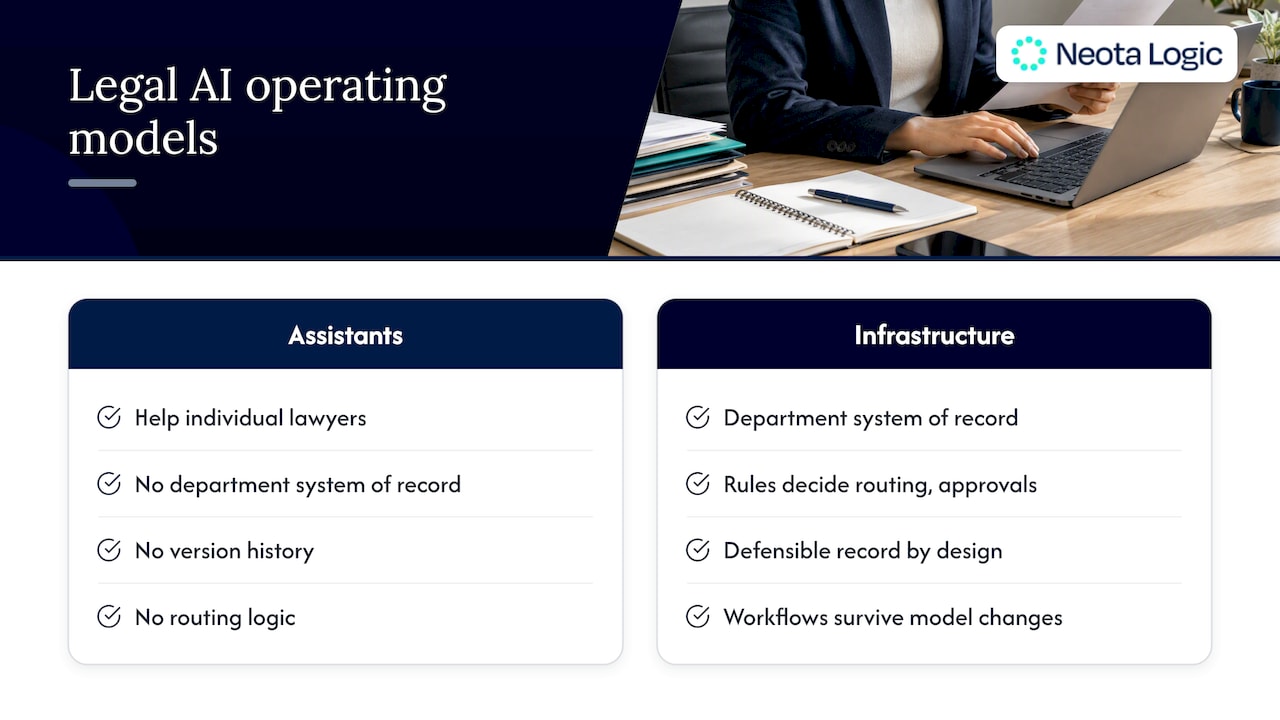
No model should own your process. Models change. Providers change terms. Your workflows should survive both. That is why we orchestrate multiple models and keep logic outside any single one.
If you are a GC or a legal ops leader, the practical test is simple. Pick any AI-assisted decision from last month. Can you show who requested it, which rules applied, which model ran, who reviewed it, and which version of the workflow was live? If not, you have a gap. It will be found by someone else first.
— Patrick
Where Neota fits in your stack
Most mature teams will run two layers. Keep the research assistant your lawyers trust. Add a governed layer for the work that carries department-level risk: request intake, matter triage, contract workflows, compliance assessments, and AI governance itself.
To see the workflow and AI-enabled offerings, review the Neota Logic solutions. To scope a deployment, including platform access, services, and a Discovery Sprint, start on the Neota Logic pricing and engagement page. A Discovery Sprint is the fastest way to test one real workflow before a wider commitment.
How to choose
| If your priority is | Start with |
|---|---|
| Legal research inside Westlaw | CoCounsel |
| Legal research inside Lexis | Lexis+ AI with Protégé |
| Broad drafting and analysis for lawyers | Harvey |
| Transactional drafting in Word | Spellbook |
| Intake, triage, decision logic, audit trails, AI governance | Neota Logic |
| Avoiding model lock-in across departments | Neota Logic |
The decision is rarely either-or. The question to settle first is which work must be governed and which work can stay with the individual lawyer.
FAQ
What is the best legal AI platform for a corporate legal department?
It depends on the layer. For research, pick the assistant that matches your content subscription. For intake, triage, compliance, and AI oversight, pick a governed orchestration platform such as Neota Logic. Most departments need both.
Is there a legal version of ChatGPT?
Yes. Several vendors sell assistants grounded in legal content, including Harvey, CoCounsel, and Lexis+ AI. They add legal sources and controls that a consumer chatbot lacks. They still need human review and a defined verification step.
Which AI platforms are vendor-agnostic?
Few are fully agnostic. Test whether you or the vendor chooses the model, whether a model swap needs code changes, and whether the audit trail records the model used. Neota Logic is built to orchestrate multiple models so your workflows do not depend on one provider.
What should I verify before approving a legal AI vendor?
Verify encryption, tenant separation, retention, deletion, incident notification, and subprocessor use. Confirm that SOC 2 Type II or ISO 27001 evidence covers the exact product. Then run a scored test on your own matters. Do not accept demo results.
Do ethics rules apply to AI use by lawyers?
Yes. The ABA’s Formal Opinion 512 applies the existing duties of competence, confidentiality, communication, and reasonable fees to generative AI. Your state bar may add its own guidance, so check it as well.
Sources
- Legal Geek: Buy. Build. Bin. What legal is really doing with AI
- Best AI Agents for Legal Teams in 2026
- Legal AI Vendor Operations: Data Policy, Model Providers
- Harvey vs Lexis+ Protégé: 2026 Comparison
- 9 Best AI Tools for Lawyers in 2026
- AI Tools for Legal Work: Claude, Gemini, Copilot, and More (ABA)
- ABA issues first ethics guidance on a lawyer’s use of AI tools
- Which AI agent platforms support agents that are not tied to a single model
- Designing failover across OpenAI model providers
- How Do You Compare Legal AI Vendors Without Overselling or Missing the Fine Print
- AI for legal research: where it helps, where it gets it wrong
Ready to make your AI workflows defensible?
Book a demo and we'll walk one of your real processes through Neota.
Book demo