An AI-native law firm is built around a logic engine. The engine holds the firm’s rules, routes each request, calls models where they help and records every step. Without it, you do not have an AI-native firm. You have lawyers using tools.
This article is for general counsel and legal ops leaders. We do not explain AI here. We explain what has to sit around it so the work survives a regulator, a client audit or a privilege challenge.
TL;DR
- A logic engine converts legal methodology into executable, versioned rules. Models operate inside those rules. They do not replace them.
- Governance is the differentiator. Features are not. Audit trails, versioning and explainability decide whether AI work is defensible.
- Keep your playbooks in your own systems. The engine executes them. It must not trap them.
- Use more than one model. Model choice should be a setting, not a contract.
- Start with one high-volume workflow, define the human checkpoints first, then add AI.
Table of Contents
- What “AI-native” actually means
- What a logic engine does
- Why governance, not features, separates the options
- The regulatory pressure is already written down
- Where the logic should live
- Perspective: governed infrastructure, not a point solution
- How to build the engine: a practical sequence
- What to ask any vendor
- Common objections
- See the control layer in practice
- FAQ
- Sources
What “AI-native” actually means
The label is everywhere. Practitioner definitions agree on one point: agents can now draft intake forms, run conflicts searches, calendar deadlines and prepare memos. Each of those tasks still runs inside a lawyer’s ethical walls and under a lawyer’s signature.
That is the real line. An AI-native firm does not let models decide. It designs the process so that models contribute at defined points and humans own the outcome.
A firm that bolts a copilot onto a legacy process gets throwaway outputs. A firm that encodes its methodology gets repeatable ones. Stanford Law’s conversation with John Nay and Ryan Daniels describes this as an encoding layer, where legal expertise becomes executable workflow and agents act on high-level guidance instead of reactive prompts.
The encoding layer is the logic engine. Everything else is a model call.
What a logic engine does
A logic engine is deterministic infrastructure. Given the same inputs and the same rule version, it returns the same route, the same decision and the same record. A model can be probabilistic. The system around it cannot be.
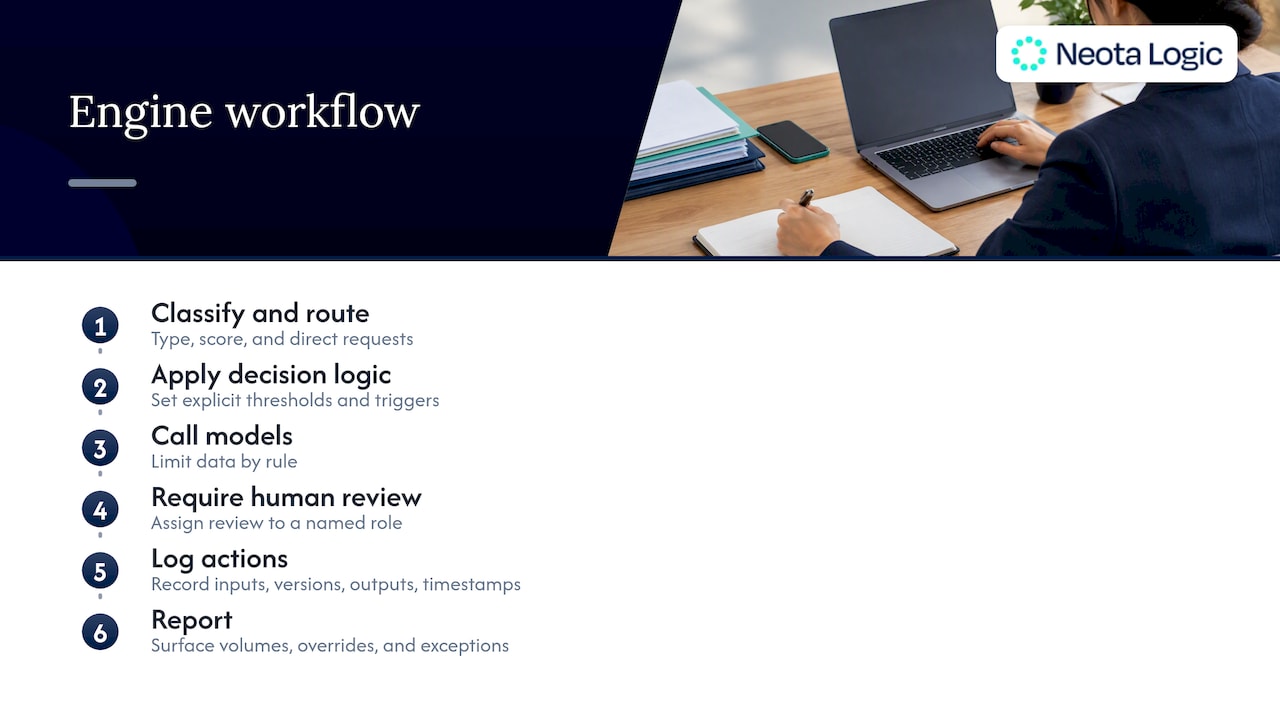
A working engine does six things.
- Classifies and routes. Every request is typed, scored and sent to the right queue, person or automated path.
- Applies decision logic. Thresholds, jurisdictional rules, approval hierarchies and escalation triggers are explicit, not implied by a prompt.
- Calls models under control. A model sees only the data the rule permits. Its output is a recommendation that the workflow then checks.
- Enforces human checkpoints. Review is a required step with a named role, not a suggestion.
- Logs every action. Inputs, rule version, model used, output, reviewer and timestamp are written to the record.
- Reports. Volumes, cycle times, overrides and exceptions are visible to legal ops without a manual audit.
None of this is a chat window. A chatbot answers. An engine decides what is allowed to happen next.
Why governance, not features, separates the options
Every legal AI vendor lists drafting, summarizing and review. Those features converge fast. Your exposure does not.
The question a GC will face is not whether the tool was fast. It is whether the organization can show how an answer was produced, who checked it and which rules applied. If you cannot, the argument against you writes itself.
Three governance properties carry the weight.
Audit trails
An audit trail that lives in a vendor’s log viewer is weak. One that stays attached to the matter is strong. DeepInspect frames the standard well: connect each routed request to the matter, the authenticated lawyer, the confidentiality class, the destination and the policy decision.
That is the test to apply. Can you pull one matter and reconstruct every AI touchpoint on it? If the answer takes a week, the trail does not exist in any useful sense.
Versioning
Rules change. Playbooks change. A clause position approved in March may be retired in June. If the engine cannot tell you which version governed a decision made in April, you cannot defend that decision.
Versioning means every workflow, rule set and prompt template carries an identifier and a date. It means a decision record points to the exact version that produced it. It means rollback is a controlled action, not a scramble.
Explainability
Explainability in legal work is not model interpretability. It is the ability to say why a request went down a path. The rule fired. The threshold was crossed. The reviewer approved. A deterministic workflow gives you that sentence for free. A free-roaming agent does not.
The regulatory pressure is already written down
You do not need to wait for a sanction to act. The obligations are in print.
ABA Formal Opinion 512. The American Bar Association’s 2024 opinion on generative AI requires lawyers to understand the benefits and risks of the tools they use and to review or verify outputs. It also places duties on supervisory lawyers to set clear policies on permissible AI use, train staff on secure data handling and ensure compliance with professional conduct rules.
A policy document alone does not satisfy that. A workflow that enforces the policy does. If the rule says outputs on privileged matters need attorney review, the engine should make skipping review impossible.
EU AI Act. If your organization serves European markets, treat this as live. Article 12 requires high-risk AI systems to have automatic logging across their lifecycle. Article 14 requires that they be designed so humans can oversee them. The regulation’s text, Regulation 2024/1689, spells out that deployers must keep logs and assign human oversight roles so systems can be monitored, interpreted and overridden. Whether a given legal use case counts as high-risk is a classification question for your counsel. The logging and oversight design is worth building either way.
NIST AI RMF. The AI Risk Management Framework treats GOVERN as a cross-cutting function. That fits legal operations. Governance is not a phase that ends. It links technical design to organizational policy and keeps human-in-the-loop checks both feasible and enforced.
The pattern across all three is the same. Regulators and bar bodies ask for oversight and records. A logic engine produces both as a byproduct of normal work.

Where the logic should live
Here is the mistake we see most often. A team builds its playbooks inside a vendor’s application. Two years later the vendor changes terms, the model underneath degrades or the contract ends. The methodology goes with it.
The Law Tech AI whitepaper states the principle plainly. Legal teams should extract their methodology into neutral playbooks, version them and store them in their own document management system. The orchestration engine then executes those rules. It does not own them.
We agree. Take a position on this early, because it is expensive to reverse.
- Your playbooks are your asset. Write them in plain, reviewable form.
- The engine is the executor. It should read your rules and run them.
- Models are interchangeable. Route to the best model for the task and swap it when the market moves.
Model-agnostic design is not a nice-to-have. A single-model dependency ties your regulatory posture to one vendor’s roadmap, pricing and outages. Multiple models behind one governed layer means a change in the market is a configuration change.
The same discipline applies outside law firms. Compliance teams in other regulated fields face the same demand to record the decision inside the workflow instead of reconstructing it afterward. The principle travels: encode the method, then log its execution.
Perspective: governed infrastructure, not a point solution
We build Neota Logic for one reason. Legal and compliance teams need AI they can defend.
We are not a chatbot. We are not a point solution for contract review or intake. We are governed AI infrastructure. We sit between your legal team and your AI tools. We classify requests, route them, apply your rules, trigger models and log every action. When the matter calls for a human, we escalate to one.
Our position is simple. AI is only as good as the workflow it sits inside.
That is why we lead with governance and not with features. A feature gets copied in a quarter. A governed record of how a decision was made is what a general counsel needs when a client, a court or a regulator asks. Privilege dies quietly when confidential material flows to the wrong place without a control. The reasonable-measures argument is won or lost on whether you can show the control existed.
We are also model-agnostic by design. Your methodology belongs to you. Your models should be replaceable. Your audit trail should outlast both.
If your team is piloting AI without a control layer, the pilot is already generating risk. Fix the architecture before you scale the usage.
— Patrick
How to build the engine: a practical sequence
Do not start with a model. Start with a workflow.
Step 1: Pick one high-volume, rule-heavy process
Good candidates are legal request intake, NDA triage, vendor onboarding and policy questions from the business. They have clear inputs, repeatable decisions and measurable cycle times. Legal departments report the pressure to do this: Thomson Reuters’ Legal Department Operations Index infographic shows 56% of legal departments report being under-resourced.
Step 2: Write the rules before the prompts
Document who decides what. Define thresholds, jurisdictions, escalation paths and approval authority. If a rule cannot be written down, it cannot be audited. Resolve that now.
Step 3: Place the human checkpoints
Decide which outputs need attorney review, which need a second reviewer and which can proceed on rule alone. Name the role at each checkpoint. Make the checkpoint mandatory in the workflow.
Step 4: Add models behind the rules
Now bring in AI for classification, extraction, drafting and summarization. Constrain what data each model sees. Treat each output as a recommendation that the next rule evaluates.
Step 5: Define the record
For every action, capture the matter, the user, the rule version, the model, the input class, the output and the reviewer. Store it where legal ops and audit can query it.
Step 6: Test, version and release
Run the workflow against historical requests. Compare outcomes to what your lawyers decided. Release under a version number. Change it only through a controlled update.
Step 7: Measure and extend
Track turnaround time, override rate, escalation rate and exceptions. Use the data to expand to the next workflow. Reuse the same governance layer. That reuse is what turns a project into infrastructure.
What to ask any vendor
Use these questions in procurement. They separate governance from marketing.
| Question | A strong answer | A weak answer |
|---|---|---|
| Where do our playbooks live? | In our systems, versioned, executed by the engine | Inside the vendor application only |
| Can you reproduce a decision from last quarter? | Yes, with rule version, model and reviewer | Only the final output is stored |
| Which models can we use? | Several, switchable by configuration | One, bundled |
| Are human checkpoints enforceable? | Mandatory steps with named roles | Optional prompts to review |
| Does the audit trail attach to the matter? | Yes, queryable by matter and user | Separate log, hard to map |
| How do you handle confidential data? | Rule-based controls on what each model sees | A policy statement |
Ask for a live demonstration of an audit reconstruction. Do not accept slides.
Common objections
“Deterministic logic limits what AI can do.” It limits what AI can do without supervision. That is the point. Models still handle the language work. The rules decide what happens with the result.
“We can govern this with a policy.” A policy states intent. A workflow enforces it. ABA Formal Opinion 512 asks supervising lawyers for policies and training. An engine makes those policies operational and leaves evidence.
“We will wait for the market to settle.” Your lawyers and business clients are not waiting. Bloomberg Law reported that more legal departments in 2024 expected to automate routine tasks than in 2023. Ungoverned use fills the gap you leave open.
“Clients are bringing work in-house anyway.” That is the reason to build now. Above the Law reports that almost two-thirds of legal departments intentionally brought more work in-house over two years. Firms and departments that can show governed, auditable delivery hold the stronger position.
See the control layer in practice
Neota Logic gives corporate legal teams and law firms a governed orchestration layer. It covers no-code workflow and document automation, request intake, matter triage, decision logic, multi-model AI integration, reporting and full audit trails. It connects to your existing document, CRM and communication tools.
If you want to map a first workflow, a Discovery Sprint and platform options are the place to begin. To see the solution areas, from contract automation to AI governance, visit our solutions overview. Or start at neotalogic.com and ask for a demonstration of an audit reconstruction on your own use case.
FAQ
What is a logic engine in an AI-native law firm?
It is the layer that holds the firm’s rules and executes them. It classifies requests, applies decision logic, calls models within limits and records each action. Models contribute language work. The engine controls the process.
Is a logic engine the same as a legal AI chatbot?
No. A chatbot generates answers in conversation. A logic engine governs what happens to those answers, including routing, review, escalation and logging. You can place a chatbot inside an engine. You cannot make a chatbot into one.
Does the engine replace lawyers?
No. It enforces where lawyers review and decide. Supervisory duties under ABA Formal Opinion 512 stay with the lawyers. The engine makes those duties easier to meet and easier to prove.
How do we avoid vendor lock-in?
Keep your playbooks in neutral, versioned form inside your own document management system. Choose an engine that executes those rules and supports several models. Then a change of vendor or model does not erase your methodology.
What should the audit trail contain?
At minimum: the matter, the authenticated user, the rule version, the model used, the input class, the output, the reviewer and the time. Each record should be queryable by matter. If you serve EU markets, check the logging expectations in Article 12 of the AI Act.
Sources
- Stanford Law: AI-Native, Lawyer-Centered: Building the Law Firm of the Future
- OrchStack: AI-native law firm playbook
- DeepInspect: Law Firm AI Audit Trails Must Stay Attached to the Matter
- ABA Formal Opinion 512 (2024)
- EU AI Act Service Desk: Article 12, Record-keeping
- EU AI Act Service Desk: Article 14, Human oversight
- Regulation (EU) 2024/1689
- NIST AI Risk Management Framework
- Law Tech AI: From Opportunity to Infrastructure
- Thomson Reuters Legal Department Operations Index infographic
- Bloomberg Law: Four Trends for Corporate Legal Departments to Watch in 2025
- Above the Law: Biglaw’s Worst Enemy Isn’t AI
- AML Guard: Microsoft 365 AML workflows
Ready to make your AI workflows defensible?
Book a demo and we'll walk one of your real processes through Neota.
Book demo