AI model governance is the set of policies, controls and records that decide which models your legal team may use, for what, under whose approval, and with what proof afterward. Policy alone does not do it. A policy that no system enforces is a statement of intent. Real governance puts enforcement in the workflow, logs every step, and keeps a human accountable at each point where a wrong answer costs you.
This guide is written for general counsel and legal operations leaders. It skips the primer on AI. It covers what a defensible framework contains, which authorities shape it, and where most programs fail.
Neota Logic
neotalogic.com
Govern Legal AI in the Workflow
Neota adds governed, auditable workflows to the AI tools legal teams already use, with rules for critical decisions and human checkpoints.
TL;DR
Table of Contents
What AI model governance covers
AI governance is the organization’s whole posture toward AI: policy, vendors, data, oversight, risk appetite. Model governance sits inside it. It answers a narrower question. Is this specific model documented, tested, approved, monitored and retired responsibly?
Data governance is a third discipline. It handles data quality, lineage, access, privacy and security. A model can run on perfectly governed data and still be ungoverned itself. Nobody approved the use. Nobody records which version produced the output. Nobody watches for drift.
Legal teams feel this gap sharply. Your tools touch privileged material, client confidences and regulatory positions. An output you cannot trace is an output you cannot defend.
Why IT controls fall short
Most legal departments start by running AI through the existing IT risk checklist. That is the wrong tool. The American Bar Association’s technology section argues that AI needs its own risk management policies. Its reasoning is direct. AI is trained rather than conventionally coded, and outputs can drift. Behavior changes without anyone touching the code.
That has three consequences for you.
The same ABA material recommends an AI-specific inventory and risk assessment. Start there.
The lifecycle: seven controls
A workable framework follows the model from first request to retirement. Each stage has a control and a record.
1. Inventory
List every model and every tool that embeds one. Include the ones individual lawyers adopted on their own. For each entry, record purpose, owner, approved use, version history, validation record, monitoring plan, change process and retirement path. An inventory with no owner column is a list, not a control.
2. Use-case classification
Classify the use case, not only the tool. The State Bar generative AI governance framework requires risk classification for every proposed use case, including already approved systems used for a new purpose. The same system can land in different risk tiers depending on use. Summarizing a public filing is not the same act as advising on a regulatory position.
3. Pre-approval review
Review each use for compliance, legal, cybersecurity and data-handling concerns. The same framework sets implementation gates, human-review triggers, bias-management plans, reviewer qualifications and error documentation. Adopt that structure. It gives you a defined moment when someone says yes, and a record of who.
4. Controlled deployment
Approval means nothing if users can route around it. Deployment must enforce the approved scope. Only approved models. Only approved data. Only approved tasks. This is where governance moves from a document to a system.
5. Versioning
Record the model version, the prompt or rule set, and the configuration behind every output. When a model updates, treat it as a change that needs review. You must be able to reproduce what the system was at the time of a given decision.
6. Monitoring
Track usage, error patterns, user feedback and drift. Watch performance against the business case you approved. Route concerns to a named owner.
7. Review and retirement
The State Bar framework calls for semiannual reviews covering performance, risk management, bias and fairness, compliance and security. Each review ends in one of three outcomes: continue, modify or discontinue. Build the discontinue option into the process from day one. A program that cannot retire a model is not governing it.
Audit trails, versioning and explainability
These three are the substance of governance. Everything else supports them.
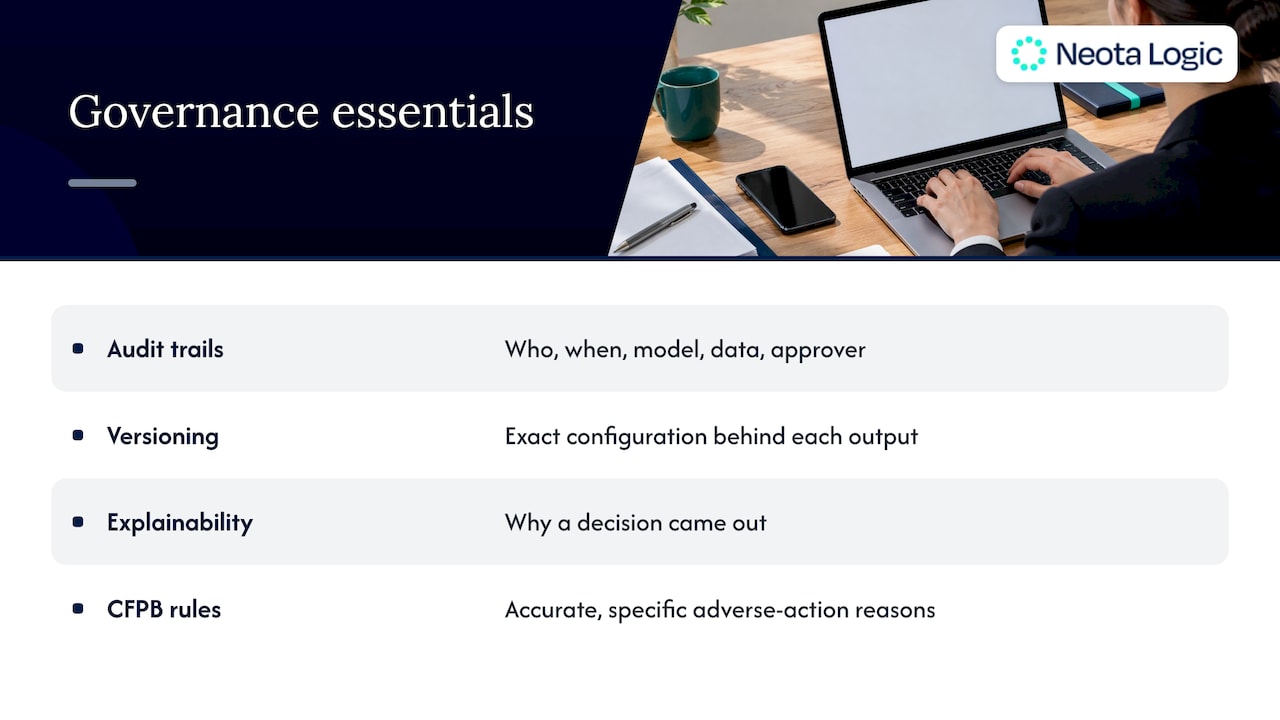
Audit trails record who did what, when, with which model and which data, and who approved the result. They answer the first question anyone asks after an incident.
Versioning ties each output to the exact configuration that produced it. Without it, an audit trail points at a moving target.
Explainability means you can state why a decision came out the way it did. For a probabilistic model, that is hard. For a deterministic rule, it is exact. You can show the rule, the inputs and the result. That difference should shape where you place each technology in your workflows.
External pressure points the same way. Federal agencies issued a joint statement on enforcement against automated systems. It says existing civil rights, consumer protection, fair competition and equal opportunity authorities apply. It is not a new legal obligation. It is a warning that old law reaches new tools. It also notes that CFPB rules require adverse-action reasons to be accurate and specific, even when a complex or opaque model makes the decision. Technological complexity is not a defense. If your team cannot explain an output, you have no answer to give.
Who owns it
Governance fails when everyone is responsible. Name the owners.
The National Center for State Courts guidance, written for courts but sound for any legal body, recommends a governance working group with leadership, business-process, legal and technology representatives. It also lists what the policy should define: scope, acceptable and prohibited uses, data protection, bias controls, patching and compliance monitoring. It adds staff communication, training and regular policy review.
For a corporate legal department, a practical split looks like this:
For a law firm, replace business owners with practice group leaders, and add knowledge management and the innovation lead. Professional responsibility sits on top of all of it.
Your professional duties are the floor
ABA Formal Opinion 512 states that lawyers using generative AI must consider competence, confidentiality, communication, supervision, meritorious claims, candor toward the tribunal and reasonable fees. Each duty maps to a control.
DutyGovernance controlCompetenceDocumented tool assessment, training on approved toolsConfidentialityData-handling rules, approved models only, access limitsCommunicationRecords of where AI was used on a matterSupervisionHuman checkpoints, named reviewers, escalation pathsCandor toward the tribunalVerification step before any filingReasonable feesUsage logs tied to matters
The opinion explains that Model Rule 1.1 requires lawyers to understand the benefits and risks of the technology they use. Lawyers need not become AI experts. They may use self-study, consultation, or association with someone competent. A governance program is how an organization shows that it did exactly that.
Our position
We hold a clear view on this, and it shapes how we build.
Governance is the product. Features are not. A legal team can buy any model it wants. What it cannot buy off the shelf is proof of control: who approved a use, what ran, what it decided, who checked it.
So we split the work. Deterministic rules handle the decisions that cannot be wrong. Eligibility, routing, thresholds, policy application. A rules engine does not hallucinate on the decision path, by design. AI handles the work that benefits from it: drafting, classification, summarizing. A human checkpoint sits wherever you want one. Every step is logged.
We do not ask you to replace the AI tools you already run. We sit on top of them as a control layer. That is the only approach that matches how legal teams actually work, because lawyers adopt tools faster than policy can follow.
Governance that depends on lawyers remembering the rules will fail. Governance that is built into the workflow will hold.
Patrick
Governing the tools you already use
Most legal teams do not need to choose a model. They already have several. The task is to bring them under control without stopping the work.
The NCSC guidance gives a sound starting sequence. Understand each tool and its terms. Assess data sensitivity and what happens to input and generated data. Require human review of output for accuracy, bias and completeness. Train staff on approved tools and responsible use.
Turn that into five steps.
Step four is where most programs stall. Policy memos and training sessions are necessary and not sufficient. Enforcement has to live in the workflow itself.
Deterministic where it matters
Not every decision deserves a model. A sound design assigns work by consequence.
Use rules for:
Use AI for:
The rules path is explainable by construction. The AI path is bounded by the rules around it and checked by a person. That structure gives you an answer when a client or regulator asks how a decision was made. You show the rule, the input, the model output where one was used, and the reviewer who signed off.
Is your governance working?
Measure it. The State Bar framework offers a useful list. Review usage statistics, error patterns, user feedback, performance against business-case projections, and concerns raised. Then hold the semiannual review and reach a decision on each system.
Add these checks:
If the answer to the first question is no, you have a policy and no governance.
What Neota provides
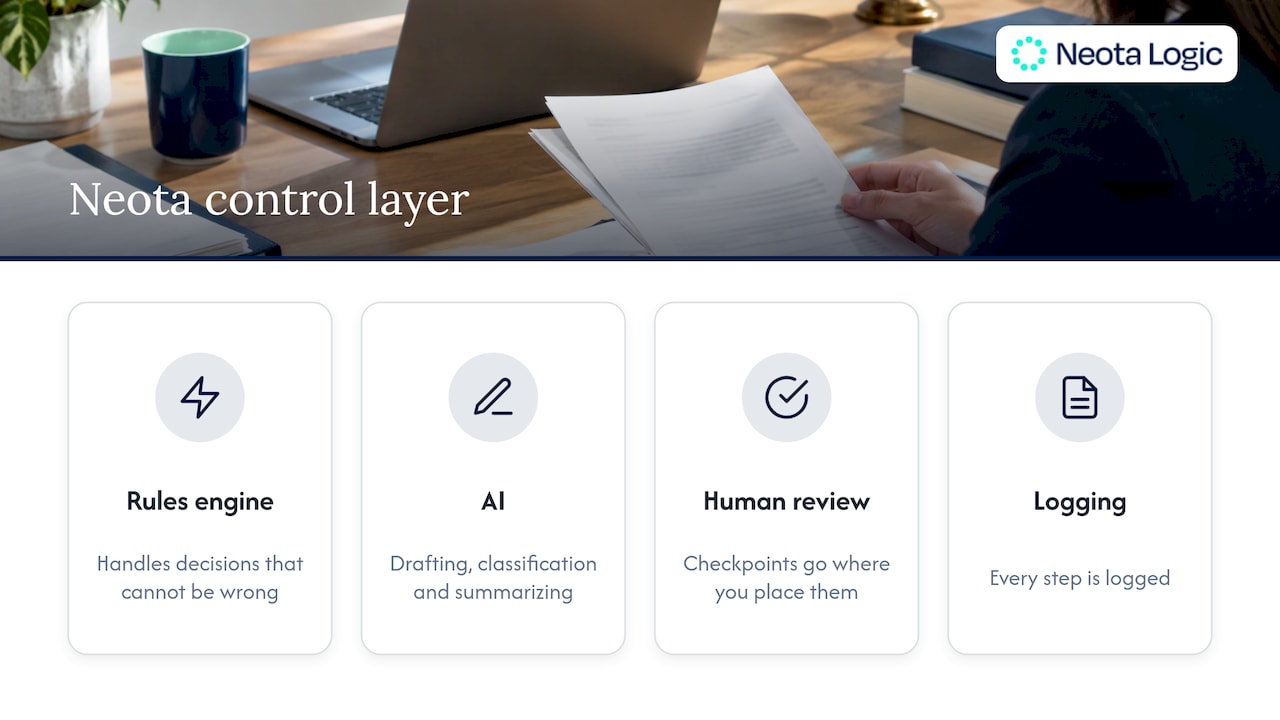
Neota Logic is governed AI infrastructure for legal and compliance teams. It is not a point solution and it is not a chatbot. It is the control layer that sits on top of the AI tools you already run, including Harvey, ChatGPT and Claude. A deterministic rules engine handles the decisions that cannot be wrong. AI handles drafting, classification and summarizing. Human checkpoints go where you place them. Every step is logged.
Our legal engineers scope and build each solution, so your team keeps working on client matters while the application takes shape in weeks. Explore AI governance and advisory solutions for risk assessment and compliance workflows, or see how AI enabled solutions put controls around the models you use.
If you are ready to put audit trails, versioning and explainability under your AI use, talk to us about Neota Platform Access.
FAQ
How is AI model governance different from AI governance?
AI governance is the organization’s overall approach: policy, vendors, data, oversight and risk appetite. Model governance controls individual models across their life, from inventory and approval through monitoring and retirement. You need both. The model layer is where policy becomes enforceable.
What should an AI model governance framework include?
Start with a working group, an inventory and a policy that defines acceptable and prohibited uses. Add risk classification per use case, approval gates, human-review triggers, monitoring, and scheduled reviews. The ABA’s sample risk management policies for law firms recommend first determining how AI is used, then identifying risks and selecting controls tailored to the firm.
Is the NIST AI Risk Management Framework mandatory?
No. It is voluntary guidance. Binding obligations come from existing law, including state AI, privacy, employment and consumer protection rules, and from professional conduct rules such as those in ABA Formal Opinion 512. Many teams use NIST as the structure and map legal duties onto it.
How often should we review a governed model?
The State Bar framework uses semiannual reviews. Each review ends in a decision to continue, modify or discontinue. Add an immediate review whenever a model version changes or a use case expands.
Do we have to replace the AI tools our lawyers already use?
No. Route them through a governed layer. That gives you one audit trail, one set of version records and enforced approval, without disrupting the work.
Sources
Ready to make your AI workflows defensible?
Book a demo and we'll walk one of your real processes through Neota.
Book demo