Yes, AI is worth adopting in legal operations, provided you start where the risk is lowest and the volume is highest. That means intake triage and first-pass contract redlines, not litigation strategy or privileged advice. Applied correctly, AI moves legal from reactive risk management to proactive business advising, but only when the workflow around it is governed from day one.
- High-volume, low-complexity tasks (intake, first-pass redlines, metadata extraction) show the clearest early gains.
- Industry commentary treats a roughly 30% reduction in task time as a planning target for these categories, not a guarantee.
- Neota Logic’s governed orchestration model demonstrates that auditability and automation can coexist without vendor lock-in.
Pro Tip: Scope your first pilot to one matter type and one task. A narrow, well-measured win builds the credibility you need to expand funding and headcount later.
Key Takeaways
AI in legal operations delivers measurable gains only when paired with governance, clear KPIs, and a disciplined pilot-to-scale process.
| Point | Details |
|---|---|
| Start narrow | Pilot intake triage or first-pass redlining before expanding to other tasks. |
| Track six KPIs | Monitor turnaround time, cycle time, legal spend, throughput, error rate, and adoption. |
| Treat 30% as a heuristic | Use it to set early targets, not as a guaranteed outcome. |
| Govern from day one | Build human-in-the-loop checks and audit logging into the pilot design itself. |
| Choose governed orchestration | Neota Logic’s multi-model orchestration preserves audit trails and avoids vendor lock-in. |
Table of Contents
- High-Impact AI Use Cases for Legal Operations
- What Results Should You Expect, and What Is the 30% Rule?
- What Risks Should Legal Ops Watch For?
- How Do You Roll Out AI Across Legal Operations?
- What Does a Governed AI Workflow Look Like in Practice?
- What Legal Ops Leaders Should Do Now
- Where Neotalogic Fits Into Your AI Rollout
- Sources
- FAQ
High-Impact AI Use Cases for Legal Operations
Not every legal task belongs in an AI pipeline. The ones that do share a pattern: high volume, repeatable structure, and low tolerance for creative interpretation. Industry analysis points to intake triage, first-pass contract redlining, and legacy agreement metadata extraction as the categories where automation pays off fastest.
Intake and matter routing. AI classifies incoming requests, flags urgency, and routes them to the right owner. Legal ops typically owns this layer, since it sits upstream of any attorney review.
First-pass contract redlining. The model compares incoming paper against your playbook and flags deviations before a lawyer opens the document. Contract managers and paralegals supervise this stage.
Metadata extraction from legacy agreements. AI pulls renewal dates, governing law, and liability caps from old contracts to feed reporting dashboards. This work usually falls to legal ops analysts, not attorneys.
Research and briefing support. AI drafts preliminary summaries of case law or regulatory changes, which attorneys then verify and refine.
Matter and SLA automation. Workflow rules trigger reminders, escalate overdue tasks, and log status changes automatically.
For a small team, start with intake triage. It touches every matter and needs the least customization. Enterprise departments with existing document management systems should prioritize metadata extraction, since the payoff compounds across thousands of legacy files.
Pro Tip: Pick the use case with the most repetitive volume, not the most impressive demo. Flash fades; throughput doesn’t.
| Point | Details |
|---|---|
| Best starting point | Intake triage requires the least setup and touches the widest range of matters. |
| Enterprise priority | Metadata extraction from legacy agreements scales value across large document volumes. |
| Ownership matters | Assign each use case to a specific legal ops role before automating it. |
What Results Should You Expect, and What Is the 30% Rule?
Legal ops teams need numbers before they need enthusiasm. Track turnaround time, cycle time per matter, legal spend per matter, throughput, error rate, and user adoption from week one of any pilot. These six metrics tell you whether AI is actually changing outcomes or just changing appearances.
The 30% rule has become a common planning heuristic: teams often target roughly a 30% reduction in time spent on a specific routine task as an early benchmark. It’s a starting assumption for setting KPIs, not a promised return. Early pilots tend to show smaller, noisier gains as teams learn the tool; mature deployments with refined playbooks tend to close in on that heuristic or exceed it in narrow categories.
| Deployment stage | What to expect |
|---|---|
| Early pilot (4 weeks) | Inconsistent gains as the team calibrates prompts, playbooks, and review steps |
| Maturing deployment | Time savings trending toward the 30% planning heuristic in the targeted task |
| Scaled program | Gains extend to related tasks once governance and training stabilize |
- Set KPI baselines before the pilot starts, not after.
- Treat the 30% figure as a target to test, not a contract to fulfill.
What Risks Should Legal Ops Watch For?
The upside of AI in legal operations is real, but so is the downside when governance is an afterthought. Reuters reported on attorneys sanctioned for submitting fabricated case citations generated by AI, and that case remains the clearest warning available: unverified output can end up in a court filing.
The core risk areas are data privacy, model hallucination, privileged data exposure, uncertain vendor or model provenance, and gaps in your audit trail. Bar association guidance now addresses generative AI directly, stressing competence, disclosure, and confidentiality obligations that apply whether the drafter is a lawyer or a machine.
- Require human-in-the-loop review before any AI output leaves the department.
- Log model version, input, and output for every decision that touches a matter.
- Restrict access by role, especially where privileged material is involved.
- Write a model-use policy before the first pilot, not after an incident.
| Risk area | Mandatory control |
|---|---|
| Fabricated citations or facts | Human verification before any output is filed or relied upon |
| Privileged data exposure | Access controls tied to matter sensitivity, not blanket permissions |
| Unclear model provenance | Logging of model ID, version, and output source |
| Audit trail gaps | End-to-end tracking from intake to final output |
Pro Tip: Build your escalation rules into the pilot design document itself. Governance bolted on after a near miss is governance nobody trusts.
How Do You Roll Out AI Across Legal Operations?
A pilot that skips defined KPIs and stop or go criteria rarely survives contact with a budget review. Documented pilot designs run in tight four to eight week loops with pre agreed success measures, because teams that can’t demonstrate value or safety don’t get funded for phase two.
- Define scope. Pick one use case, one matter type, and a clear owner in legal ops.
- Prepare data. Clean and structure the documents or intake records the model will touch.
- Run the pilot. Keep it to four to eight weeks with a fixed KPI set agreed in advance.
- Verify outputs. Have a qualified reviewer check a sample of every output category, not just the ones that look off.
- Measure against baseline. Compare turnaround time, error rate, and adoption against your pre-pilot numbers.
- Iterate or stop. Adjust the playbook if results are close, or kill the pilot if the KPIs miss badly.
- Scale deliberately. Extend to adjacent use cases only after governance controls prove stable.
When you evaluate vendors, analyst guidance recommends weighing integration, data governance, and measurable outcomes over feature lists. Check for security certifications, clear model provenance, and native integration with your document management system, contract lifecycle management platform, and case management system, since a tool that can’t talk to your existing stack just creates another silo.
Change management matters as much as the technology. Bring IT, security, and procurement in during scoping, not at signature time. Budget for training time, not just license fees. Removing bottlenecks in existing processes, as detailed in this fireside chat on legal operations bottlenecks, often matters more than the AI model itself.

Pro Tip: Assign a single accountable owner for the pilot’s KPIs. Shared ownership across three departments usually means no one actually watches the dashboard.
What Does a Governed AI Workflow Look Like in Practice?
A governed workflow follows a specific chain: intake, classification, model orchestration, human verification, then an auditable record. Each step generates a log entry, so nothing moves forward without a trace.
- The system classifies an incoming request and routes it to the correct team automatically.
- Multiple AI models can be orchestrated within the same workflow, avoiding dependence on a single vendor.
- A human reviewer verifies the output before it becomes part of the official record.
- Every step, including model ID and output, gets logged for later audit.
Governed orchestration that logs model identity, input hash, output hash, and verifier identity creates an auditable chain of evidence that satisfies both internal audit and external regulatory scrutiny.
A workflow that can’t show who verified what, and when, isn’t automation. It’s a liability with a nice interface.
Pro Tip: Ask any vendor to show you the audit log for a single completed workflow before you sign anything. If they can’t produce one in the demo, they won’t produce one in production.
What Legal Ops Leaders Should Do Now
Prioritize pilots with defined KPIs and governance baked in from the scoping stage, not added after launch. Secure executive sponsorship early, and pull in IT, security, and procurement as partners rather than approvers you notify late.
Where Neotalogic Fits Into Your AI Rollout
Neotalogic is the route to governed AI adoption without betting your compliance posture on a single model vendor. Where a standalone chatbot tool leaves you managing prompts and hoping outputs are traceable, Neotalogic orchestrates multiple AI models inside a no-code workflow that logs every decision, from intake classification to final output, for audit.
That matters directly for the pilot-to-scale path this article just walked through. Instead of stitching together point solutions for intake triage, redlining, and metadata extraction, legal teams build governed workflows once and route different tasks through the same auditable layer. It integrates with the document management, CLM, and communication tools you already run, so a pilot doesn’t turn into a rip-and-replace project. If you’re ready to scope your first pilot with governance built in rather than bolted on, explore the Neotalogic platform and see how the orchestration layer handles verification and audit trails before you commit budget to a single model vendor.
This article is general information, not a substitute for advice from a qualified lawyer. Consult a qualified legal professional about your own circumstances before acting on anything here.
Sources
- AI Moves from Novelty to Operating Model for Legal Departments
- The Impact of AI on Legal Operations Jobs - CLOC
- Practical Guidance on Generative AI (California Bar)
- Gartner — legal technology
FAQ
What Is the 30% Rule in AI for Legal Operations?
It’s a planning heuristic, not a guarantee: teams commonly target a roughly 30% reduction in time spent on a specific routine task, such as first-pass redlining, as an early benchmark for pilot success.
Is AI Replacing Lawyers in Legal Operations?
No. Legal ops leaders describe a triad model where senior attorneys supervise and verify AI outputs, shifting hiring toward verification and oversight skills rather than eliminating attorney roles.
How Is AI Being Used in Legal Departments Today?
AI is used mainly for intake triage, first-pass contract redlining against playbooks, metadata extraction from legacy agreements, and research support, all under human review before anything is finalized.
Is There a Legal-Specific Version of ChatGPT?
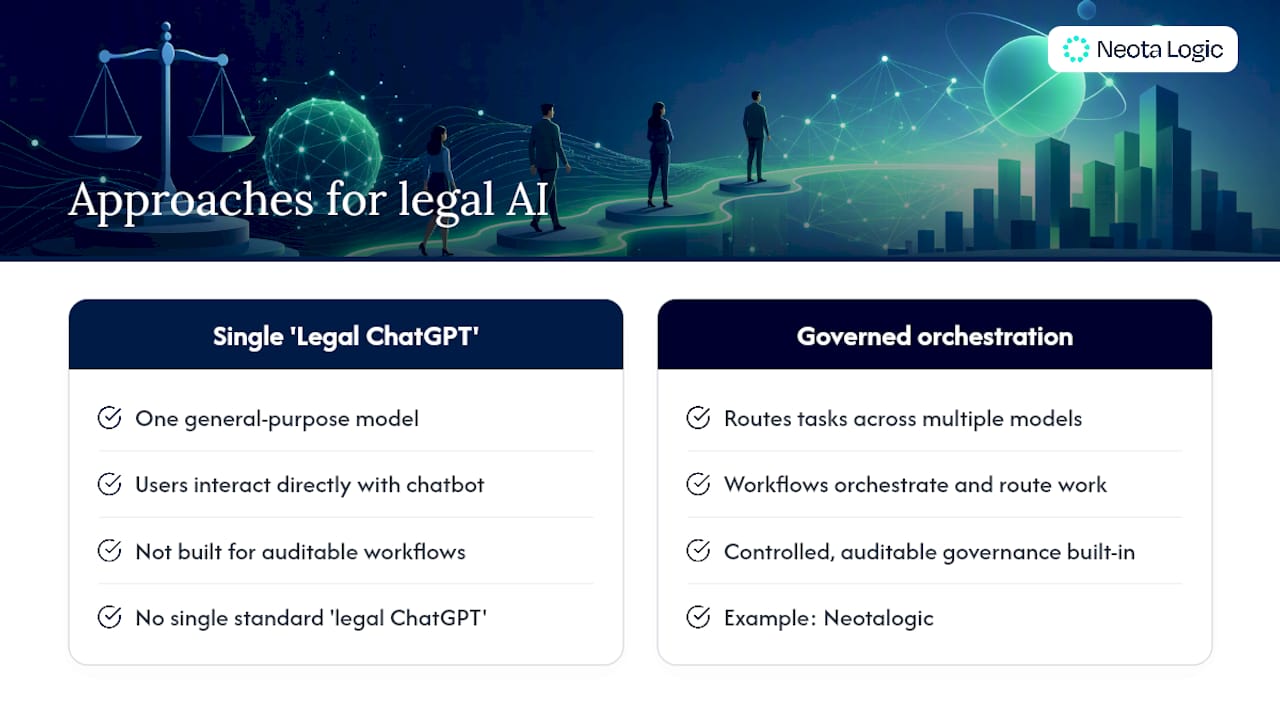
There is no single standard “legal ChatGPT.” Instead, governed orchestration platforms like Neotalogic let legal teams route work through multiple AI models within a controlled, auditable workflow rather than relying on one general-purpose chatbot.
What Is the Biggest Risk of Using AI in Legal Operations?
Unverified output entering an official record is the biggest risk. Sanctions against attorneys who filed briefs with fabricated AI-generated citations show why human verification and provenance logging are mandatory, not optional.
Recommended
Ready to make your AI workflows defensible?
Book a demo and we'll walk one of your real processes through Neota.
Book demo