Contract remediation is the work of finding what is wrong in a contract or a contract portfolio and correcting it, with a record that proves the fix. The trigger can be a performance failure, a regulatory change or a policy gap. The output is the same: a documented correction that someone owns and someone verifies.
It is not the same as a contract remedy. A remedy is what the law gives you after a breach. Remediation is the operational work that happens before, around and instead of that fight. If your team runs it on spreadsheets and inbox threads, you have no audit trail. If you add AI without controls, you add a second problem. This guide covers the definition, the process, the risks and the governance that makes AI safe to use here.
TL;DR
- Contract remediation is the documented identification and correction of contract deficiencies, in one agreement or across a portfolio.
- A remedy is a legal right after breach. Remediation is the corrective process that often prevents the breach from becoming a claim.
- A sound process has five parts: identify, assign an owner, correct, verify, prevent recurrence.
- AI speeds up review and drafting. Decisions on the remediation path need deterministic rules, human checkpoints and a log of every step.
- Governance, not feature count, decides whether AI-assisted remediation survives an audit.
Table of Contents
- What contract remediation means
- Remediation versus remedies
- What triggers remediation
- The remediation process, step by step
- Who should be involved
- How to document and verify
- Risks and limits
- Where AI fits and where it does not
- Perspective
- Build remediation on a governed layer
- What to do this quarter
- FAQ
- Sources
What contract remediation means
Two uses of the term sit side by side in legal departments.
Performance remediation. A party falls short of its obligations. The other side requires a fix. The fix is written down, assigned and tracked to completion. Procurement teams call this a corrective action plan.
Portfolio remediation. A new law, a new policy or a new risk standard makes existing clauses inadequate. The legal team finds every affected agreement, decides what each needs and amends it. Teams often call this repapering.
The mechanics differ. The discipline is shared. Find the deficiency. Decide the correction. Execute it. Prove it.
Remediation versus remedies
Search results for this term mix the two concepts. Keep them apart.
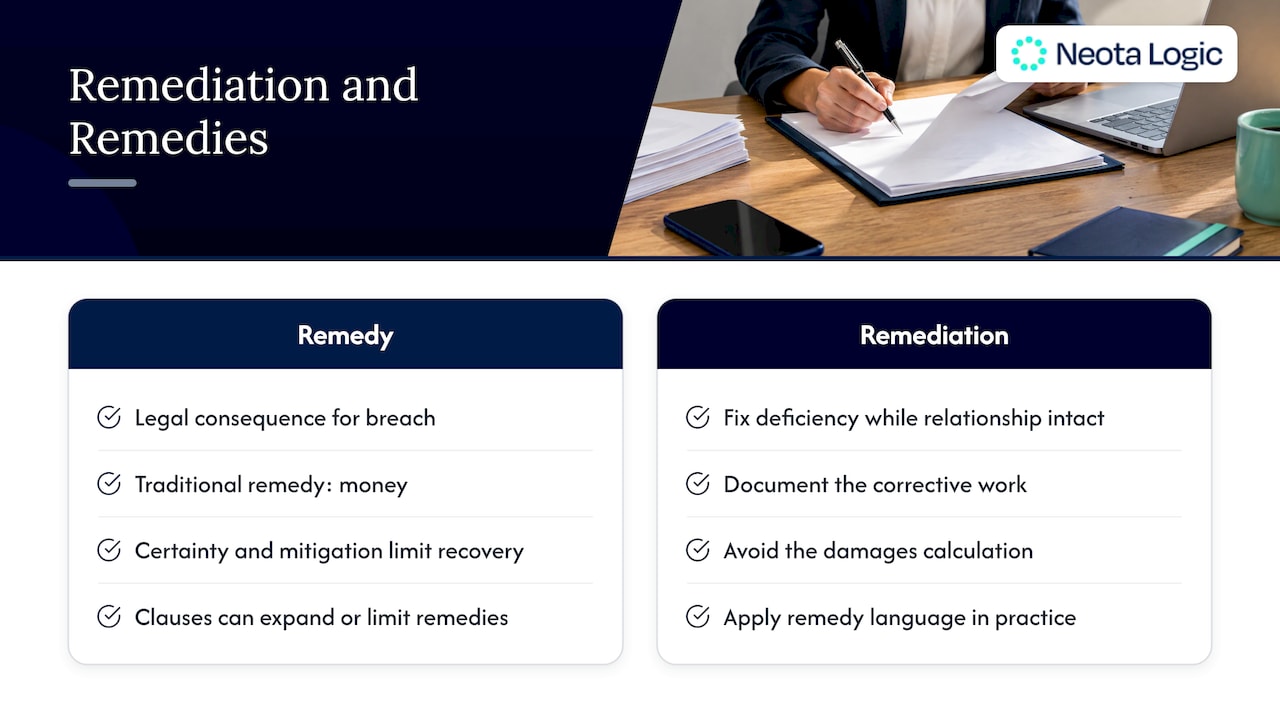
A remedy is a legal consequence. The traditional remedy for breach of contract is money, designed to protect the injured party’s expectation interest. That means putting them in as good a position as performance would have. Recovery is limited by certainty, mitigation and foreseeability. The UCC says the same in its own terms: remedies are to be liberally administered so the injured party lands where performance would have put it.
Remediation is the work that keeps you out of that analysis. You fix the deficiency while the relationship is intact. You document it. You avoid the damages calculation entirely.
Remedy clauses still matter. The ABA lists six reasons to contract for remedies even where the law already supplies them: to comply with the law, to create or expand a remedy, to make a discretionary remedy more available, to negate or limit a remedy, to set standards and to preserve a remedy the law might eliminate. The same article warns that restating legal remedies can imply that unlisted remedies are off the table. Drafting remedy language is a judgment call. Remediation is what you do when that language meets reality.
What triggers remediation
Contracts do not fail only through breach. They age. The Association of Corporate Counsel groups the changes that hit contracts into four families in its program material on change in contracts:
- Counterparty changes. Identity shifts or financial deterioration.
- Changes in the work. Business objectives move, key personnel or suppliers leave, products change, a facility goes down.
- External changes. New law or regulation, a shifted political climate.
- Market changes. Most favored nation terms, for example.
The same material says impact can be reduced through force majeure, continuity planning, representations, change orders, material adverse change clauses and termination provisions. Every one of those is a clause you either have or lack. When you lack it, you remediate.
Regulatory triggers
Regulation is the largest portfolio trigger. The ABA’s January 2025 article on forced labor describes Model Contract Clauses built around disclosure and remediation. They give buyers and suppliers a framework for a corrective action plan when a supply chain problem surfaces.
The same article shows what regulators expect. U.S. Customs and Border Protection modified the Withhold Release Order on synthetic disposable gloves from YTY Industry Holdings after finding the company had properly remediated the underlying activities. CBP modifies an order only when the manufacturing is free of all forced labor indicators. Partial remediation does not count. The fix must be comprehensive and effective, and you must be able to show it.
That standard applies well beyond customs. A regulator, a court or an auditor asks the same question. Can you demonstrate what you found, what you changed and when?
AI vendor terms
A newer trigger is the AI clause. The ACC’s February 2026 program on AI clauses in vendor contracts says vendor contracts are becoming the primary mechanism for transparency, risk allocation and governance as AI moves into core operations. In-house teams are negotiating clauses on training rights, data usage, indemnities, auditability and agent workflows. Agreements signed two years ago often say nothing on these points. That is a remediation backlog.
The remediation process, step by step
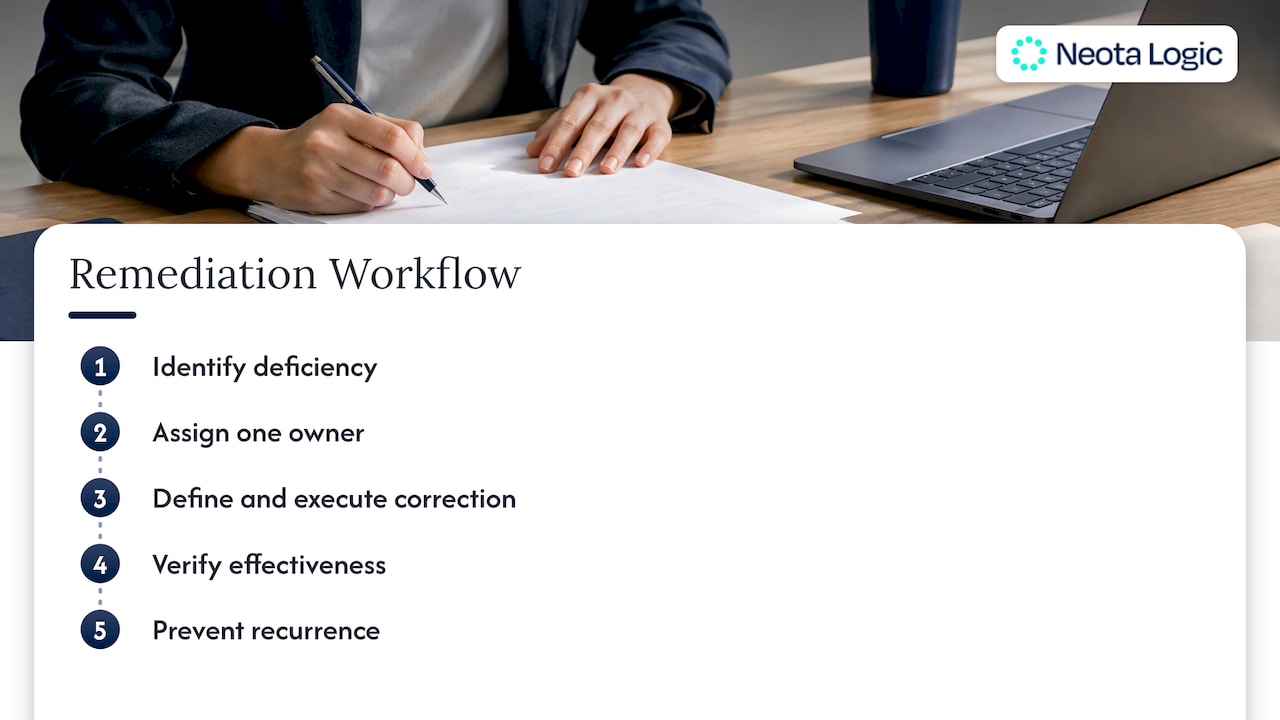
A reliable process has five parts. Texas State University’s contract monitoring guide lays out the corrective action plan model clearly. Use it as the backbone.
1. Identify the deficiency
Name each non-conformance precisely. The guide says problems should be identified early in the performance period and formalized in writing. Informal complaints do not create a record. A written notice does.
In a portfolio, identification means locating every agreement that carries the affected clause, or lacks the required one. This is the slow step. It is also where most remediation programs lose accuracy.
2. Assign ownership
Every deficiency gets one owner. Loeb & Loeb’s guidance on remediation, as summarized in the same research, recommends a cross-functional team of operations, finance, management, deal negotiators and counsel, with a single point of contact so communications stay clear. Legal does not fix a late delivery. The business unit does. Legal records it.
3. Define and execute the correction
The corrective action is specific, dated and tracked. The guide calls for reporting on completion status. For a portfolio, the correction is usually an amendment, a notice or a replacement agreement. Standardize the language before you send anything. Ten variations of one amendment create ten new problems.
4. Verify effectiveness
Closing a task is not the same as resolving the issue. The guide builds in a planned effectiveness review to confirm the correction worked. For regulatory matters, this is the step an auditor tests first.
5. Prevent recurrence
Find the root cause. The guide treats root cause analysis as part of the plan, because a fix without prevention returns as the next remediation. Update the template. Update the playbook. Update the intake rules that let the deficient clause through.
Who should be involved
Remediation fails when it sits only in legal or only in the business.
- Legal owns the standard, the language and the record.
- The business owner owns the correction in operations.
- Finance sizes exposure and any financial adjustments.
- Procurement or vendor management manages the counterparty relationship.
- Senior management decides strategy when the stakes are high.
Loeb & Loeb’s approach also starts with collecting every document and communication, then building a timeline of who knew what and when. Do that before you choose a strategy. Strategy built on partial facts gets reversed.
How to document and verify
Documentation is the product. Without it, the remediation did not happen in any way an auditor, regulator or court will credit.
Keep these records for every item:
- The deficiency, with its source clause and the date identified.
- The decision on correction, who made it and on what basis.
- Every version of the amendment or notice.
- The communications with the counterparty.
- The verification result and the reviewer.
- The root cause and the preventive change.
Versioning matters here. When a clause is amended twice, you need to know which text governed which period. Explainability matters too. If a decision classified a contract as in scope or out of scope, you need to show the rule that produced the result.
Risks and limits
The process has traps.
Escalating too fast. The Texas State guide calls default a relatively drastic remedy that usually follows failed correction attempts. It advises giving the vendor a chance to correct, with legal input, before declaring default. Formality should rise as the problem persists.
Over-drafting remedies. As noted above, restating legal remedies can imply the others are waived. Understand the governing law before you draft.
Thin document collection. Loeb & Loeb notes that collecting electronic documents takes time. It also notes that variances from the negotiated contract are often a mixed bag, favoring different sides, and that undocumented intended variances complicate the fix. Know what the parties actually did, not only what the paper says.
Causation. Most courts do not apportion contract damages when several factors contribute to a loss. A University of Pittsburgh Law Review article argues that causation rules in contract law are in a sense more important than those in tort. Parties can define the scope of their liability at formation. Clear remediation and limitation language is how they do it.
Procurement design reduces the load. Teams that choose structure up front remediate less later. Logistics teams show this well in their container procurement strategy thinking.
One construction example shows how allocation works in practice. The ABA’s critical construction contract clauses article says a contractor should receive a change order when inadequate or inaccurate documents cause added cost or delay. It also says a contractor who knowingly builds to inconsistent documents without owner approval should correct the work at its own expense. Who pays is a drafting outcome. Remediation applies it.
Where AI fits and where it does not
You know what AI does. The question is where it belongs in a remediation workflow.
AI is useful for three tasks. It classifies agreements by type and clause. It summarizes deviations from a standard. It drafts first-pass amendments. Those tasks benefit from speed and tolerate review.
AI does not belong on the decision path. Whether a contract is in scope, which fix applies, who must approve it and when it is deemed complete are decisions that cannot be wrong. They need rules that return the same answer every time and explain why.
Human oversight is the standard guidance. Leslie K. Eason of Barnes & Thornburg advises in the ACC’s AI guidance to make sure human oversight is always in place, to keep a backup plan if the system fails and to build standard AI terms and a playbook for consistent use. Apply that to remediation directly.
A governed design has four properties:
- Deterministic decisions. Scope, routing and approval follow explicit rules.
- Bounded AI. AI drafts, classifies and summarizes. It does not decide.
- Human checkpoints. A named reviewer signs off where the firm requires it.
- A complete log. Every step, input and output is recorded and versioned.
Ungoverned AI fails the audit even when its output is right. You cannot show how it got there.
Perspective
Most remediation programs fail at the record, not at the fix. Teams correct the clause and cannot prove the logic that selected it.
We built Neota Logic as governed AI infrastructure for legal and compliance teams. It is not a point solution and it is not a chatbot. It sits on top of the AI tools you already run, including Harvey, ChatGPT and Claude, and adds the control layer those tools lack.
Our deterministic rules engine handles the decisions that cannot be wrong. It structurally cannot hallucinate on the decision path. AI handles the drafting, classification and summarizing where it helps. A human checkpoint sits wherever you want one. Every step is logged.
Our position is simple. In remediation, governance is the differentiator. Features are not. Audit trails, versioning and explainability decide whether your work holds up when someone challenges it.
Our legal engineers scope and build each solution. You get a working application in weeks, and your team stays on client work. We bring twenty years of law firm deployments to every build.
Patrick
Build remediation on a governed layer
If your team runs remediation across email, spreadsheets and a general-purpose AI tool, the process has no spine. Neota Logic gives it one. Document Automation and Contract Automation standardize the amendments and notices your remediation produces. AI Enabled Solutions put governed AI on classification, intake and review. The Risk Assessment, Compliance Advisor and AI Governance solutions carry the decision logic and the audit trail.
We scope and build the application with you. Start at the Neota Logic platform and services page and request a demo.
What to do this quarter
Take a position on remediation before the next trigger arrives.
- Inventory your triggers. List the regulatory, vendor and policy changes that already require contract updates.
- Write the standard. Define the required clause language and the approved fallback positions.
- Define the decision rules. Put scope, routing and approval in explicit rules, not in someone’s head.
- Set the checkpoints. Decide where a human signs off and who that is.
- Require the log. Every step recorded, every version retained.
- Verify and close. Run an effectiveness review and fix the root cause.
A team that does these six things can answer any auditor. A team that skips them cannot.
FAQ
What is contract remediation in simple terms?
It is the documented process of finding contract deficiencies and correcting them. The deficiency can be a performance failure or a clause that no longer meets a law or policy. The process ends with verification, not with a signature.
How is contract remediation different from a contract remedy?
A remedy is a legal right that arises after breach, usually money damages. Remediation is the corrective work that happens first and often prevents the claim. One is a legal outcome. The other is an operating process.
What is a corrective action plan?
It is a written tool that identifies a deficiency, assigns an owner, sets the correction and tracks it to completion. Texas State University’s guide describes it as a way to identify, agree upon, manage and monitor remediation actions. It also calls for an effectiveness review and prevention steps.
Can AI run contract remediation?
AI can classify, summarize and draft within it. It should not make the scope, approval or completion decisions. Those belong to a deterministic rules engine with human checkpoints and a full audit log.
Who should own remediation?
Legal owns the standard and the record. The business unit owns the operational fix. A single point of contact keeps communication with the counterparty consistent.
Sources
- Contracts, Causation, and Clarity (University of Pittsburgh Law Review, 2017)
- Reckoning Contract Damages: Valuation of the Contract as an Asset (Columbia Law School)
- When to Contract for Remedies (ABA Business Law Today, 2014)
- Dealing with Change in Your Contracts (ACC)
- Using Contractual Frameworks to Comply with US Forced Labor Regulations (ABA, 2025)
- AI Clauses in Vendor Contracts (ACC, February 2026)
- Contract Monitoring Guide (Texas State University, 2017)
- Critical Construction Contract Clauses (ABA Property & Construction Law)
- AI center of excellence (ACC)
- Container procurement strategy explained
Ready to make your AI workflows defensible?
Book a demo and we'll walk one of your real processes through Neota.
Book demo