Legal data analytics turns court records, matter data and contract terms into numbers that drive decisions. Those decisions include whether to settle, which firm to hire and where the legal budget goes. The analysis is only half the job. The other half is proving where each number came from, who reviewed it and which version of the logic produced it. If your legal analytics software cannot show that, you do not have insight. You have a liability.
TL;DR
- Legal data analytics mines large volumes of data for decisions such as motion outcomes, case connections and settlement ranges.
- Results differ by vendor because datasets, data cleaning and editorial correction differ. Two tools can return different counts for the same query.
- Every analytic that feeds a legal decision needs an audit trail, a versioned rule set and an explanation a general counsel can defend.
- Governance is the differentiator. Features are a commodity.
- Neota Logic is governed AI infrastructure that sits above the analytics and AI tools you already run.
Table of Contents
- What legal data analytics actually covers
- What data these tools analyze
- How legal teams use analytics in practice
- Where legal analytics goes wrong
- Governance is the real selection criterion
- Confidentiality and privacy
- How to evaluate legal analytics software
- Perspective
- Put governance under your analytics
- FAQ
- Sources
What legal data analytics actually covers
Legal analytics combines data analysis with AI-enabled insight. It mines large volumes of data to support decisions such as motion-outcome probabilities, case connections and settlement awards. That is the litigation side, and it is the side most vendors sell.
The American Bar Association describes predictive analytics in litigation as the use of AI and machine learning algorithms on past rulings, filings, judicial decisions and even jury behavior. The goal is to estimate whether a case is likely to settle or win and what the trial risks are.
There is a second side that gets less attention. Legal departments generate their own data: intake requests, matter types, outside counsel spend, contract terms, cycle times and approval records. Analytics on that data answers operational questions. Where does work pile up? Which request types should be automated? Which suppliers carry risk?
Treat these as two categories:
- External analytics. Court and docket data about judges, litigants, counsel and outcomes.
- Internal analytics. Your own matter, contract, intake and spend data.
Both need governance. External analytics fail through bad data. Internal analytics fail through bad process around the data.
What data these tools analyze
For litigation, inputs are court data and filings about judges and rulings, litigants, attorneys, expert witnesses and cases. Software organizes those datasets and returns information for litigation decisions. The same ABA Journal piece describes common analytic categories:
- Judge analytics. How a judge rules and whether a motion type tends to succeed before that judge.
- Law firm analytics. A firm’s prior litigation history, including outcomes and the lawyers assigned.
- Company analytics. A company’s litigation history, including lawsuits, outcomes and the firms it used.
- Expert witness analytics. Involvement, credentials, parties testified for and exclusions.
- Case analytics. Case counts, time pending and appearances.
Products expose these dimensions as filters. One law-school comparison of the major research platforms notes that Bloomberg Law’s motions analytics can be filtered by motion type, outcome category, date and legal topic. The same study notes its court and judge analytics are limited to Federal District Courts.
That limit matters. A filter looks authoritative. The coverage behind it may not match your forum.
Internal data works differently. Contract analytics depends on clause-level structure: parties, dates, change of control, termination rights, restrictive covenants and assignment terms. Without that structure, there is nothing to count. Extraction comes first. Analysis comes second.
How legal teams use analytics in practice
A Notre Dame framework describes litigation analytics as quantitative, replicable observations about litigation. Attorneys derive insight from them and use them for predictions about outcomes and trial strategy. The same source notes they appear in client pitches and help in-house counsel select outside counsel.
In practice, the use cases cluster into four groups.
Litigation strategy
Counsel check how a judge has handled a motion type, how long a court takes to rule and how an opposing firm has performed. The output informs the settlement conversation and the budget. Teams that publish what they learn from this work, such as thought leadership built on their own matter trends, can pair it with AI content optimization for legal marketers so the findings reach the right audience.
Outside counsel selection
General counsel compare firms on outcomes, time to disposition and staffing patterns. This is where analytics meets spend. The question is not only who wins. It is who wins at a defensible cost.
Legal operations
Intake volumes, turnaround times and request categories show where a department loses hours. Operations leaders use this to decide what to standardize and what to route to a lawyer.
Risk and compliance
Trend data on litigation, regulatory matters and supplier issues feeds risk scoring. A score only helps if the logic behind it is fixed, documented and repeatable.
Where legal analytics goes wrong
Vendors do not publish the weak points. The research does.
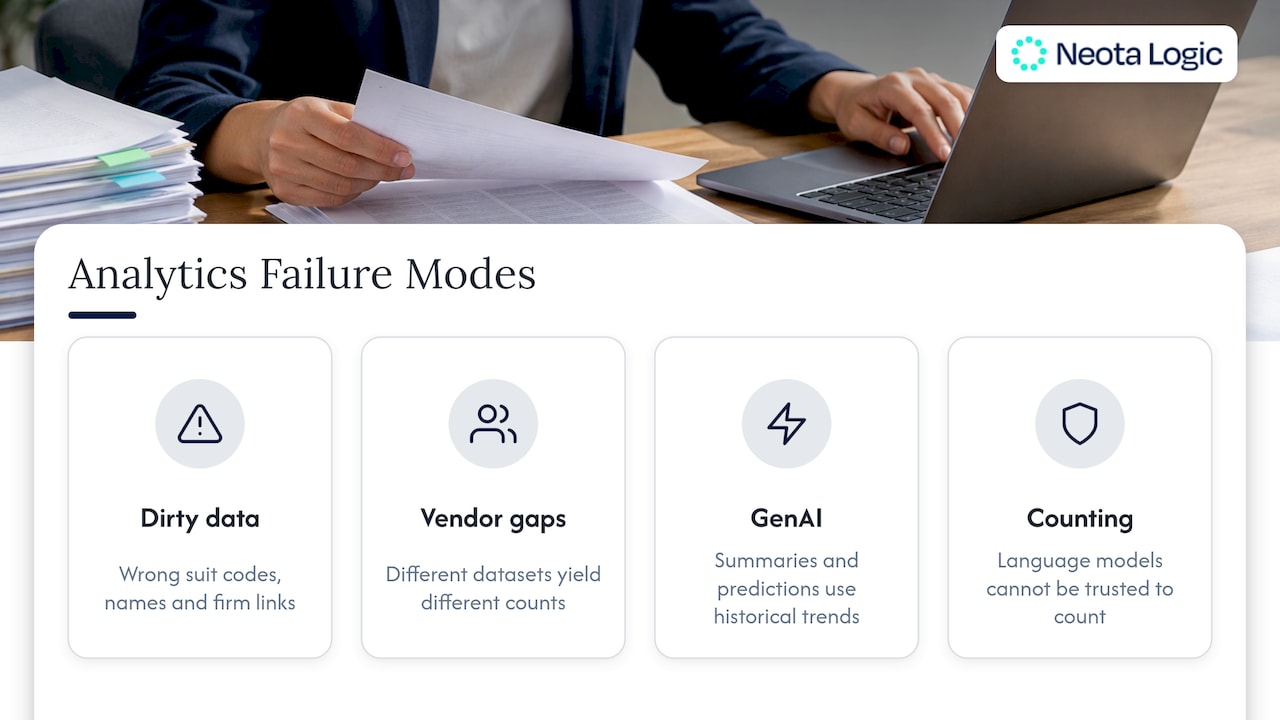
Source data is dirty. An ABA Journal study of analytics products found PACER problems: incorrect nature-of-suit codes, spelling errors in attorney and firm names, and wrong attribution of attorneys to firms after moves or acquisitions. Some products may not count firms appearing pro hac vice.
Vendors disagree. The Indiana comparison found that platforms differ in dataset size and composition. Some draw strictly from docket sheets. Others correct data through an editorial team. The result is different counts for the same jurisdiction and query.
This is the core problem. Two analysts run the same query and walk into the same meeting with different numbers. Neither can say which is right without knowing the pipeline behind each.
Generative layers add a new failure mode. Generative AI now sits on top of analytics and generates summaries, predicts outcomes and offers strategic recommendations from historical trends. That reduces manual research time. It also moves a probabilistic system into the path of a decision.
A language model can write a fluent summary of a judge’s record. It cannot be trusted to count that record. Counting, thresholds and eligibility rules belong in deterministic logic. Summaries belong to AI. Mixing the two without a boundary is how a wrong number reaches a client.
Governance is the real selection criterion
Most buyers compare dashboards. They should compare control.
The Association of Corporate Counsel’s guidance on AI in legal operations lists vetting questions: is the data right for the use case, including bias that undermines reliability, has the application been tested for that use case, does the system provide reference material for verification, and how often does the algorithm hallucinate. Those are governance questions, not feature questions.
Three controls decide whether analytics is defensible.
Audit trails
Every analytic that informs a decision needs a record. What data went in. Which rule or model ran. What came out. Who reviewed it and when. If a regulator, a client or a court asks how you reached a conclusion, the log is your answer. Without it, you reconstruct from memory.
Versioning
Rules change. Thresholds change. Models change. A settlement-risk score computed in March under one rule set cannot be compared with one computed in September under another unless both versions are preserved. Version every rule set and every prompt. Tie each output to the version that produced it.
Explainability
A general counsel must be able to explain a number to a board. “The model said so” fails. A deterministic rule that reads “matters in this category above this exposure go to a partner” passes. Explainability is a design choice made before deployment, not a report generated after a problem.
Human checkpoints
The ACC guidance states that responsible use requires review of outputs for accuracy and completeness and that AI is not a substitute for legal judgment. The ABA adds that every AI-assisted draft should be reviewed, fact-checked and cite-checked before sharing. Build the checkpoint into the workflow. A policy memo is not a checkpoint.
Confidentiality and privacy
Analytics platforms touch sensitive information. The ABA advises organizations to ensure privacy and security and to confirm compliance with data privacy laws such as GDPR or CCPA.
The ABA’s implementation guide puts confidentiality at the top of ethical use. It instructs lawyers never to enter client-specific or privileged data into unsecured, consumer-grade AI platforms. That includes free versions of public chatbots unless deployed in a secure enterprise environment with encryption and clear data-handling policies.
The ACC example goes further. It requires training before use of generative AI, bars public tools from client work, and prohibits loading client names, privileged material or firm work product into unauthorized generative AI.
The practical conclusion is direct. Privilege waiver is the risk. If matter data flows into an ungoverned tool, privilege dies quietly. You will not see it happen. You will see it in discovery.
How to evaluate legal analytics software
The ABA recommends assessing whether platform data is comprehensive and current, covers relevant jurisdictions and includes long-term history. It also recommends a demo and a look at accuracy records, case studies, reviews and reasoned predictions.
Add the governance layer. Use this checklist.
- Coverage. Does the dataset cover your courts, case types and time range?
- Data lineage. Can the vendor say where each data point came from and how it was corrected?
- Reproducibility. Does the same query return the same result next quarter, and can you see what changed?
- Decision path. Which steps are rules and which are model output? Can you separate them?
- Logging. Is every query, output and reviewer action recorded and exportable?
- Human review. Can you require approval at a defined point?
- Integration. Does it connect to your document, matter and communication systems?
Integration deserves attention. One published example describes Power BI dashboards integrated with a law firm’s practice management system on SQL Server. It delivered visibility into financial performance, hours and billable utilization, with drill-down from executive summaries to detail. The lesson is that analytics earns its keep when it sits on the systems where work already happens.
The same logic applies to AI. You already run tools. Replacing them is slow and rarely necessary. Governing them is faster and more valuable.
Perspective
Most legal analytics conversations start with what the tool can predict. We start with what the tool can prove.
A prediction without a record is an opinion. A general counsel who relies on it owns the consequences, and so does the firm that delivered it. The risk is not that analytics is wrong sometimes. The risk is that nobody can show how it was wrong, when, and under which rules.
That is why we build the control layer first. Deterministic logic handles the decisions that cannot be wrong: eligibility, thresholds, routing, escalation. AI handles the work that benefits from it: drafting, classification, summarizing. A human checkpoint sits where you want one. Every step is logged and every rule is versioned.
We take a firm position. Governance is the differentiator, not features. Any vendor can add a dashboard. Few can show an auditor the exact path from input to decision.
Neota Logic is governed AI infrastructure. It is not a point solution and not a chatbot. It sits on top of the AI and analytics tools your team already uses, and our legal engineers build the application with you.
Patrick
Put governance under your analytics
Neota Logic gives corporate legal departments and law firms a control layer for the tools they already run. Our deterministic rules engine and AI Control Layer keep decisions on a fixed, logged path, with human checkpoints where you set them.
For intake, triage and contract work, see our Document Automation capabilities. For risk assessment, compliance and AI governance workflows, see our advisory solutions. When you are ready to scope a build, start with platform access and deployment.
FAQ
What is legal data analytics?
It is the use of data analysis and AI to draw conclusions from legal data. Litigation analytics covers judges, rulings, counsel and outcomes. Operational analytics covers your own matters, contracts, intake and spend. Both support decisions about strategy, staffing and risk.
How is legal analytics software different from a legal research platform?
Research platforms retrieve authority. Analytics software counts and compares patterns across cases, judges and firms. The two overlap in the major platforms, but the output differs. Research returns documents. Analytics returns measurements, and measurements need data lineage you can defend.
Why do two analytics tools return different results for the same query?
Datasets differ in size and composition. Some draw only from docket sheets and others apply editorial correction. PACER errors in codes, names and attorney attribution also flow through unevenly. Always record which tool, dataset and date produced a number.
Can we use public AI tools to analyze matter data?
No. The ABA instructs lawyers never to enter client-specific or privileged data into unsecured consumer-grade AI platforms. Use an enterprise environment with encryption and clear data-handling policies, and keep a log of every use.
What should a GC require before relying on an analytic?
Require an audit trail, a versioned rule set, an explanation of the logic and a named human reviewer. If any of the four is missing, the number should not drive a decision.
Sources
- What is Legal Analytics? (LexisNexis)
- Using AI for Predictive Analytics in Litigation (American Bar Association)
- Finding treasure with litigation data analytics software (ABA Journal)
- Analyzing Analytics: Litigation Analytics in Bloomberg Law (Indiana University Maurer School of Law)
- Litigation Analytics: A Framework For Understanding (Notre Dame Law School)
- Not all litigation analytics products are created equal (ABA Journal)
- Generative AI brings new insights to litigation analytics (ABA Journal)
- AI in Legal Operations (Association of Corporate Counsel)
- A Guide for Responsibly Implementing AI in Legal Practice (American Bar Association)
- Law Firm Analytics with Power BI Dashboards (VNB Consulting)
Ready to make your AI workflows defensible?
Book a demo and we'll walk one of your real processes through Neota.
Book demo