The best legal automation software with human review is the one that governs the decision path, not the one that adds a review button at the end. Neota Logic is built that way: a deterministic rules engine decides, AI drafts and classifies, a human checkpoint sits wherever you place one, and every step is logged. If your legal department or firm already runs Harvey, ChatGPT or Claude, this is the layer that makes those tools defensible.
This comparison covers the categories of tools you will actually shortlist, the criteria that separate them, and where each one fails a GC or legal ops leader who has to answer for the output.
Neota Logic
Put Governance Around Legal AI
Neota Logic combines deterministic rules, AI tasks, human checkpoints and logged steps to govern the legal AI tools your team already uses.
TL;DR
Table of Contents
Why “human review” is not a feature
Every vendor now claims human review. Most mean a screen where a lawyer clicks approve.
That is not governance. It is a signature on something nobody can reconstruct.
The duty sits with the lawyer. ABA Formal Opinion 512 addresses competence, confidentiality, communication, supervision and candor when lawyers use generative AI. It also states that managerial lawyers must set clear policies on permissible AI use and that supervisory lawyers must make reasonable efforts to ensure compliance. A policy needs enforcement. Enforcement needs a system that records what happened.
The same opinion notes that the review a lawyer owes depends on the tool and the task. Document review demands more independent verification than brainstorming. Your software should let you set that difference in the workflow, not in a memo.
So ask one question of every platform. When a regulator, a client or opposing counsel asks how this output was produced and who approved it, can you show them?
The three categories you are comparing
Legal automation software with human review falls into three groups. They solve different problems.
Document assembly platforms
These tools turn templates and questionnaires into finished documents. HotDocs and Contract Express are the names most teams know. They are strong at generating consistent contracts from structured inputs.
They were designed before generative AI. Review in these tools usually means an attorney reads the generated draft. The logic inside the template is deterministic, which is a strength. But they do not govern the AI tools your lawyers now use beside them.
Cost structure matters here. Contract Express is priced per user annually, with potential added fees for template development, training and support, according to Vendr’s 2026 pricing profile. Per-seat models punish broad intake use. Departments that want business users submitting requests feel it fast. Buyers often negotiate bundled pricing and negotiation terms when they add it to other Thomson Reuters products, so the true cost depends on the whole contract.
General workflow and no-code builders
Bryter, Tonkean, Checkbox, Josef and similar tools let legal ops build intake forms, approvals and routing without code. They are good at moving requests to the right person.
Their limit is the decision itself. A routing workflow tells you who gets the matter. It does not guarantee the legal conclusion reached on the way. When AI is added to these workflows, the question becomes whether the model’s output drives the path or a rule does.
Governed AI infrastructure
This is the control layer category. It does not replace Harvey, ChatGPT or Claude. It sits on top of them and decides what they may do, what they must hand to a rule, and where a human must sign off.
Neota Logic sits here. We do not sell a chatbot or a point solution. We sell governance.
The five tests that matter
Feature grids hide the differences. Use these five tests instead.
A tool that fails any one of these leaves you holding the risk.
Comparison table
CriterionDocument assemblyGeneric workflow buildersNeota LogicPrimary jobGenerate documents from templatesRoute and approve requestsGovern workflows and AI across legal and complianceDecision pathTemplate logicWorkflow rules, AI optionalDeterministic rules engine on the decision pathRole of AIAdd-on or separateAdded step in a flowDrafting, classification and summarizing, under controlHuman checkpointDraft reviewApproval stepPlaced wherever the firm wants oneAudit trailVaries by deploymentWorkflow historyEvery step loggedWorks with Harvey, ChatGPT, ClaudeNot its purposePossible by integrationBuilt to sit on top of themWho builds itYour team or vendor servicesYour teamNeota’s legal engineers scope and build
Where the rules engine changes the answer
Most AI risk in legal work is not a bad draft. A lawyer catches a bad draft. The risk is a bad decision that nobody reads.
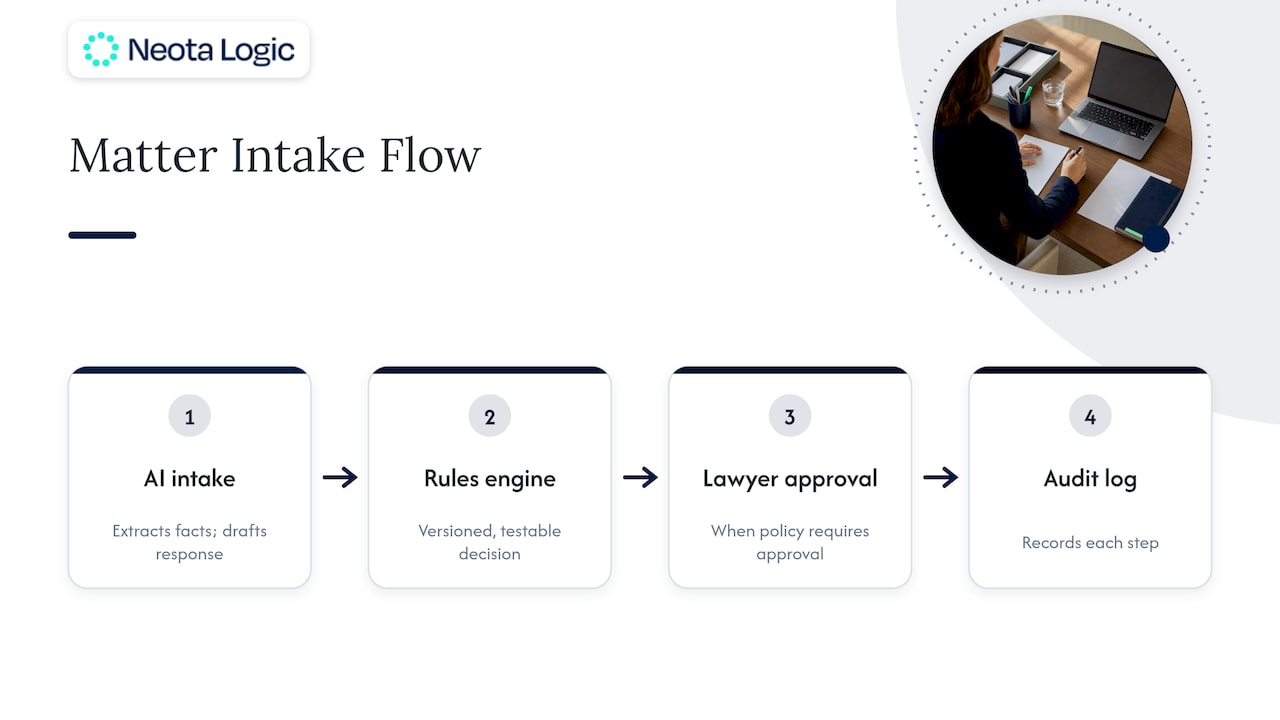
Consider matter intake. A request arrives by email. Someone must decide whether it needs privileged handling, which team owns it, and whether a conflict check or regulatory review applies. If a model makes that call, you have an unexplained classification driving real work.
In a governed design, the rules engine makes the call. It follows logic your lawyers wrote, versioned and testable. AI reads the email, extracts the facts and drafts the response. A lawyer approves what the policy says needs approval. The log shows all of it.
Our rules engine structurally cannot hallucinate on the decision path. That is the design, not a promise about model quality.
What human review looks like in a governed workflow
A checkpoint should be a defined event, not a habit.
Place the checkpoint by risk. Not every output needs a partner. Not every output can skip one. The platform should let you set that policy once and enforce it everywhere.
Law firms versus in-house teams
The use cases differ, but the governance need is the same.
Law firms need to deploy AI across client matters without exposing privilege or creating malpractice risk. Knowledge management and innovation leads need a way to turn firm know-how into governed applications. Clients increasingly ask how the firm controls AI on their matters. An audit trail answers that.
Corporate legal departments need to absorb volume without adding headcount. Intake, triage, contract review and redlining, vendor onboarding and compliance questions all arrive from the business. GCs need to show that AI use inside legal, and the business’s use of legal AI, follows policy.
AI-native firms start with AI doing more of the work. They need governance more, not less. A rules layer and checkpoints are what let a small team stand behind high output.

Implementation effort
Implementation is where tools die. A platform that needs your lawyers to learn a builder, map every workflow and maintain it becomes shelfware.
Neota’s legal engineers scope and build each solution. Firms get a working application in weeks without pulling their own team off client work. We have deployed in law firms for twenty years. We are not a startup learning on your matters.
Ask every vendor the same questions:
Governance leads: what to put in your RFP
If you own AI governance, write these requirements into the evaluation.
A vendor that answers these with a demo of a chat window has answered a different question.
Our position: governance is the product
We build Neota Logic on one conviction. Legal AI fails at the decision, not the draft.
Drafting, classifying and summarizing benefit from AI. Eligibility, escalation, risk tiering and compliance outcomes do not. Those need rules a lawyer wrote, tested and versioned. That is why our rules engine handles the decisions that cannot be wrong and AI handles the work that benefits from it.
Human review belongs in the design from the first step. It is built in, not bolted on. You decide where the checkpoint sits. The system enforces it and logs it.
We sit on top of the tools you already run. You keep Harvey, ChatGPT or Claude. We give you the control layer, the audit trail and the explainability a GC needs to stand behind the output.
If your organization is already using AI without a governance layer, the exposure is live today. Privilege waiver and malpractice claims do not wait for a roadmap.
Put a control layer under the AI you already run
Neota Platform Access and Deployment & Services give legal and compliance teams governed workflows, a deterministic rules engine and logged human checkpoints. Our legal engineers build the application with you.
Start with the AI Enabled Solutions page for intake and AI control. See Document Automation and Contract Automation for drafting and review. For AI governance, risk assessment and compliance workflows, see our solutions overview. When you are ready to scope a build, go to Platform Access and Deployment & Services.
Our team also hosts working sessions for legal leaders. See the AI Strategy Roundtable in New York.
FAQ
What is legal automation software with human review?
It is software that automates legal tasks such as intake, drafting, triage and review, and places a lawyer checkpoint at defined points. The strongest versions log every step and keep decisions under rules, not model output. That is what makes the review provable.
Should human review sit at the end or inside the workflow?
Inside. A review at the end sees only the result. A checkpoint inside the workflow sees the inputs, the rule that fired and the AI output. Place it where your risk policy requires it.
Do we need to replace Harvey, ChatGPT or Claude?
No. Neota Logic sits on top of the AI tools you already use. It governs what they do, hands decisions to the rules engine and logs every action.
What should a legal AI audit trail contain?
It should record the input, the logic version, the model used, the output, the rule that triggered review and the reviewer’s decision, each with a timestamp. Without those, you cannot reconstruct a decision for a client or regulator.
Sources
Ready to make your AI workflows defensible?
Book a demo and we'll walk one of your real processes through Neota.
Book demo