Legal AI decision support is safe to rely on only when the decision path is governed. Models can draft, classify and summarize. They should not decide alone. Every recommendation needs a rule that sets its limits, a human checkpoint where the stakes demand one, and a log that proves what happened. Neota Logic is governed AI infrastructure for legal and compliance teams, and it supplies that control layer on top of the AI tools you already run.
TL;DR
- Decision support means AI informs a lawyer’s decision. A human makes the final call. Courts and bar authorities say so in plain terms.
- Ethics duties of competence, confidentiality and supervision apply to every AI-assisted output. The lawyer owns the result.
- A written policy does not prevent failure. A verification method that runs on every matter does.
- Governance is the differentiator: audit trails, versioning and explainability, not feature lists.
- Put deterministic rules on decisions that cannot be wrong. Use AI where it adds speed. Place human checkpoints where you choose.
Table of Contents
- What legal AI decision support actually is
- Where decision support helps and where it breaks
- The duties do not move to the vendor
- A policy is not a control
- What governed decision support looks like
- The three properties that make it defensible
- How to evaluate a decision-support tool
- Start with one governed workflow
- Neota Logic: the control layer for your legal AI
- Our view: governance is the product
- FAQ
- Sources
What legal AI decision support actually is
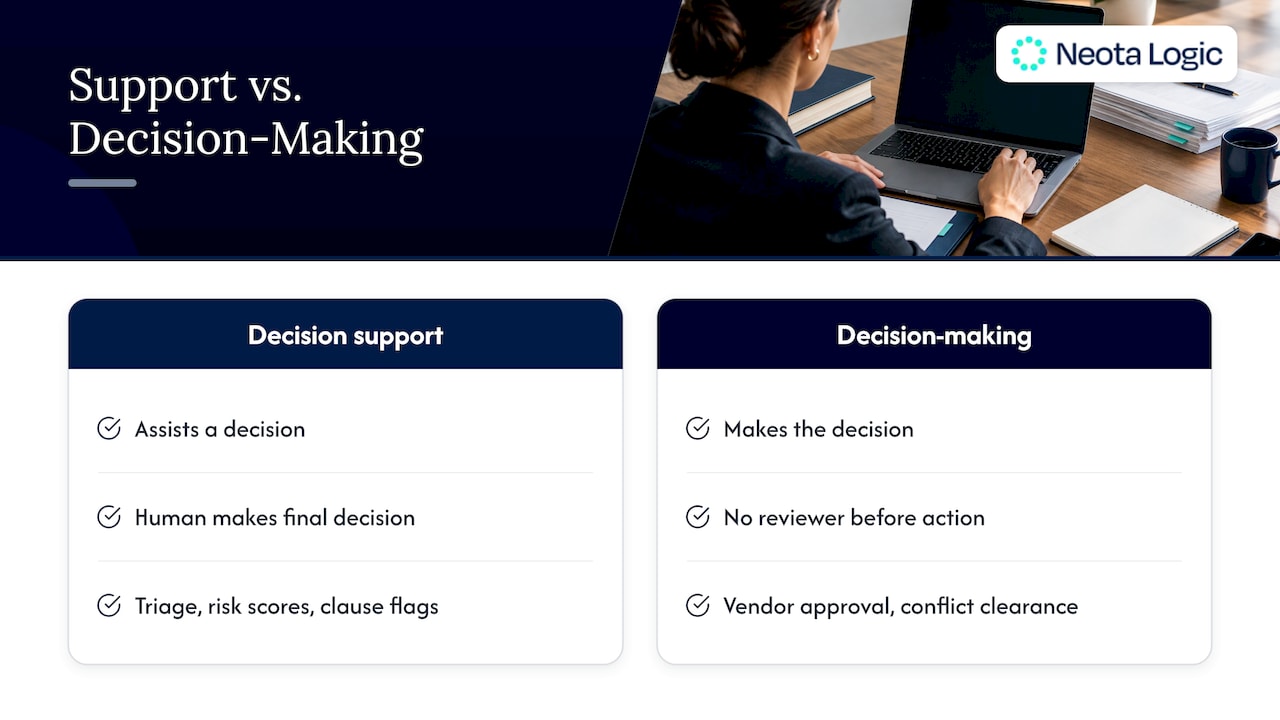
Decision support is analysis that assists a decision. It does not make the decision. The distinction matters because the whole risk model hangs on it.
The National Center for State Courts classifies decision-support tools as high-risk AI. Examples include suggesting litigation outcomes and assessing legal risks. Where use is appropriate, the NCSC calls for rigorous human-in-the-loop oversight and critical review, with the final decision resting solely with a human. The same guidance puts fully automated final decisions in areas such as incarceration, health and housing in the unacceptable-risk category.
The courts have been consistent. A 50-state survey of judicial AI policies found that policies differ on whether judges may use AI for research, drafting or analysis. All of them agree that judges cannot delegate their judgment to AI. The NCSC-TRI Consortium says AI should never be the final arbiter of a court decision.
In a legal department the same logic applies. A tool that triages a request, scores a risk or flags a clause is decision support. A tool that approves a vendor, clears a conflict or signs off on a regulatory position without a reviewer is decision-making. Your governance model must tell the two apart, and it must enforce the difference in the workflow itself, not in a memo.
Where decision support helps and where it breaks
The use cases are real. AI decision support helps with eDiscovery, drafting and editing work product, legal research and analysis, and outcome prediction. Intake, matter triage, contract review and compliance questions belong on the same list. One study reported by Law.com found that generative AI could cut the time on routine legal assignments by as much as 32%. Quality effects depended on the participant’s skill and the task.
The failure modes are just as real. A preregistered Stanford evaluation found that leading legal research tools hallucinated between 17% and 33% of the time. Litigators writing on AI tools note that they struggle with professional judgment and nuance, and that limits grow as cases get more complex.
Deloitte’s guide for chief legal officers names four pressure points: strategy and legal judgment, bias, contextualization and ethics. Each one requires attorneys to monitor inputs and validate results.
The takeaway for a GC is direct. Do not ask whether the model is accurate enough. Ask which steps in the workflow can tolerate any error rate at all. For those steps, a probabilistic model has no place on the decision path.
The duties do not move to the vendor
AI use does not change who answers for the work. You do.
ABA Formal Opinion 512 tells lawyers using generative AI to weigh duties of competence, confidentiality, client communication, supervision, meritorious claims, candor to the tribunal and reasonable fees. It also notes that self-learning tools can risk disclosing client information, which calls for informed consent before representation-related information is input. Under the same opinion, Model Rule 1.1 requires lawyers to understand the benefits and risks of the technology they use.
State guidance is aligned. The Arizona State Bar states that the Rules of Professional Conduct apply fully to AI-assisted work. The lawyer bears complete responsibility for the accuracy and appropriateness of the work product. Pennsylvania and Philadelphia took the same position in Joint Formal Opinion 2024-200: AI assists and does not replace legal expertise.
For in-house teams, the ACC’s toolkit says to keep human legal judgment at the center, treat AI output as a starting point, and verify accuracy, completeness and relevance.
The consequence is privilege and malpractice exposure. If a lawyer cannot show how an AI-assisted conclusion was reached, who reviewed it and which version of the logic produced it, the defense is weak. Reasonable measures need evidence.
A policy is not a control
Most organizations answer the risk with a written policy. The Arizona guide does call for one. It also calls for a designated person or group to oversee AI use and a policy covering approved and prohibited tools, privileged information, human review, client consent and recordkeeping.
The policy is the start. It is not the control.
A 2026 academic paper on verification, From Process to Evidence, reports on Withers v. City of Aberdeen in the Northern District of Mississippi. The firm had a written policy requiring independent verification of AI output. A lawyer filed documents containing hallucinations anyway. The paper’s conclusion is that the missing shared verification method caused the failure, not the missing policy.
That is the position we take. A rule that lives in a handbook depends on memory and goodwill. A rule that lives in the workflow cannot be skipped. Governance has to be executable.
What governed decision support looks like
Governed decision support has three layers. Each does one job.

Deterministic rules on the decision path
Decisions that cannot be wrong belong to a rules engine. Which jurisdiction applies. Whether a threshold is crossed. Which approval chain a request triggers. Whether a clause deviates from policy. These outcomes should be the same every time for the same inputs, and you should be able to read the rule that produced them.
Our deterministic rules engine is built so that the decision path does not hallucinate. A model never gets to improvise an answer to a question that has a correct one.
AI where it helps
Models draft, classify and summarize. They read the email, extract the facts, propose language and summarize the contract. That is where they add speed. Neota Logic sits on top of the AI tools your team already runs, including Harvey, ChatGPT and Claude. You keep your model choices. The control layer governs how they are used.
Human checkpoints where you decide
The third layer is the reviewer. A checkpoint belongs wherever your firm or department wants a lawyer’s judgment before action. The NCSC and the Oregon federal court checklist both say workflows involving consequential decisions need appropriate human review before action is taken. Checkpoints built into the workflow are not optional steps. They are part of the path.
The three properties that make it defensible
Features change quarterly. These three properties are what a regulator, a court or a client will test.
- Audit trails. Every step is logged: the input, the rule applied, the model output, the reviewer and the action taken. If you cannot reconstruct a decision, you cannot defend it. Arizona’s guidance asks that verification be documented. A log does that automatically.
- Versioning. Rules change. Policies change. Prompts change. You need to know which version of the logic governed a decision made last March. Without versioning, an audit shows what happened but not why.
- Explainability. A reviewer must see why the system reached a result, in terms a lawyer can read. Deterministic rules are explainable by construction. A rule says what it checks and what it concludes.
These three properties turn AI use from an assertion of care into evidence of care. That is the difference between a policy and a defensible record.
How to evaluate a decision-support tool
Use the evaluation criteria bar authorities already publish. The Arizona GenAI evaluation checklist tells organizations to identify the use case, assess the sensitivity of the information, and weigh their risk tolerance for errors, including sanctions, malpractice exposure, client harm and regulatory violations. It asks about accuracy metrics, error rates and known limitations. It also asks whether input data will be used for other purposes, whether the vendor retains outputs and what derived data is created.
The Oregon checklist adds that tools must be rigorously tested before adoption, and that vendors should demonstrate evaluation for accuracy, reliability, bias and security.
Add five questions of your own:
- Which decisions in this workflow are rule-based, and which are model-based?
- Where does a human review, and is that step enforced by the system?
- Can you export the full log of a single matter?
- Can you show which version of the logic ran on a given date?
- Does the tool work with the models and document systems you already have?
A tool that answers these cleanly is infrastructure. A tool that answers with a feature tour is a point solution.
Start with one governed workflow
Do not start with a platform-wide rollout. Pick one workflow where error carries real cost: legal intake and triage, contract review, vendor onboarding or a compliance question that recurs.
Then map it. Mark each step as rule, model or human. Assign the rules to the engine. Assign the drafting and classification to the model. Place the checkpoints. Turn on logging. The New York State Bar’s access-to-justice committee, as reported in the same academic paper, recommends pilots with clear success metrics and audit trails. That is the right shape for a first deployment.
Neota Logic: the control layer for your legal AI
Neota Logic puts governed, auditable workflows on top of the AI tools you already use. Our AI Enabled Solutions cover legal intake and triage with a deterministic rules engine, AI for drafting and classification, and human checkpoints wherever you want them. Our Advisory Solutions, Risk Assessment and AI Governance offerings apply the same control model to compliance and risk questions. For contracts, see Document Automation and Contract Automation.
Neota’s own legal engineers scope and build each solution, so your team gets a working application in weeks without leaving client work. To see how platform access and deployment services fit your department, request a demo.
Our view: governance is the product
We build for GCs and legal ops leaders who already know what AI can do. The question on their desks is different. Can they prove what the system did, and why?
We take a position. Governance is the differentiator, not features. Features converge. Every vendor will draft, summarize and classify. Few can show a regulator the exact rule, the exact version and the exact reviewer behind a single decision.
That is why we separate the decision path from the generative path. Rules decide what must not be wrong. AI handles the work that benefits from it. A human checkpoint sits wherever you want judgment. Every step is logged.
We are not a chatbot and not a point solution. We are the control layer. After twenty years of law firm deployments, our view is simple: the firms that win with AI will be the firms that can show their work.
Patrick
FAQ
Is legal AI decision support the same as automated legal advice?
No. Decision support gives a lawyer analysis to inform a judgment. Automated advice delivers a conclusion without one. Courts and bar authorities place the final decision with a human, and your workflows should enforce that.
Do ethics rules apply when AI makes the first pass?
Yes. ABA Formal Opinion 512 applies the duties of competence, confidentiality, supervision and candor to generative AI use. State bars such as Arizona and Pennsylvania say the same. The lawyer answers for the output.
Does a written AI policy satisfy supervision duties?
A policy is necessary and not sufficient. The Withers case shows a firm with a verification policy still filing hallucinated material. A verification step built into the workflow, with a log, closes that gap.
Which decisions should never rest on a model?
Any decision with one correct answer and a high cost of error. Jurisdiction, thresholds, approval routing and policy deviations are examples. Route them through deterministic rules and keep a reviewer on consequential outcomes.
Can we govern the AI tools we already use?
Yes. A control layer sits on top of existing tools rather than replacing them. Neota Logic works with the AI tools you already run, so your team keeps its models and adds rules, checkpoints and logging.
Sources
- Key Considerations for the Use of Generative AI Tools in Courts, NCSC
- Clio Wants To Bring AI to the Judiciary, But 50-State Survey Reveals Policies Differ, LawSites
- Principles and Practices for AI in State Courts, NCSC-TRI Consortium
- Generative AI Boosts Speed for All Legal Work, Law.com
- Hallucination-Free? Assessing the Reliability of Leading AI Legal Research Tools
- CLO’s Guide to Generative AI, Deloitte
- ABA Formal Opinion 512
- Best Practices for Selecting AI Tools, Arizona State Bar
- Pennsylvania and Philadelphia Bar Joint Formal Opinion 2024-200
- Artificial Intelligence Toolkit for In-house Lawyers, ACC
- From Process to Evidence: How Computing Can Ground Legal AI Verification
- GenAI Tool Evaluation Checklist for Legal Practice, Arizona State Bar
- AI Product Evaluation Checklist, U.S. District Court, District of Oregon
Ready to make your AI workflows defensible?
Book a demo and we'll walk one of your real processes through Neota.
Book demo